Consider a sale that has already been made in every sense except the one that counts. The client has chosen a policy. The advisor has explained it. Then an application reaches the carrier with a missing answer, an inconsistent entry, or a signature that never arrived. The conversation was successful. The paperwork has other ideas.
Insurance has a name for this unhappy interval: not in good order, or NIGO. It sounds like an obscure railway station. In practice, it means somebody must stop, investigate, and ask somebody else to do something again. Hexure sells software designed to catch those defects before they become another person’s afternoon.
- The job: connect insurance quoting, illustrations, applications and servicing.
- The buyers: carriers, distributors and financial institutions.
- The evidence: customer cases about less re-entry and fewer handoffs.
- The next chapter: Hexure is now part of iCapital.
The answer was already in the system
Nationwide’s fixed-annuity suitability process provides a useful way into the business. Suitability review asks whether a proposed sale fits the customer’s circumstances. Collecting the information is one job. Getting it into the system that reviews it is another. When those jobs are disconnected, a digital application can still generate manual work.
In Hexure’s published customer account, Nationwide connected FireLight to its suitability application through an API. The submitted data could flow into Nationwide’s application and rules engine for immediate checks. Nationwide reported digitizing 95% of its suitability data intake, reducing handoffs and freeing associates to concentrate on more complex cases.
The telling detail is the sequence. Nationwide dedicated resources, mapped its needs, and then put the connection into operation within a few months, according to the published account. The software did not arrive bearing an understanding of every internal process. People first had to establish where the information belonged.
The lesson is portable. Before buying automation, follow an answer through the business. How often is it copied? Where does it wait? Who checks it? An attractive screen can make the first encounter pleasant while leaving every subsequent encounter expensive.
One sale, several kinds of software
Hexure’s main platform, FireLight, joins the stages of insurance sales: pre-sale work, quoting, illustrations, application entry, signatures, delivery, and post-issue requests. Its customers are organizations that need those stages to cooperate across products and carriers. That includes insurers, broker-dealers, banks, independent marketing organizations, and brokerage general agencies.
Those last two groups help distribute insurance through networks of producers. Their problem is partly variety. An advisor may sell products from different carriers, each with its own requirements. A useful sales system must preserve those differences without requiring the advisor to learn an entirely different ritual for every transaction.
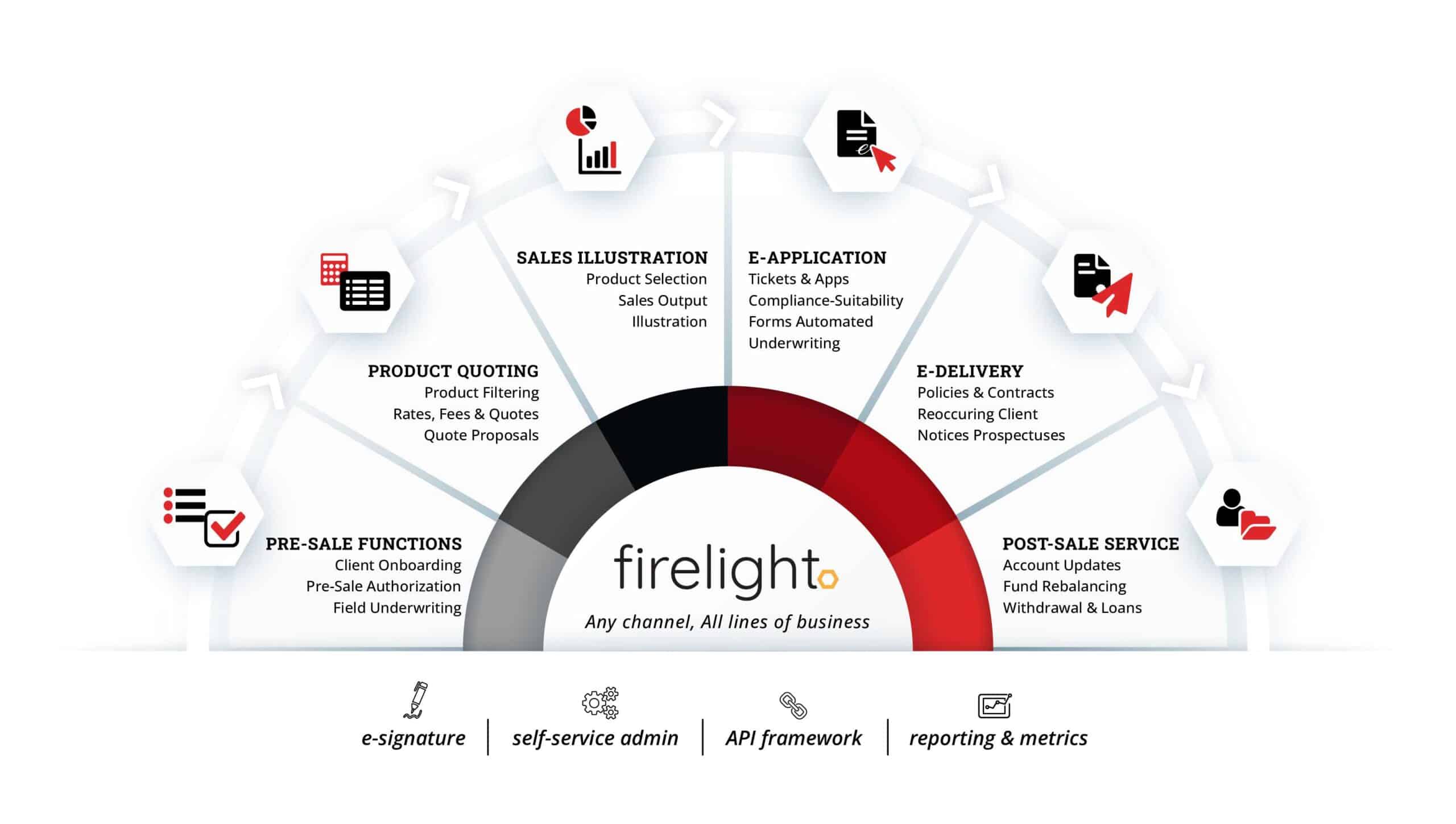
FireLight offers guided applications that present relevant fields, prefill known information, and apply business rules. Review queues can route cases for attention. License and appointment checks help establish whether a producer can sell. Its proprietary e-signature is advertised at no additional cost, a small commercial detail with considerable practical appeal when signatures appear throughout a workflow.
ForeSight does a different job. It produces insurance illustrations: presentations of how a product works under specified assumptions. Carriers can customize the branding and outputs, support new-business and in-force illustrations, and compare or combine cases across product lines. Here, accuracy and explanation have to occupy the same page. A graph that persuades but misstates the product is an expensive piece of decoration.
Vive adds a term-life route from quote to submission. It includes product comparison, case tracking, and a proprietary Vive Score intended to help compare more than price. When Hexure acquired it in September 2023, Vive reported more than 20,000 registered advisors affiliated with more than 55 brokerage general agencies. That is a dated measure of Vive’s distribution reach, rather than a current count of everyone using Hexure.

Paper had declined to take the hint
American Equity’s case is more amusing, and perhaps more useful, than a tidy tale of paper disappearing. The carrier already offered electronic applications. Paper applications continued to arrive. The new-business team still needed an efficient way to enter them.
The company used FireLight product packages configured for its sales and back-office environments to create a one-to-one data-entry experience. The published 2019 case describes fewer keying errors and estimates approximately 8.5 hours saved each week. The gain belonged to the new-business team’s process; it should not be inflated into an organization-wide productivity number.
Every transfer creates another opportunity for delay.
Keep the data moving. Send exceptions to people.
This is a sensible answer to the question of what failed first. In these customer cases, the weak point was the handoff: data captured in one place had to be entered or handled again somewhere else. There is no need to invent a dramatic failed launch. The ordinary failure was sufficiently costly.
It also offers something readers can copy. Improve the intake your customers actually use. If paper persists, give staff a better way to process it. Waiting for perfect adoption can become an elaborate excuse for preserving imperfect work.
The rules travel to the advisor
Hexure’s API proposition is that a carrier can configure products and rules centrally, then make them available inside other systems. An advisor portal, CRM, financial-planning tool, or consumer-facing experience can become an entry point. The ambition is to stop rebuilding the same insurance logic separately for each distribution channel.
That helps explain Hexure’s place in the market. It sits between product providers, distributors, and the systems through which sales occur. Its expertise lies in insurance-specific data collection, illustrations, rules, and connections. A generic form builder would still need someone to supply that industry machinery.
There are credible alternatives. iPipeline offers insurance quoting, illustrations, e-applications, and annuity order-entry technology; it announced iGO Evolve on an API-enabled platform in February 2026. Hexure’s case therefore rests on the fit of its combined products, administration tools, embedded workflows, and connections. Feature breadth alone does not establish superiority.
The business model is enterprise software and SaaS sold through consultations, with implementation and integration work around it. Buyers should evaluate the configured workflow, participating carriers, maintenance responsibilities, and commercial terms together. The practical cost includes the people needed to map the process and keep its rules current.
A bigger owner, a longer workflow
The company began as Insurance Technologies in 1995, founded by Larry Wiedeman. Palm Beach Capital announced a $5.4 million growth investment in 2005. Moelis Capital Partners invested in 2014, and Thomas H. Lee Partners announced a majority-stake acquisition in 2020. Successive owners backed a business selling the machinery of regulated transactions.
In November 2022, it became Hexure. The company explained the change through its wider insurance and wealth-management ambitions, following acquisitions including IXN and MyMedicareBot. The name, pronounced “heck-sure,” draws on hexagons and its insurance heritage. It is an unusually geometric answer to a branding problem.
On March 17, 2026, iCapital announced an agreement to acquire Hexure. The stated plan was to connect FireLight and ForeSight with iCapital’s investment lifecycle platform, bringing insurance sales and servicing into a broader financial workflow. Transaction terms were undisclosed. Hexure’s current website now identifies the business as an iCapital affiliate.
April brought a concrete extension: expanded DTCC connectivity for case-status tracking and in-force transactions, alongside producer authorization. That supports requests such as withdrawals, fund transfers, and policy updates. The application may be complete, but the relationship continues producing work.
“Our goal is to remove uncertainty and unnecessary handoffs across the sales and servicing lifecycle.”Eric Opiela · Hexure VP of Product Management · April 2026
The useful ambition is easy to state and harder to implement: information should survive the journey from a product explanation to a signed application to a later service request. Success depends on connected carriers, maintained rules, and staff who use the workflow. A complete application still needs underwriting; a rules engine still needs correct rules.
For a buyer, that suggests a good demonstration request. Bring a troublesome real case. Follow it from quote through review and then into servicing. Count the re-entry, the exceptions, and the places where somebody must telephone for an answer. Hexure’s value becomes clearest when the missing field no longer returns as somebody else’s task.
Take a closer look
Explore the tools and conversations behind the workflow.