The origin story of Input 1 sounds less like Silicon Valley and more like a family errand that got seriously out of hand. In 1984, Todd Greenbaum's grandfather was starting an insurance premium-finance business and needed software to track receivables. Greenbaum was 16. He did not know how to program, so he bought a book and learned. The tool he built became the seed of a company that now helps insurers, agencies, managing general agents and finance companies manage more than $16 billion in premiums each year.
There was no obvious glamour in the assignment. Premiums had to be invoiced. Installments had to arrive. A card or ACH payment had to be attached to the correct policy. Late notices had to satisfy rules. Commissions had to reconcile. Customers needed answers before a missed payment turned into canceled coverage. Input 1 built around that chain of chores, then kept following the money through the industry for four decades.
What the machine actually does
Input 1 calls itself revenue infrastructure for insurance. The phrase is accurate if a little architectural. Its platform sits around the core policy system and coordinates four related jobs: digital billing, payment collection, premium financing and the software used to operate a premium-finance business. It can present a client-branded bill, accept cards or bank payments, schedule installments, issue notifications, reconcile the cash and give agents or policyholders a self-service portal.
The customers are organizations, but the product reaches the people on both sides of a policy. A carrier finance team wants cleaner reporting. An MGA wants fewer billing calls. An agency wants clients to pay without leaving its management system. A policyholder wants twelve installments rather than a giant check. A bank wants the systems and servicing needed to run a premium-finance portfolio. Input 1 sells the connective tissue among them.
That breadth is the meaningful distinction. A commodity gateway moves money. Input 1 also knows why that money moved, what policy it belongs to, whether it was financed, who needs notice and what the accounting team expects to see tomorrow morning. Its competitors include insurance suites such as Duck Creek and Guidewire, billing platforms, gateways, premium-finance specialists and homegrown carrier systems. In practice, its fiercest rival may be the patchwork: one core system, another payment vendor, a financing partner, spreadsheets and a support queue.
What failed first
A Builders and Tradesmen's Insurance Services case study makes the problem concrete. BTIS, a wholesale intermediary writing more than $300 million a year, had adopted an installment-billing vendor. Within one year, the weak spots were obvious. The system lacked mobile access, automated reporting and useful self-service. Staff spent time answering billing questions rather than writing insurance. Customer support was thin. The first failure was not the transaction itself. It was everything surrounding the transaction.
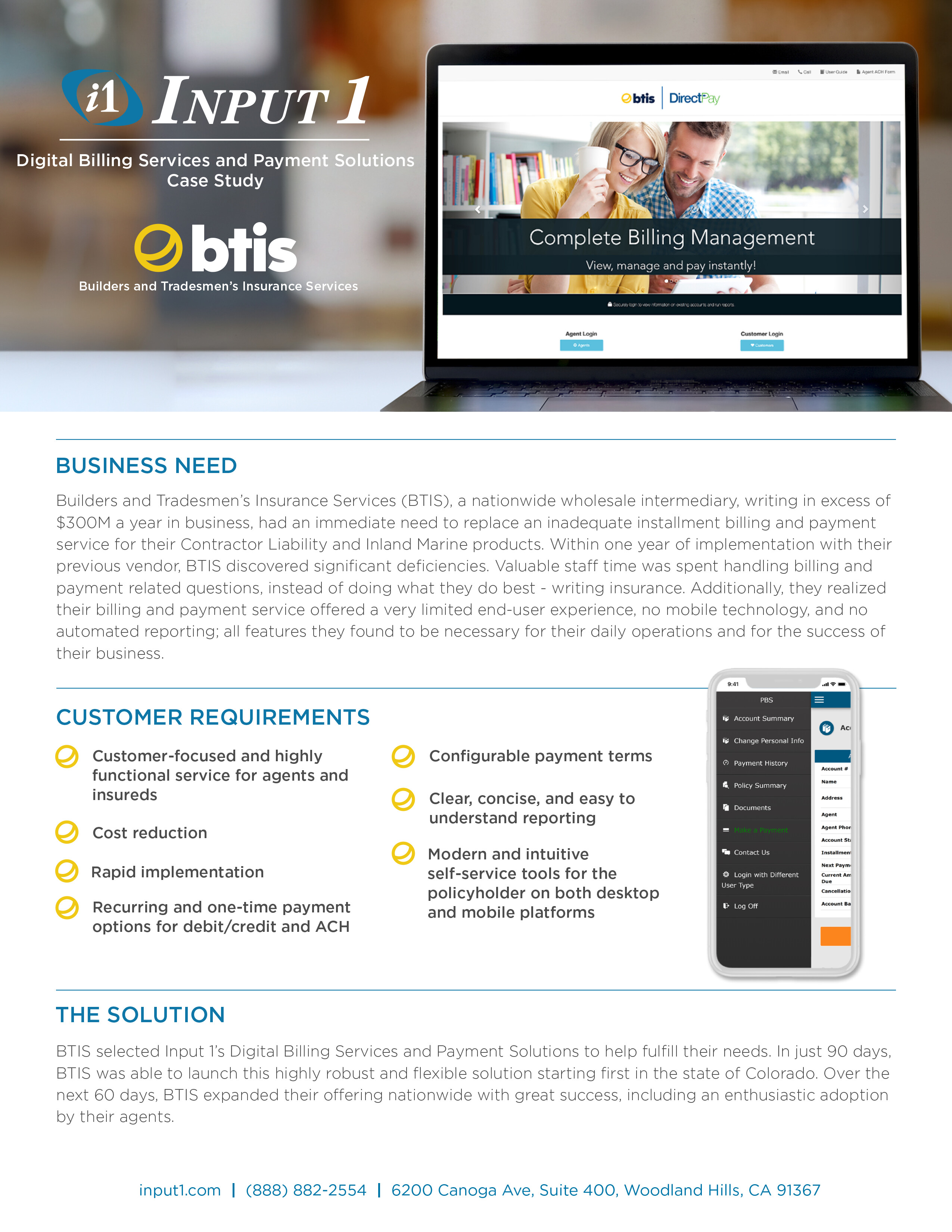
That experience changed BTIS's mind about what a billing vendor had to provide. It needed technology, but also implementation, agent onboarding, reporting and somebody to handle billing calls. Input 1 launched a branded platform in Colorado in 90 days. BTIS expanded it nationally over the next 60. Customers could make one-time or recurring payments by ACH, debit or credit card. A United States-based call center handled inquiries. Broker-commission reconciliation moved off the client's desk.
The public case study says costs fell, but does not publish a dollar figure. A separate deployment for CM&F Group does. The malpractice-insurance program administrator embedded Input 1 billing and payments into its own platform, launched in under 120 days and reported a seven-figure annual cost reduction. The setup now serves more than 140,000 healthcare professionals. Fewer vendors and less manual work did more than a prettier checkout page.
A business model with humans inside it
Input 1 is vertical SaaS, but the label misses half the story. The company sells configurable cloud software and integrations, then can add managed billing, accounting, compliance tracking, customer service and premium-finance operations. Its agency payment product is marketed with no setup, licensing or monthly maintenance fees; economics vary by transaction and program. The wider platform is enterprise software and services, sold through demos and long relationships rather than a public price card.
This makes Input 1 harder to compare and harder to replace. Software margins are attractive, while services absorb messy exceptions and create institutional knowledge. The danger is obvious: human operations can become expensive, inconsistent and difficult to scale. Input 1's answer is to automate repeatable work while keeping people around for the moments insurance refuses to behave like a tidy software demo.
The company says it is bootstrapped. That matters because its expansion resembles a product roadmap funded by customer problems, not pitch-deck fashion. Premium-finance software arrived in 1990. Private labeling followed. Web quoting came in 2000. A retail finance arm opened in 2001. The Premium Billing System launched in 2007, Direct Bill in 2013 and Input 1 Payments in 2019. Each addition followed the same premium into an adjacent workflow.
By 2023, Input 1 reported $16 billion in annual premium volume and more than 2 million users. It entered the Inc. 5000 in 2025 after 115 percent revenue growth over three years, then appeared again in 2026 after 86 percent growth from 2022 through 2025. Those figures come from different measurement windows, but together they show an old company still adding new business. It also reports greater than 99.99 percent availability and a perfect implementation record. The latter is a company claim, best understood as a signal of what management chooses to measure.
Why “legacy” is not an insult here
Insurtech founders often treat the incumbent core system as a villain to defeat. Input 1 usually works around it. Configurable APIs ingest whatever data the carrier can provide, then return payment and billing information to the systems already in place. That approach is less cinematic than a total replacement and often more buyable. A finance chief can modernize the customer-facing and revenue workflows without betting the company on open-heart surgery.
Partnerships turn that pragmatism into distribution. Input 1 embeds inside HawkSoft and NowCerts for agencies, works with Insuresoft's Diamond system for VGM, and has teamed with INTX on an integrated carrier and MGA offer. In payments, it migrated processing from Authorize.net to PayPal, with no added client cost, then expanded into PayPal digital-wallet options. The product meets customers where their policy data and payment preferences already live.
Choose a narrow, regulated workflow whose exceptions create real labor. Complexity can be a moat when you learn it deeply.
Follow one unit of value into adjacent jobs. Input 1 followed the premium from quote to bill, payment, finance and reconciliation.
Sell modernization without demanding replacement. APIs around the core can beat a grand plan to rip the core out.
Treat implementation and support as product features. Enterprise software is judged after the contract is signed.
The thing founders can copy
The obvious lesson is “find a boring niche,” but boring alone is not a strategy. The useful pattern is a workflow with money moving through it, regulation constraining it and several parties touching it. Build the ledger of what happened. Add the interface that makes it easier. Integrate with the software nobody will replace this year. Then attach services where customers still need judgment or reassurance.
Input 1 also shows the benefit of time. A 42-year product history contains several technical eras and plenty of chances to become obsolete. The company moved from desktop receivables tracking to web quoting, portals, cloud SaaS, APIs and digital wallets. Its stated culture - integrity, respect, knowledge, self-evaluation, flexibility and compassion - reads traditional. The more interesting cultural clue is the willingness to keep rebuilding the delivery mechanism while staying fixed on the same customer problem.
When this playbook would not work
Do not copy the bundle when the transaction is simple, the buyer only needs a low-cost gateway, or managed service would erase the margin. It also fails when savings cannot beat switching risk, integrations cannot access reliable policy data, or the customer refuses to change the processes around new software. Vertical depth pays only when the industry's complexity is genuine.
Input 1 is not a household name, and that is almost the point. Policyholders do not wake up hoping to admire premium infrastructure. They hope the invoice is right, the payment is easy and the coverage stays in force. For the companies selling that coverage, the payoff is cash arriving sooner, fewer calls, cleaner books and another reason for the customer to stay.
The teenager with the programming book did not set out to invent an insurtech category. He fixed a receivables problem for one business. Input 1 kept fixing the next problem beside it. Forty-two years later, “How Insurance Gets Paid” is both its tagline and a remarkably precise description of the territory it owns.