There is a particular kind of optimism required to look at specialty insurance and see a software problem. The trade deals in ships, aircraft, terrorism, cyber attacks and risks that arrive with their own vocabulary. A submission may enter as an email, a spreadsheet, a Word document or all three. A broker must turn it into a contract; an underwriter must decide whether it fits; everyone must preserve the judgment that made the market valuable in the first place. Artificial Labs has chosen this unruly middle as its territory.
The London company sells configurable software to brokers, carriers and managing general agents. Smart Placement captures and enriches submission data, builds contracts, tracks facilities and helps brokers decide where a risk belongs. Smart Underwriting turns a carrier’s appetite into rules, automates triage, connects pricing and shows the resulting portfolio. Between them sits a simple proposition: structure the risk once, then let authorised participants use the same facts without retyping them at every handoff.
This is less cinematic than asking a chatbot to underwrite a tanker. It is also closer to the work. Artificial’s software can flag that a combination of industry and domicile falls outside appetite, route an exception to a person, or generate a market-standard contract from captured fields. The aim is not to delete the underwriter. It is to delete the scavenger hunt before the underwriter can think.
A week’s work, quietly reduced to five minutes
Johnny Bridges encountered insurance automation before it had a fashionable name. During a gap year as a reinsurance analyst, he learned the reports well enough to automate his own role. Work that had taken more than a week could be compiled in under five minutes. He later studied computer science and management at University College London while continuing to work full time.
Bridges met David King through projects for Foot Locker. The pair worked well together, founded Artificial in 2013 and won BMW as an early landmark client. For the first years, the company was a bootstrapped software-development shop. That gave it a team and cash flow, but every customer project came with the same weary instruction: start again.
“What nobody realised was that I was slowly automating my own job.”Johnny Bridges, co-founder and co-CEO
The thing that changed the founders’ minds was not a lightning-bolt product idea. It was frustration. While building a two-sided marketplace for another startup, they recognised that bespoke work prevented the focus and quality they wanted. They needed one problem, a product they could improve repeatedly and recurring revenue. Insurance was the useful past life they shared. In 2016, Artificial pivoted toward it.
That origin matters because it explains both the company’s strength and its danger. Artificial is not selling a clever model in isolation. It is selling configuration: the patient work of translating the habits of a broker or carrier into data structures, rules, templates, referrals and permissions. The platform is designed to bend. Every bend must still be agreed.
The clause library was bigger than it looked
The most revealing account of an Artificial deployment comes from BMS Group, the specialist insurance and reinsurance broker. BMS wanted to create MRCv3 contracts - the machine-readable format central to London-market modernisation - inside its existing Broker Workbench. Artificial’s Contract Builder looks comfortably like a document editor, but the familiar surface conceals structured fields, ACORD validation, templates and APIs.
Six BMS business units joined pilots before the first rollout in February 2024. The teams ran development sprints, tested scenarios and found the snags that a demonstration rarely volunteers. Endorsements were difficult because market guidance and electronic-placement practice did not line up neatly. Then came the clause library. Its scale had been underestimated. Old “copy, copy” habits had created inconsistent names and duplicated material. Before automation could help, people had to impose order.
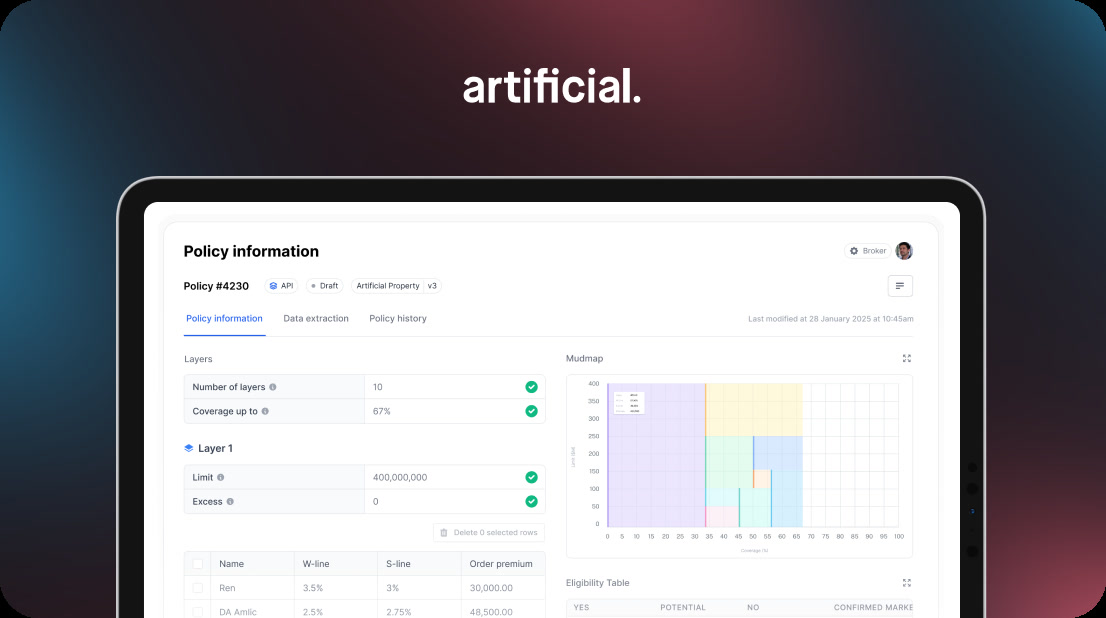
The glamorous life of a risk: ten layers, several capacity providers and exactly zero tolerance for a mysterious spreadsheet called FINAL_v7.
The cost of the implementation has not been published. There is, however, a useful distinction between price and effort. PPL said Artificial-powered contract functionality would be available under its existing master agreement at no incremental cost to users. BMS’s experience shows that software access is only one line of the bill. Subject-matter experts must clean clauses, resolve naming, set templates, test exceptions and decide who owns each rule.
The payoff was measurable. By November 2024 every BMS business unit was using Contract Builder and more than 10,000 submissions had been created. Some teams cut contract-creation time by 50 percent. With established templates, BMS and Artificial estimated reductions of 70 to 80 percent depending on placement complexity. The result did not come from dropping a generic AI tool into an inbox. It came from making the organisation legible to the tool.
A broker tool on one side, capital on the other
Artificial’s competitive argument is architectural. A broker point solution can make a cleaner document. An underwriting workbench can make a faster decision. Artificial wants the data produced in placement to arrive ready for underwriting, and the carrier’s appetite to inform where the broker markets a risk. That is why the company calls its software foundational rather than a collection of productivity widgets.
Its Apollo partnership shows the carrier side. After a proof of concept in Marine Hull, Apollo launched Smart Follow with Artificial in 2023, adding Aviation, Cargo and Terrorism. The system offers fast follow-capacity on risks that meet codified criteria while routing ambiguity back to experts. Apollo wrote the first two risks in under three months from the project’s start. The relationship was renewed in 2024.
On the broker side, Contract Builder launched through relationships with Lockton, BMS and PPL. Smart Placement, introduced in 2025, widened the brief: capture information when it reaches the inbox, create the contract, manage carrier interest and facilities, and keep an analytical view of the book. McGill and Partners became the first announced broker to adopt the product end to end, with a phased rollout beginning across UK and European specialty teams.
Customers buy enterprise software, integration and configuration; public pricing is absent. The market includes in-house systems, general document-AI vendors, established insurance platforms and specialists such as Cytora, Send, hyperexponential and Ki. Artificial’s answer is not that it owns every actuarial model or core policy record. It is that a configurable trading layer connecting both sides can reduce the expensive repetition between them.
That positioning reflects an awkward fact about specialty insurance. A policy for a familiar household object can be standardised around a stable form and a large pool of comparable claims. A complex commercial risk may be assembled from layers, written by several carriers and altered through negotiation. The value lives partly in details that resist a universal schema. Artificial therefore has to standardise enough information for machines to act while leaving room for the unusual fact that makes a specialist worth calling.
Smart Consortia extends that idea to groups of insurers that pool capacity and expertise. Traditional consortia can inherit the same manual processing and delayed portfolio visibility as the rest of the market. Artificial’s version lets participants define decision rules, share selected data and monitor how the combined book develops. It is useful when the opportunity is larger than one carrier’s desired line and repetitive enough to reward automation. It is less persuasive when every risk requires fresh negotiation or the participants cannot agree what information they are willing to share.
The product names can sound like a family of separate applications, but the data path is the more interesting product. A submission captured by a broker can populate the contract. The same structured fields can be compared with carrier appetite. A rule can accept, decline or refer rather than merely decorate a dashboard. The resulting decisions can feed a live view of accumulation and portfolio mix. Each connection removes one invitation to rekey a number, lose a version or discover too late that the risk was never a fit.
There are also boundaries to the comparison with AI-first startups. Artificial predates the generative-AI boom by a decade. Its core pitch was algorithmic underwriting long before every enterprise homepage acquired a sparkle icon. Machine learning helps extract and enrich information, but deterministic rules, data standards and workflow controls do much of the commercially important work. That may sound less futuristic. In regulated financial infrastructure, predictable behavior and an audit trail are features, not an apology.
The business model follows the realities of that infrastructure. This is not self-serve software bought with a card on Friday afternoon. Buyers are firms whose contracts, data and capital carry legal consequences. Sales are partnerships; deployment includes configuration and integration; expansion comes as more business lines, teams and geographies join. The advantage is durable use inside important workflows. The drag is that implementation cannot outrun customer readiness. Artificial may provide a platform in four to six weeks for a focused digital underwriting product, but an institution’s habits do not necessarily ship on the same schedule.
What teams can copy
Start with one class of business. Put operational experts beside engineers. Define appetite and referral ownership. Pilot with real documents. Measure rekeying, turnaround and exceptions before adding more lines.
What must already be true
Leadership must fund data cleanup. Teams must agree clause names and templates. Legacy systems need workable interfaces. Compliance must accept machine-readable records. Humans must remain available for judgment.
Agents that chase each other, so people do not have to
By 2026, Artificial had raised enough to attempt something larger. Its publicly announced rounds include £4.2 million in 2019, £9.5 million in 2022 and £8 million in 2024. A $45 million Series B led by CommerzVentures, with Move Capital and existing backers, brought the company’s disclosed institutional funding into a different scale. Artificial said it planned to expand into the United States and double its team over the following year.
Days after the round, it launched AgLabs, a research and innovation unit focused on agent-to-agent communication. The premise comes from a survey of London-market participants: 88 percent of broker submissions were reportedly not decision-ready on arrival; 64 percent of complex risks required at least six rounds of calls or email before a quote; 81 percent of teams said manual collection and correction consumed significant time.
AgLabs imagines a broker’s agent and an underwriter’s agent exchanging and validating routine information under each firm’s own controls. They might notice a missing attachment, reconcile a field or ask for clarification, then present the outcome for approval. It is a more plausible use of agents than pretending a model should own the risk. It is also hard: permissions, provenance, confidentiality and accountability become cross-company questions.
The conditions for failure are visible throughout Artificial’s own history. Automation will disappoint when data remains inconsistent, appetite cannot be articulated, exceptions swamp the standard path, or teams treat implementation as an IT installation instead of operating change. Highly bespoke, low-volume risks may never justify deep codification. A market participant unwilling to maintain its rules will simply automate yesterday’s confusion.
“Insurance professionals are paid for their expertise, not for chasing missing data across endless email chains.”David King, co-founder and co-CEO
Artificial fits into the market precisely where its limits sit. It is neither the broker, the balance sheet nor the human judgment on a difficult risk. It is the layer that tries to make each one understandable to the others. The company’s evolution from custom developer to insurance platform suggests a useful rule for enterprise software: the product is not finished when the screen works. It is finished when two organisations can move the same decision through it.
For brokers, that can mean fewer blind approaches to carriers and faster, compliant contracts. For underwriters, it can mean consistent triage, clearer portfolio signals and capital deployed without a matching rise in administration. For the reader looking to copy the playbook, the lesson is pleasantly unmagical. Pick a narrow workflow, expose its hidden taxonomy, keep experts in charge and earn the right to automate the next step.