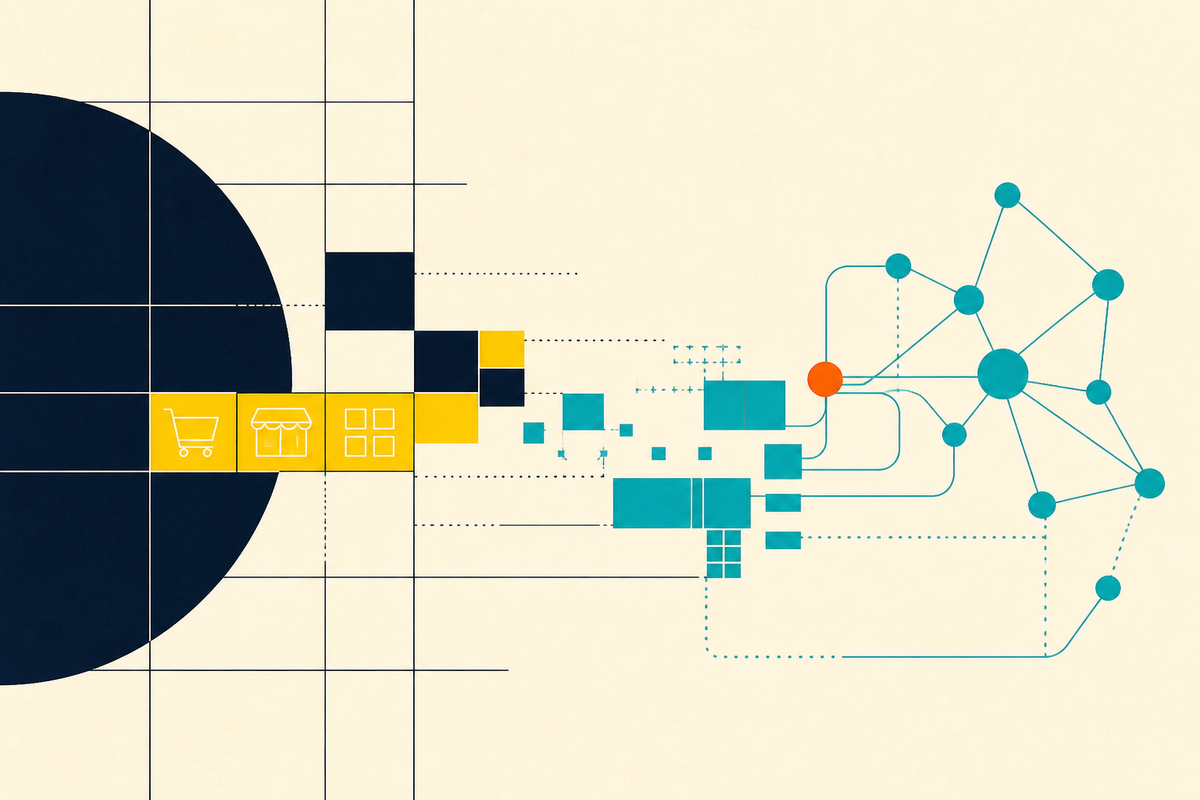
There is a particular kind of confidence that comes from spending years inside other people's checkout flows. You learn where the tax plug-in sulks, which inventory feed arrives late and how a beautiful redesign can break on an old phone at the exact moment somebody reaches for a credit card. Metizsoft Solutions Private Limited built its early business in this unphotogenic territory. The Ahmedabad company made stores, apps and integrations work. Fourteen years later, it is selling AI agents. The jump sounds fashionable. Underneath, it is more continuous than it looks.
Metizsoft was founded on April 1, 2012 by Chetan Sheladiya, now chief executive, and Manthan Bhavsar, now chief marketing officer. In a company anniversary account, the founders recalled a tiny room with two desks and two developers. They entered the Shopify ecosystem in 2013, early enough for the platform to become a genuine specialization rather than another logo on a services page. Store design led to theme work; theme work led to custom apps, payment connections, migrations and maintenance. Each task moved the company one layer deeper into a client's operations.
01 / The useful middleWhat Metizsoft actually sells
The short answer is engineering capacity with context. A retailer can hire Metizsoft to launch or rebuild a Shopify or BigCommerce operation. A startup can commission a web platform or a React Native app. A larger company can bring in a dedicated team for cloud migration, ERP connections, testing or long-term support. The newest practice covers AI strategy, retrieval-augmented generation, predictive systems, workflow agents and automation wired into CRMs, ERPs and proprietary data.
This breadth is easy to dismiss as the standard agency buffet. In Metizsoft's case, the connective tissue matters. Commerce is not merely a front-end design problem; it combines catalogs, payments, warehouses, customer records, analytics and support. Mobile products bring authentication, notifications, devices and app-store rules. An AI agent adds one more layer of probabilistic behavior to systems that were already complicated. A firm accustomed to integration work starts with a practical advantage: it expects the demo to be the beginning, not the finish.
“We start with your operational bottleneck. Then we work backward to the right AI architecture.”Metizsoft's published delivery approach
That sentence is the most useful part of the company's current AI pitch. It turns the normal sales sequence around. Instead of beginning with a model and searching for an application, the team looks for an expensive queue, a scattered knowledge base or a repetitive handoff. Metizsoft describes production work that includes monitoring, cost controls, canary rollouts and retraining triggers. Those are not glamorous nouns, but they are the nouns that decide whether an internal assistant survives beyond its pilot.
Company-reported figures. LinkedIn listed 127 employees during this profile's research.
02 / Buyers and headachesThe customers are defined by friction
Metizsoft says it has worked with more than 650 teams and delivered for clients across the United States, United Kingdom, Canada and Australia as well as India. Its public portfolio ranges from grooming and packaging retailers to healthcare, hospitality, logistics, agriculture and legal services. The common customer is not a particular industry. It is an organization with a digital product that has outgrown the clean lines of its original brief.
For a merchant, that might mean moving from Magento to Shopify without losing product data, search rankings or hard-won operating habits. For a clinic, it might mean making appointments, records, payments and remote consultations behave as one system. For a delivery company, it might mean routing, driver status, customer notifications and traffic data in one mobile workflow. For an enterprise AI project, it often means letting a model retrieve private knowledge without leaking it, hallucinating policy or wandering into a legacy system without permission.
The commercial model follows the work. Metizsoft sells scoped projects, dedicated teams, consulting, maintenance and support. Clutch lists a minimum engagement of $1,000, an hourly rate below $25 and a reviewed project most commonly in the $10,000 to $49,999 band, though a real quote depends on scope. This places the company in the global market for cost-conscious offshore engineering: more organized than assembling freelancers, less expensive than many Western agencies and more flexible than hiring an entire permanent team.
03 / The product shelfWhen client work becomes reusable software
Services still appear to be the engine, but Metizsoft has also built products of its own. The collection is revealing because it is not organized around a single grand thesis. It looks like recurring problems collected from years of delivery. eSolar CRM manages leads, proposals, site surveys and after-sales service for solar installers. PRIONDE Cloud handles records, appointments, billing and treatment plans for dental practices. MSPL Store Locator offers an embeddable map and traffic analytics. Prompt Collab gives teams a place to version, share and analyze prompts across language models.
eSolar CRM
Solar proposals, site visits and service follow-through in one vertical workflow.
PRIONDE Cloud
Chairside practice software for dental records, appointments, treatment and billing.
Store Locator
A drop-in, multi-region map that can be branded and measured.
Prompt Collab
A shared prompt library with versions, access roles and cross-model analytics.
This agency-to-product loop can become a modest moat. Client work exposes repeated pain. A reusable module lowers the cost of solving it again. A standalone product creates recurring revenue and forces the team to operate, rather than merely hand off, software. The risk is diffusion. Solar sales, dental records and prompt management are very different markets, each demanding support, distribution and patient product work. Metizsoft's catalog is best read as a laboratory, not yet a unified software empire.
There is another benefit to owning even a small product: the feedback is harder to escape. In project work, a launch can mark the end of a contract. In SaaS, renewal, usage and support volume keep reporting the truth. If Metizsoft can carry those lessons back into its client practice, the products may be valuable even before they become large businesses. They create a place to test onboarding, pricing, reliability and customer support with the company's own money at risk.
04 / The competitive lineBroad enough to own the handoffs
The company competes with large Indian development firms, Shopify specialists, AI consultancies, in-house teams and, increasingly, software that lets non-engineers assemble simple products. Its difference is not a secret model. It is the promise that one vendor can carry a project across commerce, mobile, cloud, QA, data and support - with a long Shopify history beneath the newer AI vocabulary.
Public reviews are few, so they should not bear too much weight. The two shown by Clutch gave the firm a 4.8 overall rating and praised communication, on-time work and support. The Shopify partner directory also carries merchant recommendations. More concrete signals are the public partner listing, the company's long operating history and a portfolio that shows repeated work in ecommerce. Metizsoft also lists ISO 9001 and ISO 27001 credentials, useful for buyers who need documented quality and information-security processes.
The company's culture story is similarly practical. It calls employees “Metizians,” emphasizes learning and transparency, and still retells the two-desk origin at anniversary gatherings that include employees' families. Glassdoor showed a 3.7 rating, with 72 percent willing to recommend the employer at the time of research. That is not a fairy tale or a red flag. It is the untidy middle where most real workplaces live.
05 / Where it fitsIntegration experience in an AI market
Metizsoft sits between a specialist studio and a general-purpose systems integrator. Its Shopify history gives it a recognizable door into accounts. Mobile, cloud and enterprise work widen the contract. AI is an attempt to move closer to the business decision itself: not just presenting the order screen, but predicting demand, retrieving policy, routing the exception or completing the task.
That move will be judged by production evidence. Case studies must distinguish shipped client systems from prototypes, and company-reported performance figures deserve buyer diligence. The same is true for every AI services firm. Metizsoft's advantage is that it has already lived through thousands of ordinary software constraints. Its challenge is proving that this experience produces AI systems that remain accurate, observable and economical after the novelty wears off.
For a prospective customer, the company is most useful when the problem crosses boundaries: a Shopify migration tied to warehouse software; a mobile service linked to payments and routing; a knowledge agent that must respect permissions and talk to an old CRM. Buyers with a narrow, standardized need may be better served by a focused SaaS product. Buyers with a messy operational bottleneck may value a team that is comfortable opening the walls.
The amusing symmetry is that Metizsoft's AI future may depend on the least futuristic part of its past. A checkout integration teaches humility. Data arrives in the wrong shape. Edge cases refuse to stay at the edge. Somebody has to monitor the thing on Monday morning. The firms that remember those details have a chance to make intelligent software feel less like a demonstration and more like infrastructure.