For more than 30 years, Hiroyuki Suzuki commuted by Shinkansen. It is an unusually literal detail in the biography of someone whose professional life concerns connections. Japan’s trains carried him to work; at work, he helped information travel between systems. Eventually, telework replaced the commute. The destination survived the journey.
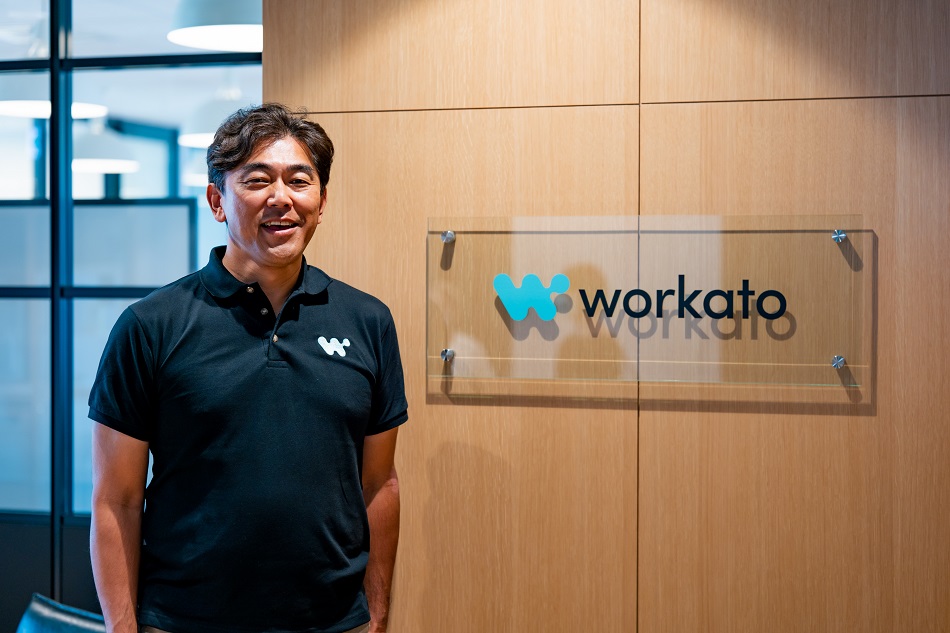
Suzuki, Workato’s Japan founder and Field CTO, comes from Shizuoka Prefecture. His listed hobbies are golf and wine, two pursuits with a rather different relationship to speed. His career has moved through engineering, business leadership, consulting and the establishment of a Japanese software business. Today, he spends much of his public working life explaining how companies can put automation and AI into ordinary operations.
The train makes a tempting metaphor, but the more revealing detail is his attention to the gaps. Applications can work perfectly well on their own while the work between them remains awkward. Departments can have capable people while their shared project waits for someone else’s attention. Suzuki’s career offers a way of looking at those intervals, where a useful idea has to become an action.
Trading systems, then a different kind of timetable
He studied artificial intelligence at university. A later speaker biography specifies natural language processing in Kanagawa University’s Faculty of Engineering. After graduating, he joined DEC Japan and developed dealing systems for banks and securities firms. This was enterprise computing with concrete users and concrete transactions, an early grounding in the business that software was expected to support.
TIBCO followed. There, he worked as an engineer and project manager; he also met Vijay Tella, who would become Workato’s CEO. Suzuki later led a new business at the Japanese IT company CIS. In 2002, he established a consulting business supporting CIOs and project managers. Each move changed his vantage point on the same broad problem: getting technology to serve the organization using it.
There is a useful progression in those jobs. An engineer sees the implementation. A project manager sees the dependencies. A consultant sees the decision that has to be made before either can proceed. By the time Suzuki encountered Workato, he had worked on several sides of the conversation between a company and its technology.
He joined Workato in 2018, helping establish its Japan business. His roles subsequently included country manager, automation evangelist and director of strategic accounts. He became Field CTO in August 2024. The title takes technical strategy into customer discussions, where a diagram eventually has to answer a business question.
A market has to meet you halfway
One early encounter with Workato involved a Japanese company comparing roughly ten integration tools. Suzuki helped with its trial. He later recalled being struck by how quickly interfaces could be built, tested and revised. The experience persuaded him to join the Japan business. A product demonstration became a career decision.
That decision also required patience. In 2018, his work involved developing customers and partners in a market where even the term iPaaS was unfamiliar. The acronym expands to “integration platform as a service.” It describes a way to connect applications through a cloud service. The explanation matters because buying another application does not, by itself, settle how it will cooperate with the ones already installed.
The Japanese subsidiary was announced in November 2021, after registration that September. Suzuki became an automation evangelist. His ambition included helping customers do more of the work internally, with less dependence on outside system integrators. He expressed the aim plainly:
“We want Japanese businesses to become less dependent on system integrators while having more agility and less cost.”
Hiroyuki Suzuki · 2022
His approach to market development nevertheless made room for established partners. Trust, local business customs and the customer’s success were central to his thinking. He also argued that practices developed in Japan could teach the wider company how to expand more flexibly. The traffic could run both ways: software coming into the country, lessons travelling back out.
Let the person with the problem into the room
Suzuki’s August 2026 writing returns to a common organizational frustration. Someone in a business department knows what needs improving. The means to change it sit elsewhere, often in an IT team with other demands on its time. The problem remains familiar to its owner and remote from the people who can alter the system.
He advocates fusion teams, bringing business and IT together around the work. Business participants contribute the problem and the hypothesis. Technical colleagues help with implementation, security and governance. Small rounds of development and improvement keep the process close to the people who will use it.
Two kinds of access are involved in his argument. Employees need tools they can use, and they need a place in the process of changing the workflow. A usable interface alone cannot organize that conversation. Someone must decide who can participate, who can approve a change and how the team learns whether it helped.
An onboarding example makes his interest tangible. A signed employment document can set off the creation of an email account and access to applications for the joining date. Data already collected during recruitment can carry forward. The desired result is less repeated entry and fewer disconnected steps. The interesting unit is the whole sequence, including its handoffs.
- SignEmployment documents
- PrepareEmail and app access
- StartAccounts for joining day
A microphone for the awkward questions
By January 2026, Suzuki had another way to convene the conversation. Workato announced an interview podcast about the mindset needed for the AI era, hosted by its Japan Field CTO. The opening guest was Norihiro Itano, a Mitsubishi Materials executive responsible for digital and information leadership.
The episode’s agenda included how people and AI could work together, what Japanese businesses could bring to adoption, and the role of senior leaders. These are management questions with technical consequences. A company has to decide how work should change before it can sensibly decide which part of that work to automate.
The second episode, announced in February, brought in Teijin CDO Yukihiro Funyu. Its focus was generative AI in global manufacturing transformation, including decision-making and organizational change. Suzuki’s role as host puts him alongside executives facing the implementation problem from inside their own companies.
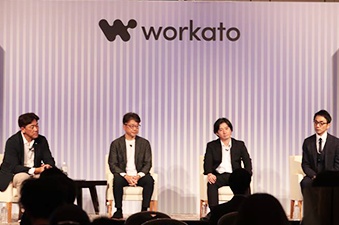
His public conversations extend to events. At Automate Tokyo in November 2024, he joined a FUJISOFT panel on architecture combining Workato, data and AI to support revenue operations. A later article reflected on a June 2025 discussion with LIXIL’s digital leadership about employee experience and AI. The recurring setting is a conversation across functions, with the business process in view.
Give the clever software a rulebook
Suzuki’s recent writing pays close attention to what happens when AI can act through enterprise systems. In his January 2026 discussion of IT and operational technology, he raises questions about control, tracing decisions, separation of responsibilities and audit requirements. These concerns become more pressing when an agent can initiate work rather than simply display an answer.
His June explanation of Model Context Protocol takes up the connection between AI and external tools or data. He describes conversations with enterprises that see the technical possibility of access while still worrying about safe use inside the company. A connection is a beginning. Operational permission and responsibility require further decisions.
His advertised September 2026 MCPCon Japan session brought the issue into its title: “Reliable Agents by Design: Reasoning + Deterministic Execution.” The pairing is revealing. AI reasoning can help interpret a situation, while governed execution supplies defined actions. In that agenda, reliability depends on how the two work together.
For a customer, the distinction has practical weight. If software changes a business record, somebody may need to establish what triggered it and whether the action was permitted. Suzuki’s emphasis on control places those questions close to the design work. A capable agent still enters an organization with rules, obligations and people who must answer for its effects.
Interpret the situation. Carry out actions within governed business processes.
The next stop is a small one
His advice on AI deployment is deliberately manageable. In his small-start article, Suzuki proposes choosing a limited task, preparing the relevant data and using feedback to improve the result. He connects that method to kaizen, the habit of continuing improvement. The scope can grow as the organization learns.
He also urges companies to examine business value, alongside technical feasibility. An experiment should help establish whether the work is worth pursuing. His May 2026 roadmap similarly encourages a staged approach to agent deployment. Waiting for complete readiness can leave a project standing still; beginning with an appropriate use case creates something people can evaluate.
The engineer who once developed trading systems now helps companies decide who should build, which systems should connect and how AI should be allowed to act. There are new terms in the discussion, but many familiar dependencies. A customer still has a process to run. A technical team still has responsibilities. Someone still needs the handoff to work.
Suzuki’s long commute has given way to a different working arrangement. His professional interest in movement remains: an idea reaching the people who can test it, information arriving where it is needed, a useful action getting done. For a career spent on connections, a modest first improvement is a perfectly respectable destination.
Continue the conversation
Watch the Japanese-language interviews: Taka’s Tech Talk (2021), Mitsubishi Materials podcast and Teijin podcast.
Find Suzuki on LinkedIn and Wantedly. Explore Workato Japan, his fusion-team essay, small-start AI advice and MCP explanation.
Interviews and event reports: ASCII, JETRO, Fujitsu, FUJISOFT and MCPCon Japan session listing. Company updates: Workato Japan on X.