There is a small joke hidden inside the language of enterprise software: the more consequential the system, the less likely anyone is to describe it in words a normal person might willingly repeat. Harish Shetty has spent a career in that thicket - integration middleware, workflow orchestration, API management - yet the product he helped build settled on a word from the kitchen. Workato calls an automation a recipe. A thing happens; this causes that; the result can be tested, revised and shared. Suddenly the machinery sounds almost hospitable.
The metaphor suits Shetty because his public record is less a heroic founding myth than a collection of useful instructions. He is a Workato co-founder and, since 2024, a strategic advisor. Before that came years leading its engineering organization, more than a decade at TIBCO, two smaller SaaS companies, several patents, product tutorials and an improbable quantity of public troubleshooting. His Stack Overflow profile records more than 64,000 reputation points, 786 answers and 3.7 million people reached. It is a résumé written in other people's error messages.
An apprenticeship in the difficult middle
Shetty studied electronics and communication engineering at the University of Mysore from 1988 to 1992. By late 1999, he was at TIBCO, the company that helped make “middleware” a commercial category. He stayed until 2011, becoming a lead architect and engineering director. The products associated with his tenure - BusinessWorks, ActiveMatrix and tibbr - lived in the difficult middle between a company's applications, where formats disagree, credentials expire and yesterday's tidy data model becomes today's exception.
That work taught an enduring lesson. Connecting two systems is rarely the whole job. The valuable part is preserving context while work crosses the border: who asked, what changed, what is permitted, what should happen next and what to do when it fails. After TIBCO, Shetty held technology leadership roles at Thinkspeed and iProfile. Then, in 2013, he joined Vijay Tella, Gautham Viswanathan and other longtime collaborators to start Workato.
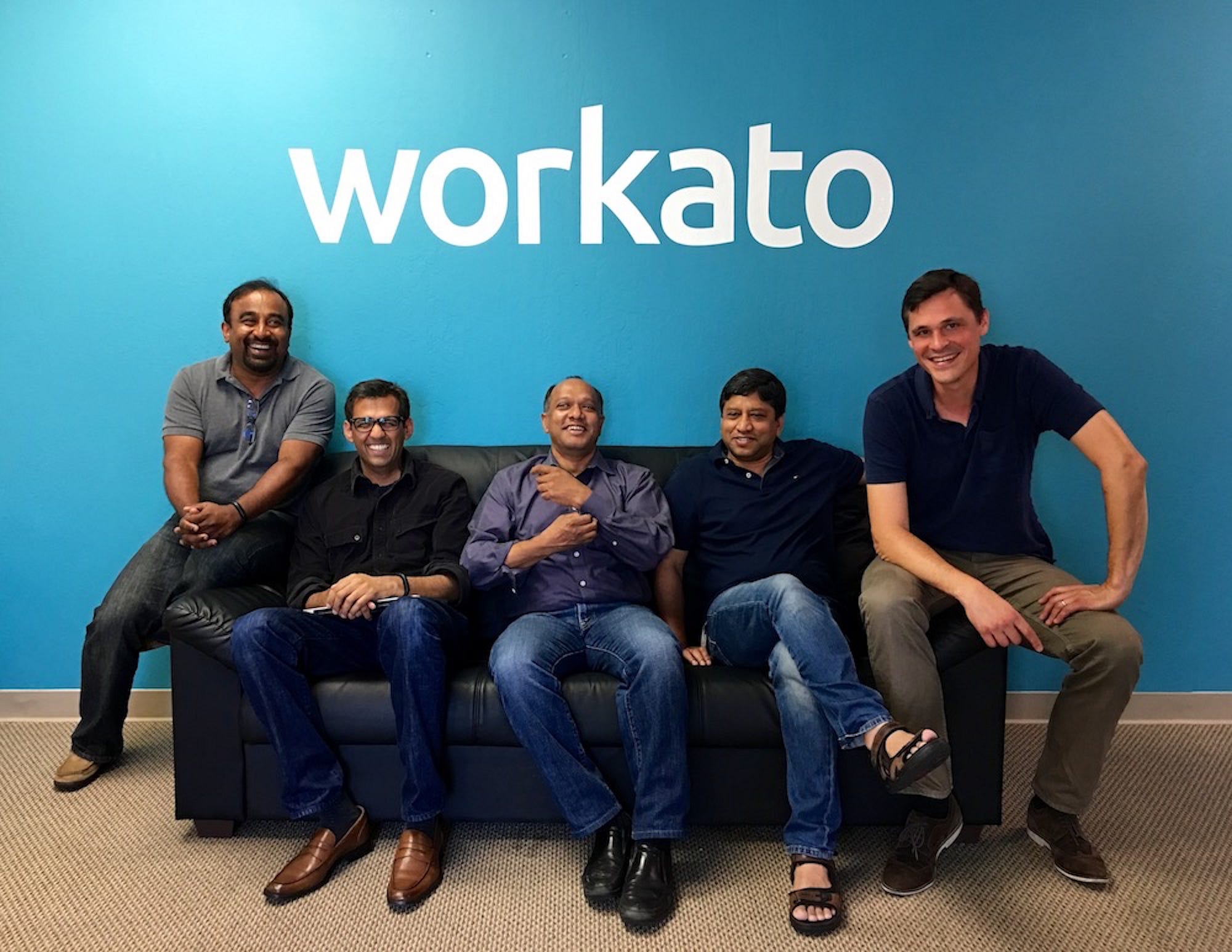
A company built around the handoff
Workato began with a blunt ambition: let business teams and technical teams automate work on the same platform. That meant taking capabilities once guarded by specialists and exposing them without abandoning the governance enterprises expect. “Low-code” makes this sound like subtraction. In practice, simplicity sends the complexity downstairs, where engineers must pay every debt the interface has politely hidden.
One early internal example catches Shetty's instincts at work. Customer problems arrived in Freshdesk; developers worked in GitHub. A basic integration could copy a ticket into an issue, but it dropped useful details, handled comments awkwardly and could create duplicates. Workato designed a recipe to carry customer context, route comments and alerts, and keep support staff informed. Shetty's explanation contained no grand theory: keeping engineers on top of important customer issues made the company more responsive and helped customer service deliver a better experience. The point of the plumbing was the person waiting at the tap.
The bot that could do something
When workplace chatbots became fashionable, most were gifted town criers. They delivered alerts and then left the recipient to find the application, recover the context and take action. Shetty, part of the original Workbot team, named the defect without ceremony: “At the time, most existing bots only sent notifications.” A bot could announce a Zendesk ticket, he noted, but the user could not do anything with the bot itself.
“Apart from receiving notifications, you might want to get data from systems.”Harish Shetty, on the thinking behind Workbot
The team's answer was contextual commands. A new-ticket alert might offer the account's full view; a new contact might invite the user to check the funnel in Mixpanel. The design joined information to the likely next move. It also produced patentable machinery. Shetty is named on patents covering intelligent bots that orchestrate work across applications, late connection binding for bots and the cloning of API recipes.
The hardest part was not the cleverest-looking part. Shetty said that making one bot-building flow “dummy-proof” consumed nearly 80 percent of the work. The phrase is inelegant; the ratio is revealing. A pleasant automation builder must anticipate malformed input, missing access, ambiguous actions and the inventive mischief of a hurried human. Ease is not the absence of engineering. It is engineering that has agreed to remain backstage.
Teaching in public
Shetty never entirely disappeared into management. In a 2021 Product Hour, he and product manager Gabriel Sim taught users how to manage recipes through APIs, schedule automations with cron expressions, transform data with scripts and coordinate dependencies with scatter-gather patterns. At Workato's Automate event that year, he presented the platform's security features and upcoming controls. The pairing mattered: democratizing automation without governance would merely democratize the production incident.
His older developer trail makes those sessions feel like a continuation. Under the handle “kandadaboggu,” he answered hundreds of Stack Overflow questions, largely around Ruby and Rails. His public code snippets include a calculator domain-specific language, a bulk-insert helper and a Ruby version of Conway's Game of Life. None is a founder glamour shot. Together they show somebody comfortable reducing a problem until another programmer can pick it up.
Three inventions, one recurring argument
Patent documents are not famous for revealing personality. They are where verbs go to acquire legal counsel. Yet the inventions bearing Shetty's name make a surprisingly coherent sequence. The first concerns cloning an API recipe. A recipe contains a trigger and actions, each with expectations about the shape of its inputs and outputs. Copying it safely means calculating those requirements, carrying the schemas across and checking that the new instance can still do the job. In plainer English: reuse should not require rediscovering every trap.
The bot patents move the same principle into conversation. Events arrive from distributed applications. The system turns them into notifications, accepts a command and can recommend related commands based on the event's metadata. A support alert is therefore not an informational cul-de-sac. It becomes an entrance to the surrounding workflow.
Late connection binding addresses a less theatrical problem: whose credentials should an automation use? A shared recipe may include a placeholder for a connection. When a particular user runs it, the system resolves that placeholder against the user's authorized connection and executes with the proper details. The convenience of reuse meets the boundary of identity. It is precisely the sort of detail that vanishes in a cheerful demonstration and returns, carrying a clipboard, when software enters a real company.
Across the three inventions, the argument is consistent. Make a unit of work portable. Preserve enough context for it to remain useful. Bind the sensitive parts at the moment they are needed. Then offer the human a sensible next action. What looks like automation from the outside is, underneath, a sustained campaign against missing context.
Architect and engineering leader at TIBCO, working around the enterprise integration layer.
Co-founds Workato and takes on engineering leadership.
API recipe-cloning patent is granted.
Explains Workbot's shift from passive alerts to contextual action.
Moves into a founder and strategic advisor role.
Scale, with the labels removed
By November 2021, Workato had raised a $200 million Series E at a $5.7 billion valuation, bringing its announced funding to more than $420 million. At the time it reported more than 11,000 customers. These are company numbers, not a personal fortune, and they measure capital and adoption rather than authorship. Yet they establish the scale at which Shetty's engineering choices had to survive.
The deeper continuity is between old middleware and the modern automation canvas. Both ask systems to cooperate. The difference is who gets to issue the invitation. Workato's recipes put more of that power in the hands of people who understand a business process even if they do not identify as integration engineers. Shetty's work has occupied both sides of that transfer: he knew the underlying machinery, and he kept appearing in rooms where users were being shown the controls.
In 2024, public professional listings began describing him as a founder and strategic advisor rather than Workato's day-to-day engineering head. The title implies distance, though his latest visible technical milestone points backward and forward at once: in January 2025, the United States granted a Workato patent on late connection binding for bots, naming Shetty among the inventors. The underlying filing traces to work begun years earlier. Software has a long memory, even when the market has moved on to a fresher acronym.
Shetty's career resists the tidy punctuation of an exit. He helped carry integration from heavyweight middleware into browser-based recipes and conversational interfaces, then stayed long enough to see automation become infrastructure. The thread is not disruption. It is follow-through: the ticket reaches engineering with its context intact; the bot offers an action; the recipe can be reused; the answer remains online for the next developer at 2 a.m.
A recipe, after all, is valuable because somebody else can make it work. That may be the most accurate description of what Harish Shetty has been building all along.