In 2012, Alan Lai encountered chia farmers in Uganda and found himself thinking about a grocery shelf in London. The seeds travelled between very different worlds. So did their price. He would later describe the Ugandan produce as selling for six times less than its London counterpart. What bothered him was the question sitting underneath the arithmetic: how could anyone establish whether the quality was the same?
An expensive packet can offer handsome packaging, a convenient postcode and a reassuring label. None of those things answers what is inside. Lai wanted a way for the person growing an ingredient and the person buying it to look at comparable evidence. Before there was an analyser or an investor presentation, there was this awkward little gap between value and knowledge.
That question became ProfilePrint, the Singapore business he founded and now leads as CEO. It captures digital fingerprints of food ingredients and uses AI to help assess their quality. Coffee, cocoa, tea and grains have become part of its working vocabulary. The aim is practical: give buyers and sellers useful information before a costly decision has already travelled halfway around the world.
An engineer takes the long way to the farm
Lai arrived at the problem with a career that had already crossed several borders. He trained as an aeronautical engineer under a Singapore scholarship, earning engineering qualifications at the National University of Singapore and a Diplôme d’Ingénieur at École Centrale Paris. He also completed an executive programme at Tsinghua. His education combined technical work with the increasingly useful experience of operating in more than one language and institutional culture.
His professional route included the Republic of Singapore Air Force, where he became a commander. After his service commitment ended, he turned down a promotion and moved into commercial work. There followed roles across China, Europe and Africa. An engineer accustomed to systems was getting an education in the people who buy, sell, invest and decide whether a system is worth using.
At CapitaLand and Ascott, his work included investment and acquisitions in the United Kingdom, general management in South China, and assisting the group president and CEO. He later became assistant CEO of IHDpay, a Hong Kong investment group working on digital payment identity checks in China. He also brought venture capital and private equity experience through ZIDO Capital.
Those jobs do not make a food scanner inevitable. They do help explain why Lai’s eventual business addressed a transaction as well as a measurement. A quality report matters when somebody can use it to accept a shipment, find a supplier or negotiate a sale. The commercial decision gives the engineering its purpose.
The demo that earned interest, and no customers
One of Lai’s early overseas demonstrations took him to Sri Lanka. He carried a rough first version of ProfilePrint, complete with a newly issued patent number. The technology surprised people. Enquiries followed. Customers did not. It is an unusually useful detail in a founder’s account: the machine could impress a room without earning a place in anyone’s working day.
Looking back in 2024, Lai described learning that technical capability needed a product designed around actual user needs. Industry experts supplied frank feedback, some of it painful. The company changed. Its tea work eventually extended beyond Sri Lanka to markets including China, the United States and Japan, while its ingredient coverage widened.
There is a particular comedy to the impressive demonstration that fails to produce an order. Everyone has enjoyed the performance; the invoice remains theoretical. Lai’s recollection keeps that distinction visible. An enquiry is encouraging. A customer entrusting a recurring task to your equipment asks considerably more of you.
His network helped with that transition. Through IPI’s advisory programme, he worked with Phey Teck Moh, whose international experience supported ProfilePrint’s expansion and investor engagement. Lai credited an adviser who thought carefully before making suggestions and returned to important points when the team needed focus. He also acknowledged the value of paying only a nominal advisory fee during the company’s cost-conscious early stages.
An apprentice at the tasting table
Food grading puts a formidable amount of judgment into apparently small decisions. Two coffee lots can look similar and suit different buyers. A taster brings experience, preferences and the discipline of repeating an assessment. Lai’s proposition is to capture information that can help that person screen samples and spend more attention on the difficult calls.
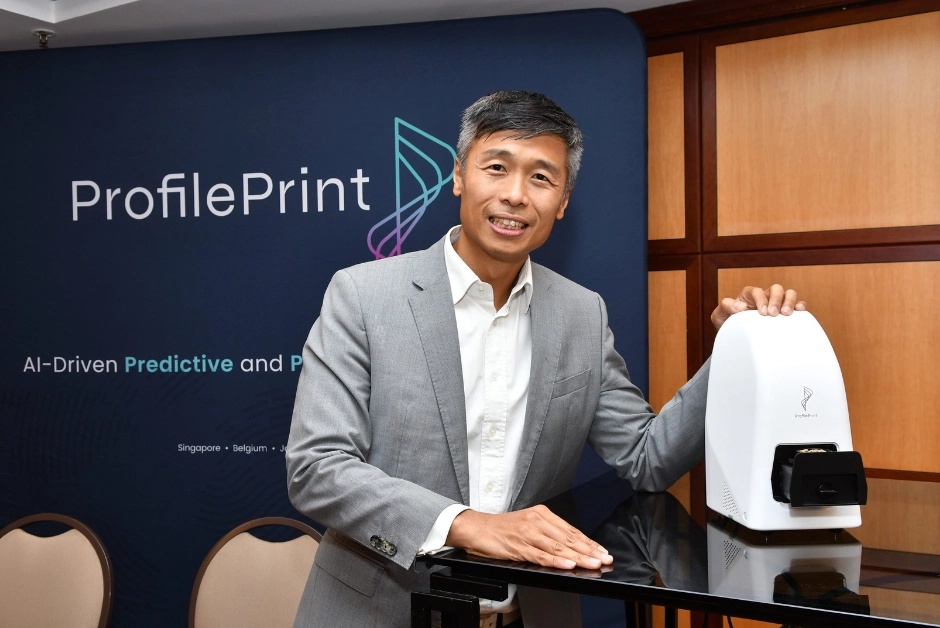
ProfilePrint combines sensing hardware with an online platform. The analyser acquires a molecular signature; software turns the measurements into a digital fingerprint and applies models to produce quality insights. The resulting report can help compare ingredients against a buyer’s requirements. The sample remains intact. Nobody has to brew a cup merely to obtain the digital reading.
The system’s usefulness depends on connecting those readings with industry knowledge. In discussing tea assessment, Lai has described the technology as an apprentice that learns how a client works. Repetitive screening can move to the machine while experienced people concentrate on more complex work. The analogy gives the software a modest job description and leaves the senior employee with responsibility.
His own public language often returns to fit. At the Swiss Coffee Trade Association forum in 2022, he discussed the commercial cost of supplying either more or less than a customer requires. Excess quality can consume a seller’s margin; a shortfall can produce rejection. Matching the requirement more precisely gives a digital report something concrete to do.
The company’s current workflow follows that thinking: analyse the ingredient, let experts review the findings, then make the decision. A report can travel quickly. Responsibility travels with the person who acts on it.
“The real issue is what humans do with that enhanced capacity.”Alan Lai
When the customers become shareholders
By February 2022, ProfilePrint’s Series A included Louis Dreyfus Company, Olam Food Ingredients and Sucafina, alongside other investors. These were businesses already involved in moving ingredients through the world. Their participation connected the startup to the networks where its reports would need to earn their keep.
Lai also had to address an obvious question: how does a shared platform remain useful when several industry participants own part of it? The company described the strategic ingredient conglomerates as holding equal shares, with neutrality an explicit goal. For customers handing over commercially sensitive quality information, the ownership story and the data story belong in the same conversation.
Cargill joined as a strategic investor in August 2022 after completing pilots over the preceding six months. Those trials included applications across cocoa and chocolate. This was a further step beyond a demonstration: a large ingredient business had tested the technology against its own portfolio before investing.
In December 2023, a Series B led by Tai Partners, with four existing shareholders participating, supported continued expansion. At that point the company reported deployments in nearly 50 locations across six continents. It also described Verify, a feature intended to let customers share digital sample reports for viewing and approval, reducing the need to send physical samples back and forth.
Lai’s account of fundraising has put customer work first: understand a client’s needs, build something that addresses them, and allow that evidence to interest investors. The customers becoming shareholders made that sequence unusually literal. The pitch could point to a working relationship already underway.
A smaller machine, a wider invitation
On 8 April 2026, ProfilePrint announced the global launch of Mini Beluga and ProfilePrint Lite. The enterprise business had grown, but independent roasters, regional traders and smaller buyers needed a different entry point. Lai said conversations with customers had exposed a demand for simpler deployment and equipment better suited to everyday use.
The Mini Beluga weighs 1.3 kilograms. The combined device and Lite subscription launched from US$300 a month. It captures fingerprints of green coffee beans without roasting or brewing them. Lite is built specifically for specialty Arabica green beans, giving the smaller package a defined task rather than requiring every user to navigate a full enterprise installation.
Its model draws on more than 30,000 specialty coffee samples assessed by Q-graders. Reports include predicted scores and flavour profiles, with room for cuppers to add their own assessments. Compare checks two digital lots against each other, while Roast Insights helps reveal changes in green coffee between roasting sessions.
Lai and the company showed the smaller system at coffee gatherings including Melbourne and San Diego. The appeal is easy to picture: a tool that can accompany the beans into a warehouse or roastery has fewer geographical excuses. More access also brings the business back toward the question that started it. Useful evidence should be available closer to the ingredient, including to businesses without multinational budgets.
The slow business of earning trust
The hardware can work quickly; winning a contract takes longer. In September 2026, Lai discussed the procurement questions that come from large customers. Legal and cybersecurity teams need assurances about information protection and the seriousness of the AI. A convincing result on a coffee sample does not finish that conversation.
ProfilePrint announced ISO/IEC 42001:2023 certification for its AI management system in May 2026, building on its existing ISO 27001 information security certification. Documented model controls, risk management, accountability and independent audits give customers a basis for assessing the supplier. The paperwork carries part of the product’s promise.
The commercial case has also acquired measurements of its own. In a project with Sucafina, the trader assessed between 30 and 60 percent more coffee lots in the same amount of time. That is a reported result from a particular project, rather than a guarantee for every customer. It gives the speed argument a useful, bounded example.
For Lai, trust also comes through relationships beyond a purchase order. His public profile records youth mentoring and participation in Singapore’s INSPIRIT community and the World Cities Summit Young Leaders network. Helping younger professionals think about work sits alongside his own experience of moving between engineering, command, investing and entrepreneurship.
In 2024, ProfilePrint received Leave a Nest’s Deep Tech Venture of the Year recognition and first place in the NTT Startup Challenge. By September 2026, the company was announcing a role alongside experts at the Golden Leaf India Tea Awards. The tasting table remained occupied by people. There was simply another instrument available to them.
The original Ugandan question still gives this varied career its coherence. What is the quality? Who can establish it? Who gets to use that knowledge? Lai has built a business around making the answers more portable. The price on the packet can still invite argument. At least the conversation can begin with more than the packet.