Tomi Terentjeff had noticed something uncomfortable about Finnish startups visiting the United States. They wanted the market. They had put work into their ideas. Yet, in his telling of Nordic Startup School’s origins, many arrived insufficiently prepared. A good invention could get on a plane rather more easily than a convincing business could get into a customer’s budget.
His response was to put founders back in school. The interesting part was the syllabus: customer problems, sales, team formation, and the discipline of asking whether the business made sense. Nordic Startup Ventures, the Finnish company behind the school, now brings that commercial apprenticeship into venture building and deep-tech commercialization. It sells help with the questions that a working prototype leaves unanswered.
- For founders: structured learning, a lead mentor and continued commercial support.
- For research teams: Deep Rising connects technical progress with market and funding readiness.
- The useful habit: define the customer before rehearsing the pitch.
A passport is easier than a market
The School was already operating in 2019, before Nordic Startup Ventures Oy’s 2020 incorporation. Business Tampere described its first selection as eight startups plus five prospects, assembled through collaboration with Golden Gateway and Startup Tampere. One selected business would get the opportunity to travel to Capital Factory in Austin, Texas. International ambition was there from the beginning.
The program’s early participants were varied enough to resist the usual startup caricature. A 2021 student study examined 15 alumni businesses with teams of two to seven people. Most offered software as a service. Its founder sample also contained substantial prior work experience. These were small companies, but small did not necessarily mean inexperienced. The missing knowledge was often about building this business, for this customer, in this market.
The customer gets the first lesson
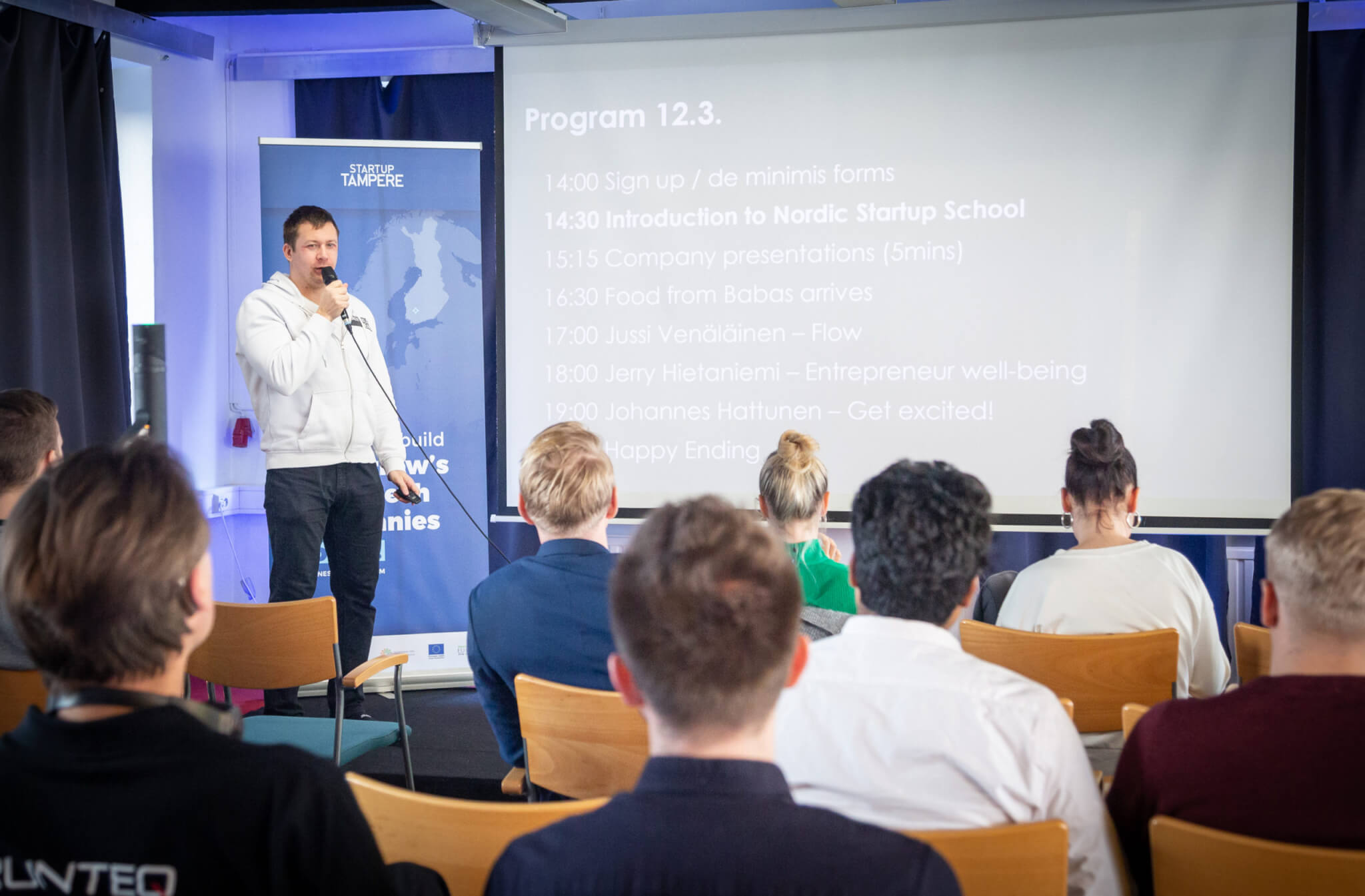
The School’s published three-month timetable is revealing. Customer definition and the value proposition appear in the second week. A sales workshop follows. Financials and fundraising come later; presentation coaching arrives near graduation. It is a sequence with an opinion: a polished explanation should follow commercial thinking.
The offer includes more than 150 hours of facilitated content, weekly follow-ups and a dedicated lead mentor. The curriculum covers branding, experiments, team profiles and US market preparation. Its evening US mentoring session supplies a pleasingly practical detail. Internationalization sometimes begins with changing the hour of a meeting.
Selected graduates can move into a nine-month After School program, divided into three-month sprints with progress checks and assigned mentors. Funding introductions sit alongside a stated mixture of equity and work contributed as investment. For a founder, the appeal is continuity: someone who understands last month’s problem can help with next month’s decision.
Then the teachers did their homework
The model has a useful blemish. Framlabs, which helped redesign the School in 2020, recorded that participants lacked time for discussions, faced too much teaching, and sometimes received material poorly matched to their stage. Later bootcamps adjusted the timing. An organization teaching experimentation had acquired a rather direct experiment of its own.
COVID forced sessions online. Framlabs reported participant ratings of 8.5 for the first, in-person bootcamp, followed by 9.4 and 9.6 for the virtual sessions. Those are satisfaction scores from small groups, not proof of investment returns. Still, the practical lesson travels: leave space for teams to work, brief mentors properly, and prepare tasks before the meeting.
There was a condition attached to the online success. Participants already had human connections from meeting before the switch. Moving workshops onto a screen did not make relationships optional. That distinction matters to anyone copying the format: build familiarity, then give it a useful working structure.
A lab result meets a buying decision
Deep Rising applies venture building to early-stage deep-tech startups and research-to-business projects. The six-month hybrid service, listed by the European Innovation Council, targets market fit and fundability, including team composition, ownership and financial planning. Each team gets a lead mentor, with specialists brought in according to need.
The published average package is around €50,000, with €35,000 offered to EIC beneficiaries. Terms may be negotiated, and part-payment can take the form of a convertible loan. NSV may subsequently invest, but participation carries no investment promise.
That arrangement places NSV between a conventional adviser and an investor. Working together lets it assess a company before backing it. For the founder, it makes the support itself a purchase to evaluate: does the proposed work address a commercial bottleneck worth that commitment?
“Why have ten people in a team if they all think the same?”Nordic Startup School’s published values
Consider the distinction in practical terms. A research team might explain what its device measures, how accurately it performs, and why the underlying science is difficult to reproduce. A commercial discussion has to ask who needs that measurement, who controls the budget, and what would make an existing supplier difficult to replace. Those are examples of questions, rather than claims about any NSV portfolio company. They show why commercialization support can be useful even when the founders know their technology thoroughly.
More minds, fewer comfortable assumptions
The School’s mentor directory includes sales, service design, fundraising, growth and California business development expertise. Its stated values emphasize continuing education and diversity of perspective. The practical purpose of that variety is challenge. An engineer, a salesperson and a prospective buyer may each hear something different in the same product description.
The work also extends beyond a single founder cohort. AEL Foundation awarded a €32,000 grant in October 2022 for training in green, agile and sustainable business. In 2023, NSV’s Enrique Montaño contributed roadmap and KPI expertise to the ESCALTECH scale-up kickoff in Tampere. Training is part of the company’s broader ecosystem work.
Price also helps distinguish the alternatives. Red Brick publishes free, equity-free programs for early startups, while Deep Rising is a paid venture-building package. A team shopping for support should therefore ask what is actually delivered: general learning, company-specific execution, or introductions. The next question is who will do the work between sessions. A mentor network is useful only when its advice reaches the decisions the founders must make.
Founders considering accelerators such as Kiuas, Red Brick or Aalto Startup Center should compare the actual work, time commitment and commercial terms. NSV’s distinguishing proposition is the connection between founder education, sustained mentoring and selective investment. The habit worth borrowing is inexpensive: schedule the difficult customer conversation early. A classroom helps when the team is willing to reconsider its answers. It has much less to offer a founder who treats every question as an invitation to repeat the pitch.