A startup without customers is an awkward object to value. It may have clever technology, an ambitious team and a spreadsheet in which everything goes beautifully. What it lacks is evidence that anyone will pay. Accelerace has built its business around entering at precisely this uncomfortable moment, then helping founders get ready for the next investor.
The Copenhagen company offers something unusually tangible in a field fond of vague promises: early money, access to experienced founders and a program designed around the next financing round. Its public profile reports more than 2,000 startups supported; its portfolio page counts investments in more than 200 startups. Those are different populations. Passing through an accelerator does not automatically mean receiving a cheque.
Now the organization is taking that experience into a larger institution. Its combination with BioInnovation Institute, announced in October 2025, puts a technology accelerator alongside an organization rooted in science commercialization. The immediate question is familiar to anyone who has watched an impressive laboratory demonstration: how does this become a company somebody wants to buy from?
The million-kroner offer has a fee attached
Accelerace’s funding page advertises DKK 1 million through a convertible loan, including for companies without revenue or customers. It also specifies a one-time DKK 250,000 fee for the program and Allstars community. Subtracting that fee leaves DKK 750,000 from Accelerace’s contribution before other costs. The fee equals a quarter of the headline investment.
Simple subtraction, not a runway forecast. Loan terms and other costs still matter.
The downloadable example, dated March 2023, adds detail: an 8% annual interest rate, repayment after three years if conversion has not occurred, and no personal liability. It also requires at least DKK 125,000 from another qualified investor on similar terms. The valuation cap and discount are determined case by case. These are the example’s provisions, not a substitute for a startup’s eventual agreement.
That makes the decision more substantial than accepting a place on a course. A founder is choosing financing with future ownership or repayment consequences and buying support alongside it. The sensible comparison is the cash left, the obligations assumed and the usefulness of the people involved. A large number at the top of an offer cannot answer those questions by itself.
Accelerace has also raised money for its own business. In January 2018, it announced approximately $1.7 million from Færchfonden, the Danish Growth Fund and Symbion to expand its services and specialist programs. That financing belongs in a separate column from the money its portfolio companies raise. So does foundation support for particular projects: a grant paying for matchmaking serves a different purpose from capital invested in a startup.
A graduation that brings you back
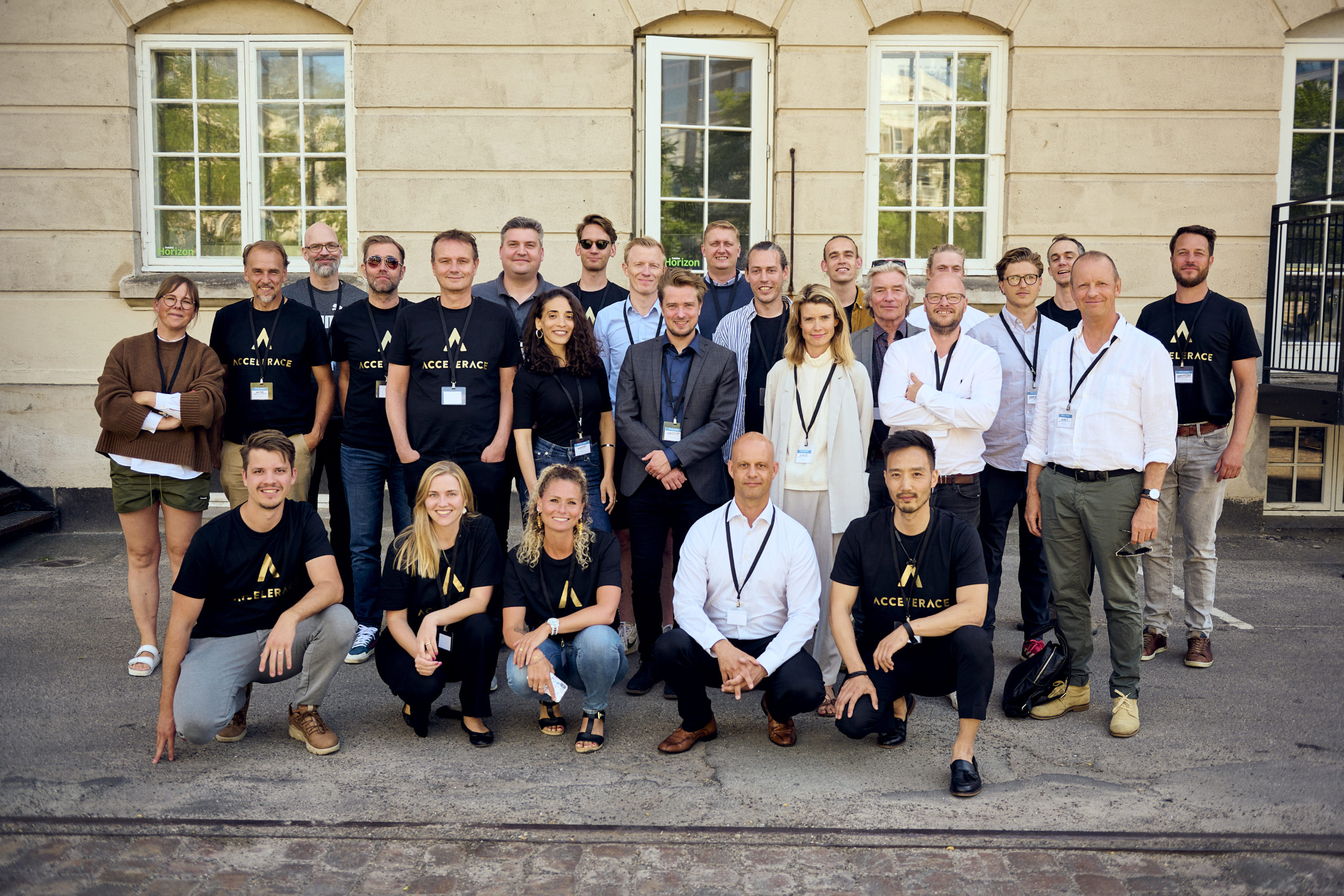
Allstars is Accelerace’s answer to the familiar problem of advice that sounds excellent until somebody tries to use it. Its mentors include founders of Templafy, Penneo, Actimo, Coinify, Axdraft and Dreamplan. They bring experience of building companies, raising money and navigating acquisitions or public markets. The relationship is intended to continue after the initial program ends.
“they introduced me to people who had the exact experience we needed.”
Peter Mühlmann, founder of Trustpilot, in an Accelerace testimonial
The investment package includes a seven-week preparation program, mock investor meetings and an Investor Day. Founders work on their fundraising approach and pitch, then meet potential backers. It runs in a hybrid format, with some activity in Copenhagen. Accelerace says around 65% of companies in its first fund raised follow-on capital, a historical result rather than a promise for the next applicant.
The alumni connection also appears inside the team. Fund manager David Today is listed as an alumnus from 2009; venture partner Mads Løntoft as an alumnus from 2011. The careers page describes an informal workplace that values experimentation, curiosity and professionalism. Its team introduction even advertises dark Danish humor. For an organization selling the usefulness of people, a little personality is relevant product information.
The research was there. The business needed help.
Accelerace began in 2008 in the startup environment associated with Symbion. Founder and CEO Peter Torstensen’s central proposition has remained recognizable: find entrepreneurial talent, help develop the company and make accumulated experience useful to the next team. Recognition followed, including the accelerator award at the 2017 Nordic Startup Awards.
The University of Copenhagen partnership made that approach available much earlier in a potential founder’s career. From September 2023, the university’s 37,000 students and 5,000 researchers could access entrepreneurship support. Accelerace supplied teaching materials, digital courses and mentor access through the KU Lighthouse innovation environment. Those figures describe the eligible university community, not the number of people who became entrepreneurs.
The next institutional step was the BII deal. BII’s 2025 annual accounts record a purchase agreement finalized in September and organizational integration planned for 2026, with Accelerace retaining its name. The public announcement describes support extending beyond biotech and life sciences into technology, AI and quantum. Later Accelerace posts refer to BII as its new home.
What pushed the organizations together was a diagnosis of fragmentation. In an October 2025 opinion piece, their leaders argued that too many separate initiatives dispersed resources and slowed the journey from research to market. Commercial validation, capital and leadership were the missing connections. Joining forces was their proposed response: give university-based companies a more coordinated route to the expertise they need.
The proposition is testable. Researchers should spend less effort navigating institutions and more effort finding out whether their technology solves a valuable problem. Combining organizations creates the opportunity to do that. Results will depend on how effectively their people work together around individual companies.
Different founders need different doors
Accelerace’s services reach beyond its investment offer. Beyond Beta combines a free online pre-accelerator with industry-specific incubation and, in its published description, a five-month accelerator. Its partners include the Danish Business Hubs, Danish Design Center and industry clusters. The intended applicant is a Denmark-based early startup with proof of concept.
Life-science teams have another route through NOME, the Nordic Mentor Network for Entrepreneurship. Funded by the Novo Nordisk Foundation, it pairs selected startups with two to four industry mentors for sustained guidance. VITA, developed with CDP Venture Capital SGR and Healthware Group, addresses digital-health companies in Italy or companies willing to do business there.
These programs serve different needs and have different eligibility rules. The free online course is an educational entry point. A specialist mentor relationship helps with sector-specific decisions. Venture funding supports a company pursuing the growth and subsequent financing that investors expect. Treating all three as interchangeable would make choosing between them unnecessarily confusing.
Learn the businessCourses and partner programs
Prepare the roundInvestment and founder mentoring
Test with a buyerCorporate and SME collaborations
Antler offers a useful market comparison. Its Nordic proposition emphasizes investing at inception and potentially supporting companies through later rounds. Accelerace’s published offer puts particular emphasis on preparing for seed investment and using its alumni network. A founder comparing them needs to examine stage, terms and available expertise, rather than assume every early investor delivers the same service.
The obstacles arrive before the applause
MederiAI shows what early support can involve when the product is medical software. The startup is developing AI to help clinicians review capsule-endoscopy footage. In Accelerace’s March 2025 account, obtaining high-quality annotated medical data was a major hurdle. Labeling required specialist clinical knowledge; hospital relationships and regulatory preparation added further work and expense.
The team brought in regulatory and compliance consultants and medical advisers, and planned clinical work with Spanish hospitals. Its announced schedule aimed at trials in 2026 and European commercialization in 2027. Those were development goals. The useful lesson is the sequence of dependencies: the data, clinical evidence and documentation must support the product before a persuasive sales story can carry much weight.
Other companies illustrate the breadth of Accelerace’s investments. Financial-planning startup Dreamplan announced DKK 20 million in seed funding in March 2025, with Three Thousand Capital and business angels participating. Its co-founder Stine Kalmer Jørgensen also appears in the Allstars mentor network. A portfolio company can contribute experience while still building its own business.
In October 2025, combat-sports technology company Jabbr announced a $5 million seed round led by Buckley Ventures. Its AI and computer vision support analysis and production in a sport with plenty of action to measure. Accelerace had invested at pre-seed. The round demonstrates one company’s subsequent access to capital; it does not establish that every company receiving the same support will follow it.
A pilot needs a willing customer
Corporate matchmaking approaches the problem from the buyer’s side. Accelerace’s AI Match pilot, announced in May 2025, received DKK 2.1 million from Industriens Fond. Its stated goal was at least five pilot projects linking Danish SMEs with startups. A brief onboarding session would lead to curated introductions and help structuring a collaboration.
The participation conditions are refreshingly practical. The 2025 Match program sought market-ready products that could be implemented within a two-to-three-month pilot. SMEs needed both spare capacity and a willingness to commit. A startup still assembling its first prototype would be too early for that particular route. An enthusiastic introduction cannot supply a customer’s missing staff time.
The Sidel innovation program offers another version, covering packaging, aseptic technologies, AI and robotics. Accelerace identifies potential matches; Sidel makes the final selection and handles collaboration discussions. The published pilot FAQ says Sidel takes no equity and generally covers technology-adaptation costs, while startups cover their own travel. That is a commercial development arrangement with different economics from the investment program.
What can another founder copy? Identify the next unresolved question, find someone whose experience fits it, and design a small test with an accountable counterpart. Accelerace packages versions of that process into mentoring, investor preparation and pilots. Its value ultimately depends on the quality of those encounters: the adviser who spots the weak assumption, the investor who understands the company, or the customer willing to put a product to work.