Consider the little cylinder at the centre of Pacific Fusion’s plan. It is about the size of a pencil eraser. An immense electrical pulse will squeeze it, heating hydrogen-isotope fuel until atoms fuse. The cylinder will be destroyed. Then the company wants to do it again. For a commercial plant, the intended rhythm is roughly once a second. A disposable object has become an electricity company’s central accounting problem.
- The method: electrical pulses compress fuel, rather than laser beams.
- The evidence: tested targets and pulser prototypes; no demonstrated net facility gain yet.
- The wager: repeated, inexpensive hardware can carry fusion from experiment to industry.
Pacific Fusion’s appeal rests on that small, unglamorous detail. Clean energy is a magnificent ambition. Replacement parts are where magnificence meets the purchasing department. The company is trying to make both the machine and its appetite for fresh targets affordable.
The trouble with throwing things away
In conventional magnetized liner inertial fusion, external coils help magnetize the fuel before compression. Hardware close to the target can be destroyed in a shot. Replacing costly coils at power-plant frequency would make the electricity an expensive souvenir.
In February 2026, Pacific Fusion reported experiments conducted with Sandia National Laboratories that offered a simpler route. Targets combining aluminum and plastic allowed the electrical pulse’s magnetic field to enter the target, preparing the fuel without external coils. The team tested two aluminum thicknesses across four shots. A thinner layer let the field penetrate faster.
This was a target-design experiment, not proof of commercial fusion. Its importance was economic: remove an expensive recurring component before it becomes a permanent expense. The experiment also checked predictions from the company’s simulation tools against actual target behaviour. There is something pleasantly unfashionable about a startup whose clever new ingredient is less hardware.
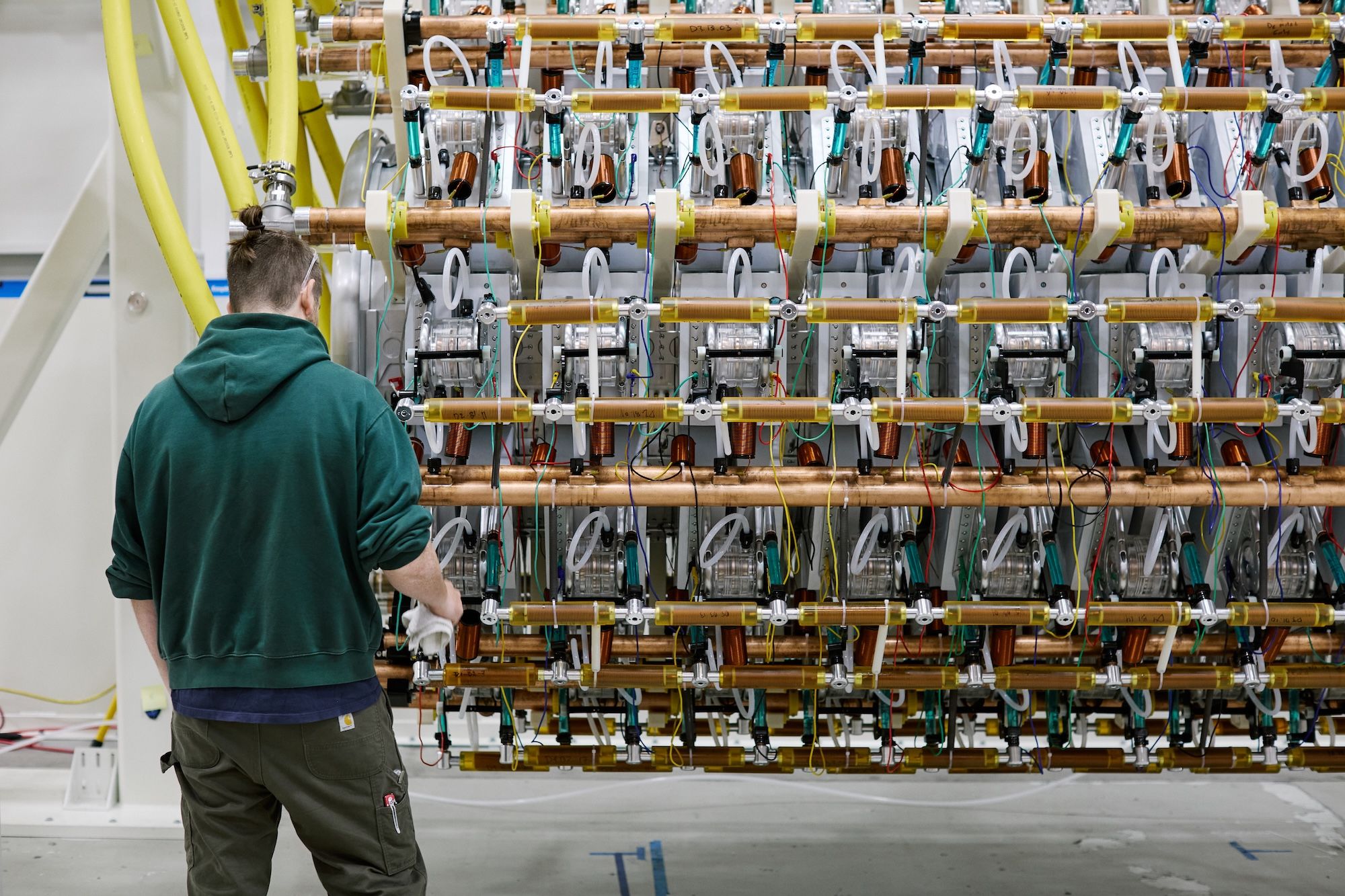
One module, then 155 more
The machine supplying that pulse is an impedance-matched Marx generator, or IMG. Keith LeChien, Pacific Fusion’s co-founder and chief technology officer, co-invented the architecture with Bill Stygar. It builds on national-laboratory pulsed-power work while arranging the energy delivery differently: synchronized electromagnetic waves combine into a fast pulse in a single step.
The company’s proposed system contains 156 modules. Each full module has repeating stages assembled from smaller “bricks”: two capacitors and a switch. Charge the capacitors, release their energy together, send it toward a central chamber. There, current creates the magnetic force that compresses the target. The attraction is repetition at two scales: identical pieces in the factory, repeated shots in the plant.
- 01StoreCharge capacitors
- 02ReleaseSynchronize modules
- 03SqueezeCompress the target
- 04FuseRelease energy
In June 2026, Pacific Fusion announced that a roughly one-third-scale prototype had delivered about 440 gigawatts of peak electrical power in an 80-nanosecond pulse. That result followed more than 1,000 qualification shots. The next task was a production-scale module, then manufacturing the rest. The gigawatts describe a driver’s fleeting burst, not electricity supplied to homes.
Demonstrated over an 80-nanosecond pulse.
Electrical driver output, June 2026.
The laboratory has a long memory
The company began in 2023, following two kinds of encouragement: fusion ignition at the National Ignition Facility, and advances in pulsed-power drivers. Those developments altered what its founders thought was worth building. Ignition established a physical possibility; efficient pulsers offered a potential route toward cheaper equipment.
Its five founders cover an unusual range. CEO Eric Lander helped lead the Human Genome Project. LeChien brings pulsed-power expertise. Carrie von Muench oversees operations, Will Regan is chief scientist, and Leland Ellison leads technology. This is a business requiring plasma physics, predictive software and the ability to make another component by Friday.
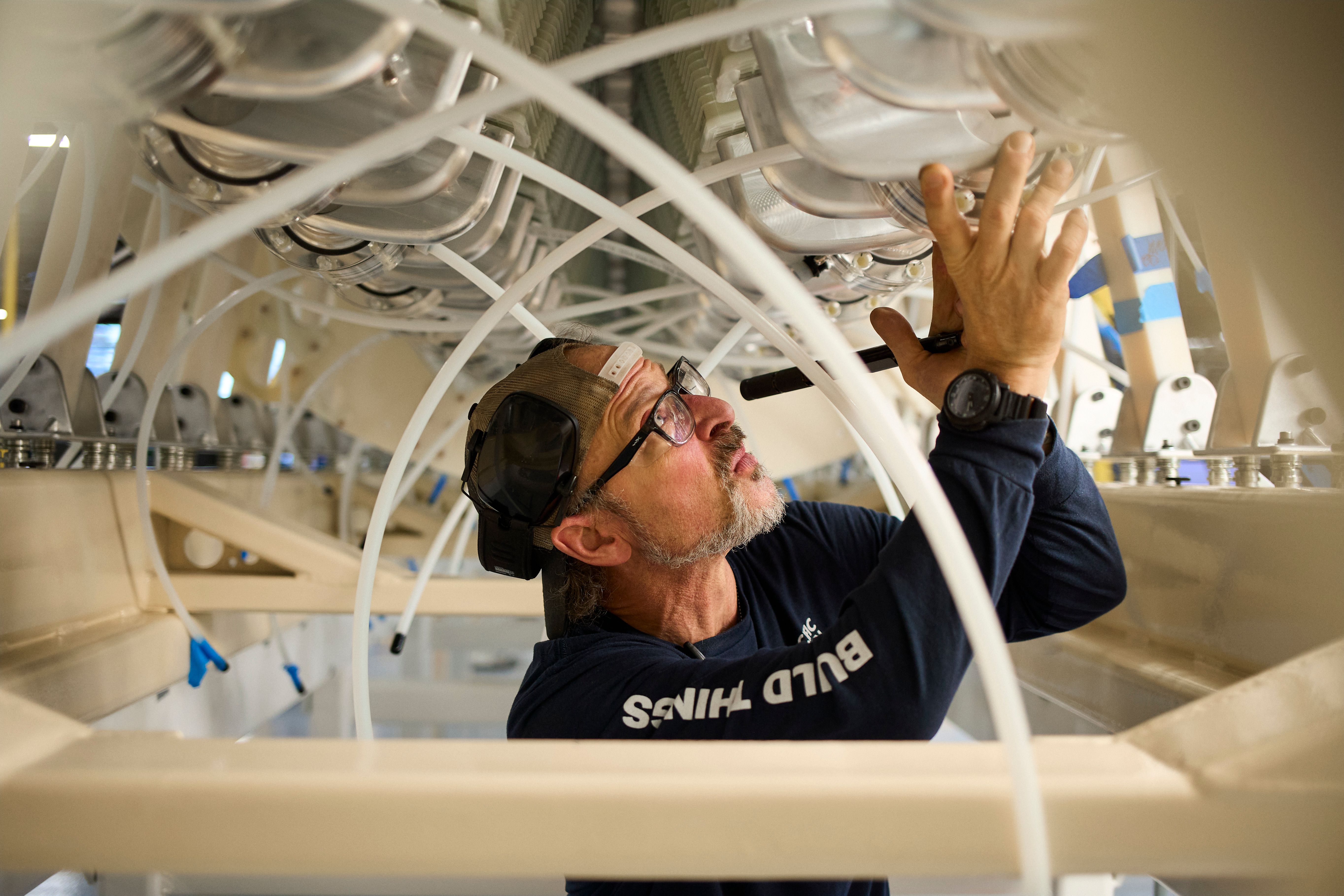
At Lawrence Livermore National Laboratory, the SIRIUS prototype surpassed 3,000 shots in a campaign supported by a Pacific Fusion research agreement. The laboratory reported that switches survived the campaign and component failure rates stayed within requirements. Wear matters because a beautiful simulation cannot establish how long a physical part survives.
“A computer simulation won’t tell us what a component lifetime is”Kumar Raman, LLNL project manager
A billion dollars, with conditions attached
Pacific Fusion announced more than $900 million in Series A commitments in October 2024. By 2026, it described the round as $1 billion. General Catalyst led it; backers included Breakthrough Energy Ventures, Patrick Collison and Eric Schmidt. The money comes in tranches tied to technical milestones. Committed capital and cash already received are different quantities.
The arrangement gives the company a funding roadmap while keeping experimental results consequential. Its stated workplace values include truth-seeking and creative approaches. Milestone financing makes those virtues practical: the next cheque depends on evidence. A useful lesson for other hardware builders is to make the financing schedule answer to the experiment schedule.
The first audience may wear a lab coat
In August 2026, Pacific Fusion announced groundbreaking for its $1 billion-scale research and manufacturing campus in Albuquerque. That project figure describes a planned investment, not a completed expenditure. The Demonstration System targets net facility gain by 2030: fusion energy exceeding the energy initially stored in the machine.
It will not be a commercial power plant. Converting fusion energy into net electricity introduces losses and additional power requirements. Repeated operation adds target production, chamber durability, maintenance and tritium supply to the list. Pacific Fusion’s roadmap explicitly separates facility gain, power gain and affordable power. It plans commercial electricity for the mid-2030s.
Meanwhile, its Users Program invites proposed experiments from industry, academia and government. Pulsers also offer prospective radiation-testing and national-security applications. An August memorandum with NNSA creates a collaboration framework; projects and funding need separate agreements. Future electricity customers and present research partners occupy different places in the business.
Commonwealth Fusion Systems pursues magnetic confinement in tokamaks; Helion pursues a different pulsed configuration and electrical recovery. Pacific Fusion’s position is a manufacturing-led route through inertial fusion. Whether it succeeds will depend on targets being cheap, pulses being reliable and the whole system producing useful power repeatedly. Until then, the most revealing question is wonderfully mundane: what must be replaced before the next shot?