In July 2026, the power went out around a metric ton of molten bismuth. At Zap Energy, that meant a useful, unscheduled examination. The metal was circulating at 400°C. When electricity disappeared, a freeze-protection valve thawed and gravity drained the metal into a safe condition. Nobody intervened. When power returned, the team restarted the system without incident.
A blackout is an odd advertisement for a nuclear company. But it gets surprisingly close to the business Zap wants to build. Making atoms release energy is one task. Building machinery that survives the ordinary indignities of running a power plant is another. Even a star needs dependable plumbing.
- Zap uses flowing plasma to stabilize a compact fusion experiment.
- Century tests the power supplies, liquid-metal walls and electrode protection around the reaction.
- Its 2026 strategy adds modular fission, with industrial power users in view.
The pinch had a manners problem
The original attraction of the Z-pinch was simplicity. Send electrical current through plasma, and the resulting magnetic field squeezes it. Unfortunately, squeezed plasma can misbehave: it bends, bulges and loses confinement. The elegant diagram becomes an unruly experiment. Stabilizing that column is essential to keeping the fuel hot and dense long enough for useful fusion.
Zap’s answer is sheared flow. Layers of plasma move along the column at different speeds, suppressing fast-growing disruptions. The company avoids the large external magnetic coils associated with tokamaks and the powerful driver lasers of laser-based fusion. Magnetic fields still do the squeezing; the current through the plasma creates them. Removing hardware is the economic wager, rather than an accomplished price advantage.
Uri Shumlak has pursued this approach since the 1990s. In 2017, he founded Zap with Benj Conway and Brian A. Nelson, drawing on University of Washington research and collaboration with Lawrence Livermore National Laboratory. The startup arrived with a long scientific prehistory. The newly incorporated business was carrying an idea old enough to have endured plenty of examinations.
One extra electrode, one useful admission
A revealing constraint appeared in Zap’s earlier two-electrode systems. They heated plasma, but did not provide the compression targeted in the theoretical models. The same power input had to accelerate the plasma and squeeze it. FuZE-3, introduced in 2025, separates those jobs using three electrodes and two capacitor banks. The researchers gained another control to adjust.
“The two-electrode systems have been effective at heating, but lacked the compression targeted in our theoretical models.”Colin Adams, Head of Experimental Physics, 2025
Zap reported peak electron pressure of 830 megapascals on FuZE-3. Its estimate of roughly 1.6 gigapascals total pressure assumes electrons and ions have similar temperatures. The pressure lasted approximately a microsecond. That is an interesting physics result, with a very short wristwatch attached. Pressure alone does not establish energy gain, much less electricity delivered to a customer.
An engine needs more than ignition
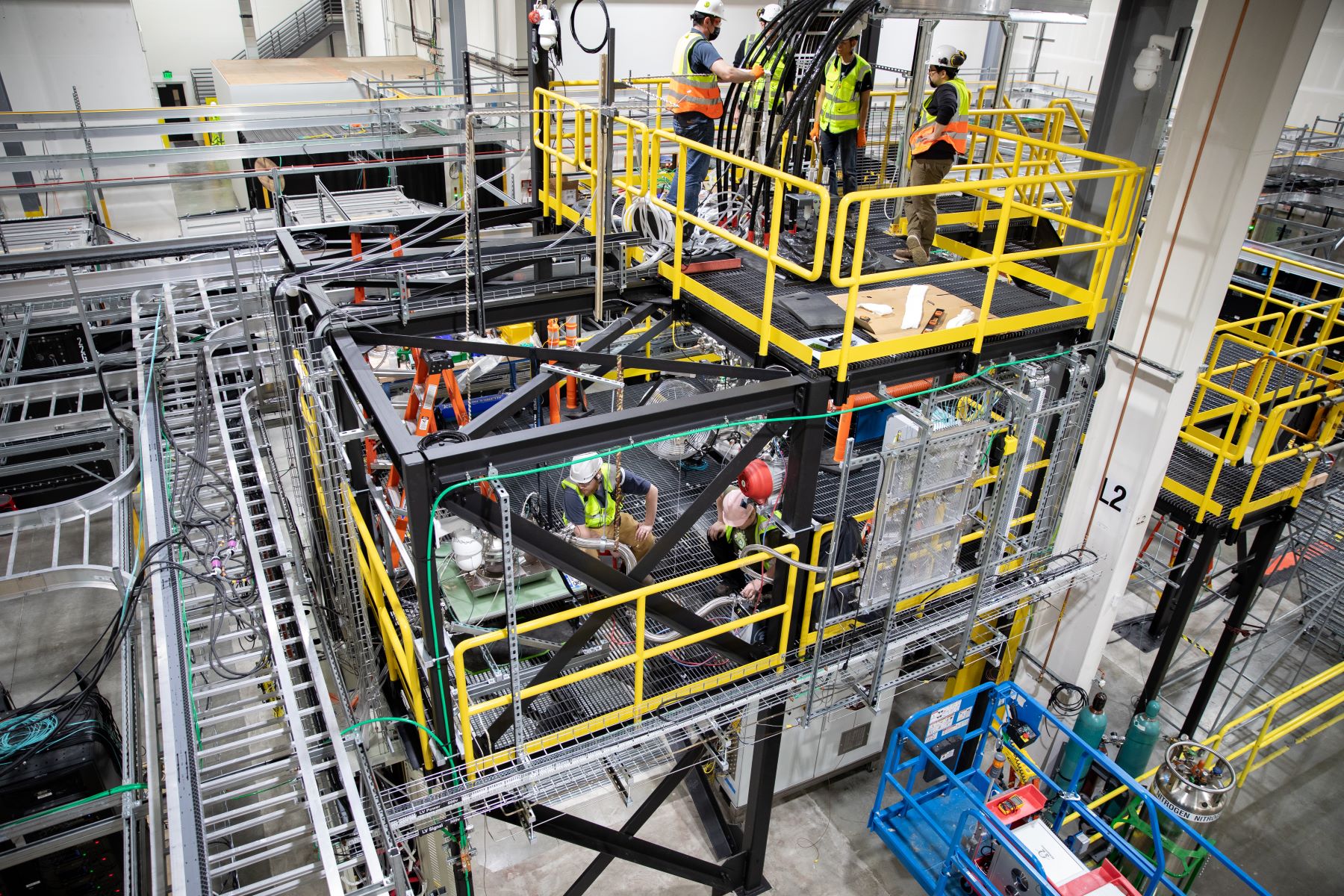
Century approaches the problem from the other direction. Commissioned in June 2024, it integrates repetitive pulsed-power supplies, circulating liquid-metal walls and electrode-damage mitigation. It uses ordinary hydrogen, so its plasmas do not produce fusion reactions. This is a rehearsal for the plant’s engineering, deliberately separated from the effort to improve fusion performance.
In February 2025, the Department of Energy certified a campaign of 1,080 shots over three hours, one every ten seconds, without failure. Later that year, Zap reported more than a hundred shots at one every five seconds. Its proposed fusion system aims for ten pulses per second. Those rates describe different stages of development; a successful rehearsal still leaves a demanding production schedule.
Demonstrated engineering runs and a design target. Different operating conditions; no claim of equivalent fusion output.
The financing reflects the breadth of that work. Zap raised $27.5 million in 2021 and $160 million in 2022. Its $130 million Series D, announced in October 2024, brought company-reported total funding above $330 million. Soros Fund Management led the round. Zap said the money would support plasma research and plant engineering in parallel, including new devices and a pulsed-power capacitor bank.
Fission joins the guest list
In April 2026, Zap formalized a wider strategy: develop fission alongside fusion. Zabrina Johal became CEO; Conway moved to President. Johal brought experience from General Atomics, AtkinsRéalis and the U.S. Navy’s nuclear program. The expansion rests on overlapping needs in materials, liquid-metal handling, heat transfer and power conversion. Zap wants development in one branch to help the other.

The proposed Zap Modular Reactor uses uranium-zirconium fuel and sodium cooling, targeting up to 25 megawatts of electricity per module. A separate fusion preconceptual design targets approximately 50 megawatts net per module. DOE approved its design-report milestone in May 2026. Neither a design target nor a reviewed report establishes an operating commercial plant.
Prospective buyers include data centers, industrial facilities and remote installations that need dependable electricity or heat. For those customers, weather-independent output and modular additions could be useful. They would still need a licensed, financeable system with credible delivery and maintenance terms. Zap’s public market pitch identifies these applications; it does not establish a fleet of paying electricity customers.
The bill comes after the breakthrough
Zap occupies an unusual position among fusion developers. Commonwealth Fusion Systems pursues a high-field tokamak with superconducting magnets. Helion pursues pulsed field-reversed configurations and direct electrical energy recovery. Zap’s proposed fusion plant captures heat through liquid metal for power conversion. Its expanded fission program adds another set of competitors for the same industrial energy budgets.
There is a useful practice here to copy: isolate expensive uncertainties and test them before they converge. Build a rig for the walls. Give acceleration and compression separate controls. In 2023, Zap also acquired liquidated capacitor-manufacturing assets from ICAR, investing in the machinery needed to make its own demanding pulses. A laboratory result needs a supply chain.
The approach depends on those shared technologies transferring successfully, and on compact hardware surviving commercial duty. Fusion must also reconcile confinement, fuel handling and electricity conversion. Investors’ checks establish the cost of financing a development effort, not the cost of a finished plant or its power. The bismuth loop’s automatic drainage is encouraging precisely because it is specific. Zap’s next business will be built from many such particulars.
Follow the current
Explore Zap’s website, its research library and newsroom. Follow LinkedIn, X and YouTube.
Further reading: The bismuth loop’s blackout test · The expanded nuclear strategy · GeekWire on the Series D.