Dinner was interrupted by a phone call eighteen months in the making. In Germany, Stevan Slijepcevic was sitting with Honeywell Aerospace engineers when news arrived that the team had won the Airbus A350 mechanical systems contract. Eighteen months of work had reached a decision. Some of the engineers cried.
“It felt amazing,” he recalled. At the time, he was Honeywell’s director of new business development. The celebration belonged to a team; the consequences would extend far beyond the restaurant.
Honeywell’s announced contract value, including aftermarket, over the life of the agreement. A long horizon, rather than a single year’s sales.
The contract covered air management systems and auxiliary power unit technology for Airbus’s new wide-body aircraft. Its value included the work that would follow the original equipment into service. In aerospace, a successful bid can establish a relationship that lasts well beyond the first delivery. The headline number arrives quickly. Much of the actual business takes its time.
An engineer learns the whole business
Slijepcevic’s working life began with a narrower assignment. After aerospace degrees at Purdue in 1993 and 1994, he joined Honeywell in 1995 as a finite element stress analyst. His early profession involved understanding what happens to a component under load. The later jobs would involve understanding what happens to a business under obligation.
His career moved through engineering, program management, sales, customer support and general management. These are different vantage points on the same product. An engineer sees a technical requirement. A customer wants a usable result. A factory has to make it repeatedly. A manager has to reconcile all three without wishing away the cost.
He also earned an MBA at Indiana University. The combination of engineering and business qualifications fits the range of responsibilities he eventually held: mechanical systems, commercial leadership, supply chain and electronics. His technical education remained part of a career that kept widening its field of view.
By October 2019, he was president of Honeywell Aerospace’s Electronic Solutions business. When Cubic recruited him, that operation had more than 6,000 engineering, product and business development professionals across more than 20 engineering and manufacturing sites. Cubic’s appointment announcement put the business at more than $4.5 billion.
Before that, he had led Mechanical Systems and Components, with responsibility for strategy and operational improvement. Other assignments included navigation and sensors, mechanical components and Honeywell’s Embraer business. The titles record a long apprenticeship in how a technical organization earns its keep.
Each change of responsibility alters the information a leader needs. A design decision has to survive production. A delivery commitment has to survive contact with the supply chain. A promising market has to justify investment. Moving across these functions gives a career its texture: the same organization can look quite different from another desk, even when everyone is working toward the same customer’s order.
- 1993 / 94Purdue aerospace degrees
- 1995Honeywell engineering
- 2022Cubic president & CEO
- 2025Cubic chairman
A different set of systems
In January 2022, Slijepcevic became Cubic’s president and chief executive. Mac Curtis became chairman. Together they succeeded Bradley H. Feldmann in the leadership of a company backed by Veritas Capital and Evergreen Coast Capital.
The change moved Slijepcevic into a business with two conspicuously different audiences. One buys technology for transportation networks. The other needs communications, information and training capabilities for defense. A passenger paying a fare and an operator preparing for a mission are unlikely to compare shopping notes. Both, however, depend on equipment and software fitting into a larger working system.
That is a useful way to understand his appointment. Cubic’s corporate biography describes his previous electronics responsibilities as including both long-term planning and execution of the annual operating plan. The first asks where the business should go. The second asks what it can actually deliver this year. A chief executive needs to keep both questions in the room.
Recognition followed early. He joined Executive Mosaic’s Wash100 list in 2022 and again in 2023. Responding to the first award, he credited Cubic employees’ collective effort. The award recognizes people in government contracting; its significance here is the attention it brought to his arrival in that sector.
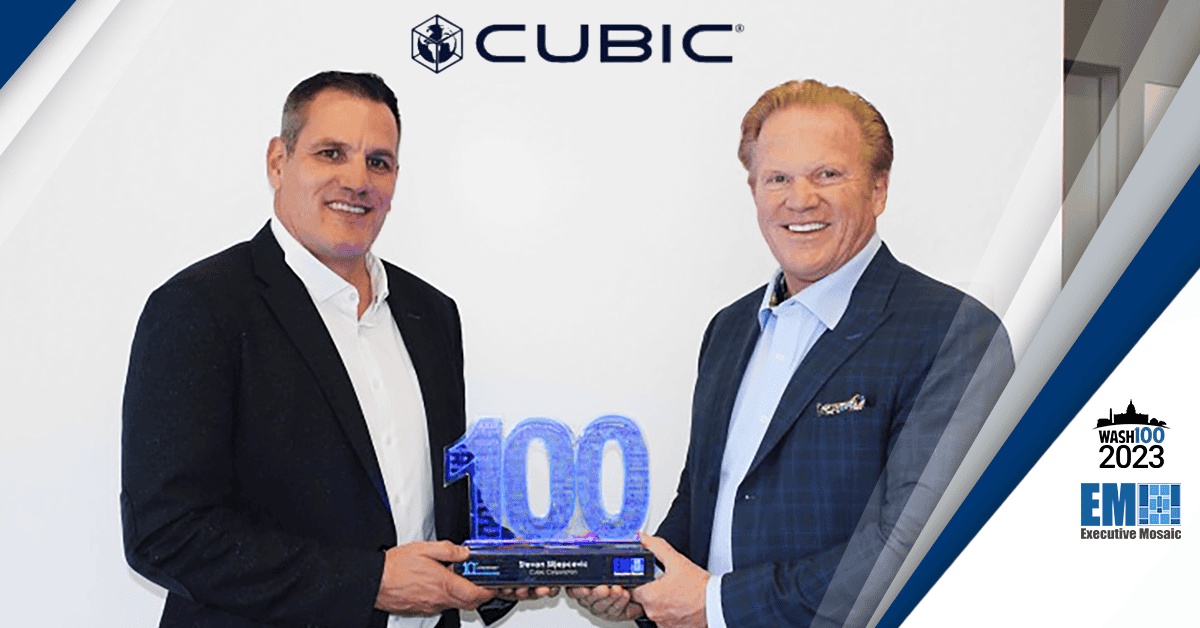
The 2023 presentation paired him with the award’s founder, Jim Garrettson. It makes a useful photograph of a moment in his tenure. The continuing assignment was less photogenic: keeping a company’s technical capabilities connected to the contracts, people and resources needed to deliver them.
The gate, the signal and the training range
Consider a fare gate. It is a small encounter in a passenger’s day, often measured in seconds. For its operator, it is also a payment checkpoint, a moving barrier and a piece of infrastructure that has to accommodate people arriving with very different needs.
Cubic introduced its FEnX gate in February 2025. The design combined computer vision and sensor technology to identify fare evasion, with software intended to distinguish different kinds of passage. The announcement also described entry features for passengers with luggage and parents with strollers, including recognizing when someone needs more time.
The commercial problem is easy to state and awkward to solve. An agency wants to protect fare revenue. Passengers want to get through. A product that answers only one side of that exchange leaves the other side standing in a queue. Cubic’s stated design brought those competing needs into the same piece of equipment.
Pay for the journey.
Move through the gate.
Manage the network.
Connect the participants.
Run the exercise.
Review what happened.
In September 2026, Cubic launched TruView Central, a web-based traffic management platform. It gives traffic professionals tools to monitor signal networks, issue commands and manage controller configurations. The approach builds on existing agency systems and field equipment, rather than requiring every intersection to begin again.
For a chief executive, that detail matters. Customers often have an installed network to maintain alongside a desire to modernize it. The new product has to find a practical place among earlier investments. Progress may arrive through a browser window while familiar hardware continues working at the roadside.
The defense side offers a different illustration. In August 2026, Cubic announced an alliance with adversary training specialist Draken. Cubic’s SPEAR software supports data collection within Draken’s Phantom Sky range control system, alongside integrated air combat maneuvering instrumentation.
The arrangement brings tracking, exercise control and reconstruction into the training environment. Participants can review a mission afterward using a detailed record. The aircraft get the dramatic role. The data has to remember what they did. Neither the gate nor the training alliance is Slijepcevic’s personal invention; both help explain the range of work his organization must coordinate.
A chairmanship, then an operating test
On March 17, 2025, Curtis retired as chairman and Slijepcevic took on that responsibility alongside his existing roles. The transition brought board leadership and executive management together in the same person.
He thanked Curtis for his guidance and set out priorities of innovation, operational excellence and customer value. Those are broad ambitions. At Cubic, they have concrete settings: a public agency’s transport program, a defense customer’s training requirement, a product team’s delivery schedule. The boardroom language eventually has to meet someone else’s working day.
The following year brought a financial task as well. On September 15, 2026, Cubic announced an agreement to raise up to $175 million in new financing from certain existing lenders and financial sponsors. Its stated purpose was to strengthen liquidity and support operations. Existing sponsors and lenders unanimously approved the financing.
The distinction between an agreement and completed funding matters, as does the phrase “up to.” The announcement set out a financing arrangement and its purpose. For the person leading the company, access to capital belongs beside product development and customer delivery in the account of the job.
It is tempting to tell an executive’s story entirely through wins: the contract, the appointment, the award. A business continues between those moments. Its obligations require resources as well as ideas. The financing announcement gives the current chapter a more practical frame.
The next person at the table
On October 5, 2026, Cubic appointed Elliot “Lee” Sander president and CEO of Cubic Transportation Systems. He succeeded Slijepcevic, who had been serving as the division’s interim president, and reports to him at the parent company.
“Lee is the right leader for CTS at this moment.”
Stevan Slijepcevic · October 2026
Sander had advised CTS since August 2025 and served as executive chairman since June 2026. His earlier roles included leading New York’s Metropolitan Transportation Authority and serving as the city’s transportation commissioner. The appointment followed a search lasting several months.
Slijepcevic’s statement emphasized Sander’s experience across public agencies, transportation businesses and policy. It was a revealing set of qualifications for a company whose products have to function inside public institutions as well as technical networks.
The handover leaves Slijepcevic leading Cubic as chairman, president and CEO, with a new division chief responsible for transportation. His own route has carried him from analyzing individual components to assembling the people and resources around much larger systems.
The restaurant call remains a good place to begin that story. A team had worked for eighteen months before a few words delivered the result. Today the titles are longer and the responsibilities broader. The work still reaches its meaning when the people around the table can deliver what they promised.