Carey Smith’s seat was between the pilot and the copilot. The aircraft’s cockpit was moving from analog instruments to digital displays, and she had helped design what the crew would see. During flight tests, she explained how to use the new systems. A display that made sense to its designer still had to make sense to the people flying the airplane.
It is a useful place to begin with someone whose current title requires three pieces of stationery: chair, president, and chief executive officer of Parsons Corporation. Long before those responsibilities, she had a job with an immediate audience and a practical test. Could the people operating the aircraft use what the engineers had built?
Smith has described that flight-test work with special operations forces as an early career highlight. Asked whether she had acquired a pilot’s license herself, she said she had not. “I’ve always thought about getting one.” There is an appealing distinction here: the person explaining the cockpit did not claim the pilot’s seat.
Her father had wanted all three of his children to become engineers. One did. He was an electrical engineer at Morgan Engineering in Alliance, Ohio, where the company built cranes for steel mills. Smith followed his discipline, earning an electrical engineering degree from Ohio Northern University. An early internship at a Cleveland steel company helped draw her into the work.
The family’s engineering recruitment campaign therefore finished with a one-in-three conversion rate. The one recruit went on to run Parsons. Such outcomes make family career advice difficult to evaluate with a spreadsheet.
The classroom came to the factory
After college, Smith joined IBM Federal Systems in Owego, New York. Her work included avionics systems engineering and software development. She wanted to move into management early in her career; engineering supplied a place to learn how a complicated undertaking actually worked before becoming responsible for one.
She also continued her education while employed. Through a partnership with IBM, Syracuse University sent engineering faculty to the site twice a week. The professors did the traveling; the engineers kept their jobs. Smith completed her master’s degree in electrical engineering in 1991. Her graduate education fitted around the working day rather than requiring a departure from it.
Her first management assignment was leading a flight simulation engineering department at IBM. The corporate names later changed through acquisitions: IBM’s federal business went to Loral, and Loral’s defense business went to Lockheed Martin. Her career passed through those organizations before she joined Honeywell.
At Honeywell, she led Technology Solutions and held a customer and product support role in aerospace before becoming president of Defense and Space. The customer list ranged across government agencies and international defense organizations. Those assignments brought responsibility for operations, customer relationships, and growth alongside her technical background.
By the time Parsons hired her in November 2016 to lead its federal business, Smith had already worked across the boundary between engineering and the business of engineering. Parsons gave her a wider collection of problems: defense, intelligence, environmental work, security, and infrastructure under one corporate roof.
- IBMSystems & flight simulation
- Lockheed MartinTechnical & business leadership
- HoneywellDefense & Space president
- ParsonsFederal president to CEO
A company with two working languages
Smith became chief operating officer in 2018 and added the presidency in November 2019. Parsons went public that year. She helped with the stock-market debut and led the acquisition and integration of Polaris Alpha, OGSystems, QRC Technologies, and Braxton Science and Technology Group before becoming CEO.
She succeeded Chuck Harrington on July 1, 2021, becoming the company’s seventh chief executive. In her first-day message to employees, she promised visits to company locations to hear directly from workers and customers. The people close to the work, she wrote, had the knowledge needed to help determine its direction.
The board’s chairmanship followed in April 2022. Her responsibilities now joined corporate strategy and daily execution with oversight of the board. The ascent inside Parsons had taken less than six years, but it rested on decades spent inside other large engineering and defense organizations.
The business she was shaping had two working languages. One described cyber capabilities, intelligence, satellites, and missile defense. The other described roads, railways, airports, water systems, and the management of construction. Smith’s proposition was that customers increasingly needed the two sets of expertise together.
Space · missile defense
Buildings · utilities
Protecting the systems that run it.
A railway has physical infrastructure and digital controls. A utility has equipment, operating procedures, and systems that can be attacked. Knowing cybersecurity and understanding how the underlying operation works are complementary skills. Smith has repeatedly used that connection to explain why Parsons keeps national security and infrastructure in the same portfolio.
Her own board work supplied another connection. Edison International and Southern California Edison elected her a director in October 2019. Their announcement specifically pointed to her cybersecurity knowledge and operational experience. The power industry had a use for the same combination she was cultivating at Parsons.
Buying an ability, then making it work
Parsons’ acquisitions supplied concrete examples of the strategy. The $400 million purchase of Xator in 2022 brought capabilities including counter-drone technology, biometrics, and critical infrastructure protection. Its 2023 purchase of IPKeys Power Partners added another business at the intersection of utilities and cybersecurity.
Smith described a monthly review of acquisition opportunities and a preference for transactions that added distinctive technology. A bigger organization was a possible result. The question guiding the purchase was what the company would be able to do afterward.
That question remained visible in January 2026, when Parsons announced its acquisition of Altamira Technologies in a transaction valued at up to $375 million. Altamira brought signals intelligence, advanced analytics, cyber, missile warning, and space capabilities. Parsons expected more than $200 million of revenue from the acquired business in 2026. That figure was an expectation, rather than a completed year’s result.
Integration is the less photogenic half of an acquisition. Signing a deal produces an announcement; getting colleagues, tools, and customer relationships to work together produces the business. Smith’s progression through acquired companies gave her direct experience of corporate ownership changing around an engineering organization.
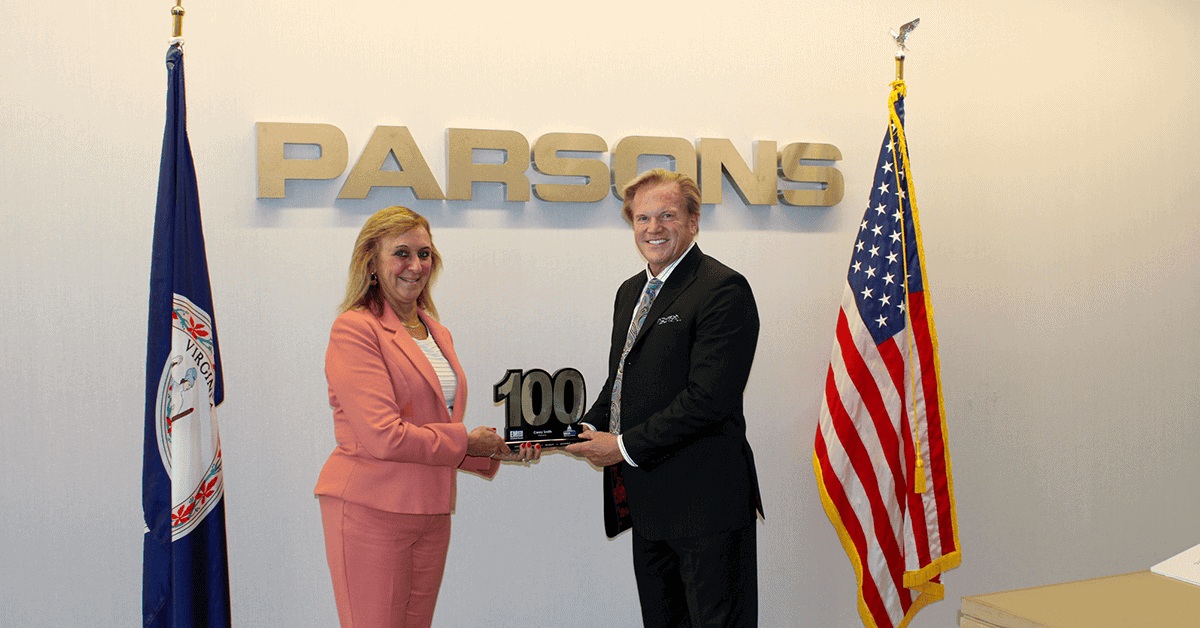
Industry recognition followed her work at Parsons. She received the Government Contractor Awards’ Executive of the Year honor in the category for businesses above $300 million in 2023. A year later, the company received its own Company of the Year recognition. The awards marked a period of expansion; they did not remove the operating work that came next.
“Get to yes” still requires a working team
When Smith described her first-year priorities as CEO, employee engagement came first. Another priority had a much shorter name: “get to yes.” She wanted the functions supporting the businesses to help them execute and win work through more agile processes. The phrase has the advantage of fitting on a meeting agenda without needing a glossary.
“Your voice matters”
Carey Smith, first-day CEO letter · July 2021
Her account of workplace inclusion was similarly practical. Parsons used volunteers as local ambassadors, with company-wide objectives and room to organize activities that suited individual locations. She favored people who wanted the responsibility. An office in Virginia and an office in California could work toward shared goals without receiving identical instructions for every event.
The connection to her own training is straightforward. A company needs people willing to develop expertise and routes through which that expertise reaches decisions. Smith’s working master’s degree is one example from her career. Mentoring and opportunities to learn management are ways to offer employees a next step within a company.
In 2024, Smith and the executive leadership team introduced a Leadership Vision with three principles and ten supporting behaviors. Parsons also launched a learning series covering subjects such as goal setting, communication, and leading virtual teams. These are ordinary managerial tasks. A global engineering company has to do them repeatedly, across offices and projects, while the more glamorous technology attracts attention.
The quarter that tests the drawing
The record includes a difficult recent quarter. For the second quarter of 2026, Parsons reported roughly $1.6 billion in revenue and a $15 million net loss attributable to the company. Charges associated with portfolio actions and a joint venture weighed on results. Management reduced its full-year revenue outlook to $6.2 billion-$6.5 billion.
Contract awards increased 24% from a year earlier, and total backlog reached $9.3 billion. Those measures describe demand and future work; the loss describes the quarter that had just ended. Both belong in an account of Smith’s tenure. A portfolio can attract customers while particular projects still create expensive problems.
Year over year
to Parsons
At quarter end
Backlog represents future work. It is not revenue already earned.
September brought a project that illustrated the overlap Smith had been describing. Parsons announced an initial $85 million agreement to act as Owner’s Advisor on the new U.S. Space Command headquarters at Redstone Arsenal in Alabama. The planned campus combines a command-and-control mission with the planning and construction disciplines needed to house it.
The role includes helping the government manage scope, cost, schedule, quality, and risk through development. It is a specific assignment with a long performance period, rather than a completed headquarters. For Smith’s strategy, it supplies a clear example of defense requirements and infrastructure delivery appearing in the same brief.
Her ambition remains to develop the company’s capabilities across those connected markets. The hard part is making the connections useful: between acquired teams, between a technical idea and a customer’s need, between a contract award and work delivered. The digital cockpit gave her an early version of that problem. Someone had to sit beside the users and explain how the thing worked. Decades later, there is rather more company around her, and the questions still have to survive contact with the people doing the job.