Forty-five days is a useful unit of measurement for Horacio Rozanski. In December 2024, announcing a partnership with Palantir, he said their joint team had produced a prototype in that time. For an executive whose professional life has unfolded inside the same institution since 1991, the small number carried a large argument. A company can have a long memory and still work to a short deadline.
The partnership concerned defense systems: sharing information securely and helping allies plan and operate together. Rozanski and Palantir chief executive Alex Karp were putting their companies behind a practical question. How quickly could their combined expertise become something people could use? A prototype offered one answer. It also supplied a more demanding clock for the work that would follow.
Rozanski became Booz Allen Hamilton’s chief executive in 2015 and its chairman in 2024. His route ran through consulting, personnel, strategy and operations. The familiar intern-to-chief-executive progression is there, neatly arranged for a corporate biography. What makes it interesting is the variety of jobs inside that apparent continuity. He kept the employer. He repeatedly changed the work.
A university chosen from a library directory
Long before he was considering the pace of defense procurement, Rozanski was studying a directory of American universities in a library. Raised in Buenos Aires, he wanted an education in a country where, he believed, effort and opportunity would have a fairer relationship. He filtered schools by academic ratings and tuition symbols. The search produced a list of 25 possibilities. A life-changing decision began with some rather sensible comparison shopping.
He came to the United States in 1988 and enrolled at the University of Wisconsin-Eau Claire. Cinthia, his future wife, followed a year later. They were the university’s first students from Argentina. A welcoming community became part of the education: people who opened their homes, explained unfamiliar customs and helped make an unfamiliar country feel inhabitable. The couple later married in Spanish professor Roma Hoff’s backyard.
Wisconsin was followed by Chicago. He graduated with his business administration degree in 1990, then earned his MBA in 1992. Between those degrees came the summer internship in Booz Allen’s Buenos Aires office. After graduate school, he joined the Cleveland office full time. His early work served commercial clients; the national security focus that now defines his public role came later.
That sequence gives his story a pleasing geographical loop. He left Argentina to study, returned there for an internship and built his career in the United States. The important institution at each stage supplied something different: an introduction to a country, a business education, then a place to apply it. The first job became a succession of opportunities rather than a brief stop on the way elsewhere.
The personnel detour
His professional education continued in a job some people advised him to avoid. When he was offered a human resources role, mentors and friends warned that accepting it could end his career. He took it because he did not know how to do it. Later, as chief executive, he would describe the experience as knowledge he used particularly often. The supposedly unfortunate detour had become preparation.
The appointments broadened his responsibilities. He became chief strategy and talent officer in 2010, chief operating officer in 2011 and president in 2014, before taking over as CEO on January 1, 2015. Strategy and talent even occupied the same title for a time. For someone eventually charged with changing what a large company does, familiarity with how its people work was a useful apprenticeship.
He also participated in the commercial business separation in 2008 and the 2010 initial public offering. These were changes in the institution itself, alongside the changes in his own job. His tenure crosses different versions of Booz Allen: a consulting career begun with private-sector clients, followed by leadership of a public company increasingly organized around advanced technology and government missions.
At Marriott, another board saw value in that combination. He joined its directors in March 2021, with initial committee assignments covering human resources and compensation, and technology and information security. The pairing is almost a pocket-sized description of his career. People and systems have a habit of arriving together, even when an organization puts them on different meeting agendas.
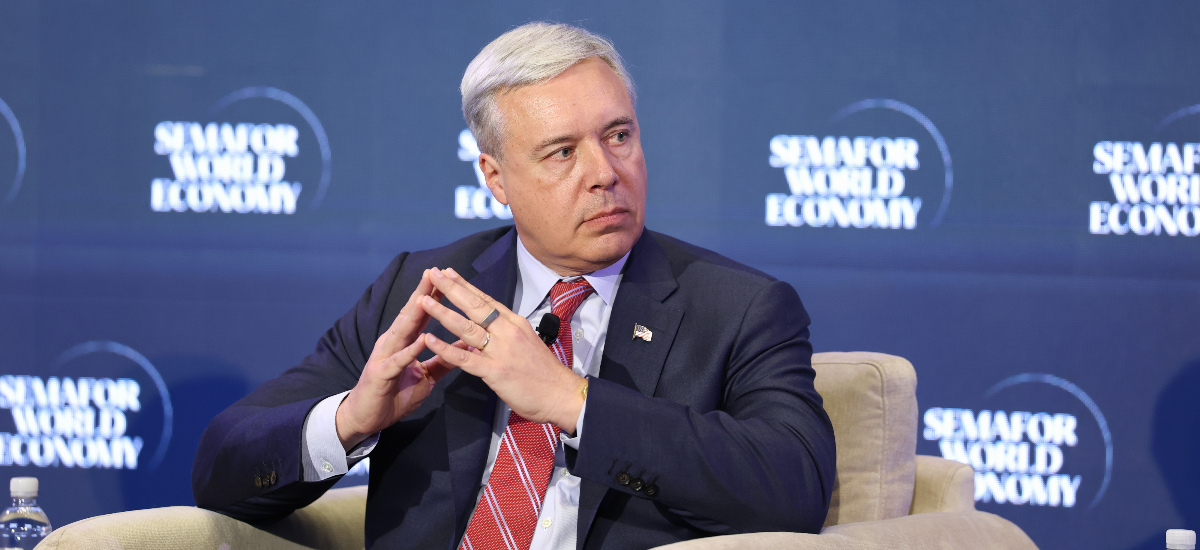
“I’m obsessed with speed.”
Horacio Rozanski · December 2024
When cybersecurity follows you home
For a leader discussing national threats, Rozanski has offered a refreshingly ordinary example of exposure: someone filed a bogus federal tax return in his name. He recounted it during a 2021 webcast. The fraudulent document’s resemblance to the genuine one illustrated how capable attackers had become. Even a chief executive whose company works in cybersecurity could find the subject waiting among his own paperwork.
In that conversation, he described Booz Allen’s work as combining knowledge of a client’s mission, technological understanding and consulting experience. The combination matters because a powerful tool still has to fit the circumstances in which it will operate. His tax-return anecdote made the distance between an abstract security discussion and an individual inconvenience rather short. Cybersecurity can be a national priority and an unwelcome administrative errand on the same day.
His public language has grown more urgent as he considers the speed of technological change. “I’m obsessed with speed,” he said in a 2024 interview. There is a lighter side to the same conversation: he described falling asleep on airplanes almost automatically and an enthusiasm for Apple devices that extended to a Vision Pro. The executive contemplating autonomous conflict also has opinions, and possessions, familiar to the electronics enthusiast.
From a clever tool to a working mission
In his writing about American innovation, Rozanski asks government to become an earlier participant in developing technology. His proposal gives agencies a role in trying products, refining requirements and offering feedback while companies are still learning what works. Industry would share investment and development, with government helping useful ideas move into practice. It is a different relationship from waiting for a finished product to appear at the end of a purchasing process.
He uses quantum computing to explain the stakes, and early consumer technology to explain the mechanism. Customers who try an imperfect product help determine what it becomes. Applied to government, that approach requires procurement and accountability to accommodate iteration. His argument is that the organization buying the technology has work to do in changing its own habits, alongside the company building it.
Booz Allen’s August 2026 acquisition of Ultra I&C’s Mission Solutions business put money behind its product ambitions. The $720 million purchase added defense software, encryption and computing products designed for use closer to operations. It joined a strategy in which the company combines its own capabilities with commercial technology, then tackles the difficulty of making them work together for particular missions.
These are concrete commitments, with concrete integration work attached. A purchase price records the cost of acquiring a business. Its usefulness will depend on what the combined organization can deliver. The forty-five-day prototype and the acquisition occupy different ends of that task: one demonstrates how quickly a team can produce an initial result; the other adds products and people intended to make delivery repeatable.
The clock has shareholders, too
Transformation has also brought difficult arithmetic. For fiscal 2026, Booz Allen reported $11.2 billion in revenue and 31,210 employees. Its customer revenue mix was 54 percent defense, 17 percent intelligence and 29 percent civil. Those numbers describe an organization with a substantial national security business and continuing exposure to decisions made elsewhere in government. They also explain why his views on procurement are central to his job.
By July 2026, the company had gone through layoffs and restructuring, concentrated largely in its civil business. First-quarter revenue was down from the previous year. Government scrutiny of consulting contracts made the change in Booz Allen’s business model a pressing commercial matter. Rozanski was being asked to explain where the company belonged as agencies dealt more directly with software vendors.
His answer emphasized the complexity of putting technology to work in demanding environments. Buying a commercial platform leaves further tasks: connecting it, securing it and making it useful for a particular operation. That is the role he argues Booz Allen can continue to earn. It is an argument about execution, one that has to survive contact with customers’ budgets and the company’s own results.
A place for the next arrival
Away from those questions, the Wisconsin connection has remained practical. Horacio and Cinthia established a scholarship for Hispanic students who would be the first in their families to attend college. Their gift returns to the place where they themselves learned how an American community could welcome newcomers. It extends a specific experience to people beginning an education of their own.
In 2023, his alma mater gave him its Lifetime Excellence Award. Addressing graduates, he described becoming comfortable with himself as unfinished work, even after decades of professional progress. “Being yourself is a process,” he said. There is something disarming about a chief executive acknowledging that the person holding the title is still under construction. It gives the younger people in the room rather more room to breathe.
His latest public writing keeps returning to adoption. In October 2026, he framed American AI competitiveness around innovation, cost and trust. For Rozanski, getting technology used has become an essential part of the contest. The concern connects his product strategy with his public policy arguments: the invention needs a route into somebody’s working day.
The career behind that view has involved a long stay at one company, a succession of unfamiliar assignments and a willingness to learn from each. The young student comparing tuition symbols could hardly have planned every stop. He did, however, choose a place to begin. Thirty-five years after his first Booz Allen summer, Rozanski is still asking what the next assignment requires, and how soon something useful can be ready.