Somewhere in Grant Verstandig’s collection is a passport for a person who never existed. It belonged to Victor Laszlo, the resistance leader in Casablanca. There are stamps for Lisbon and New York. There is, of course, no actual passenger. Even in the intelligence business, Hollywood reserves the right to improve the paperwork.
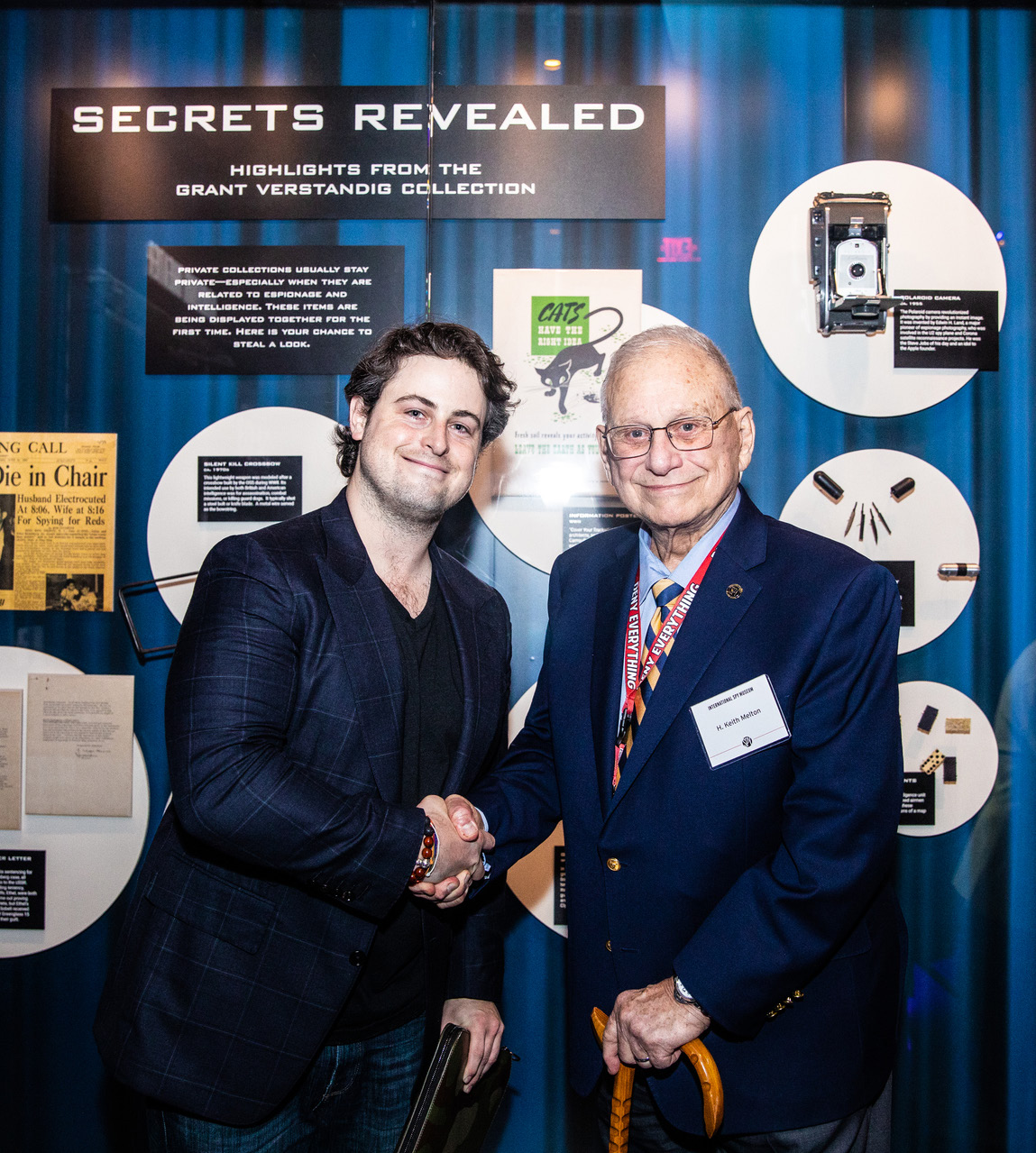
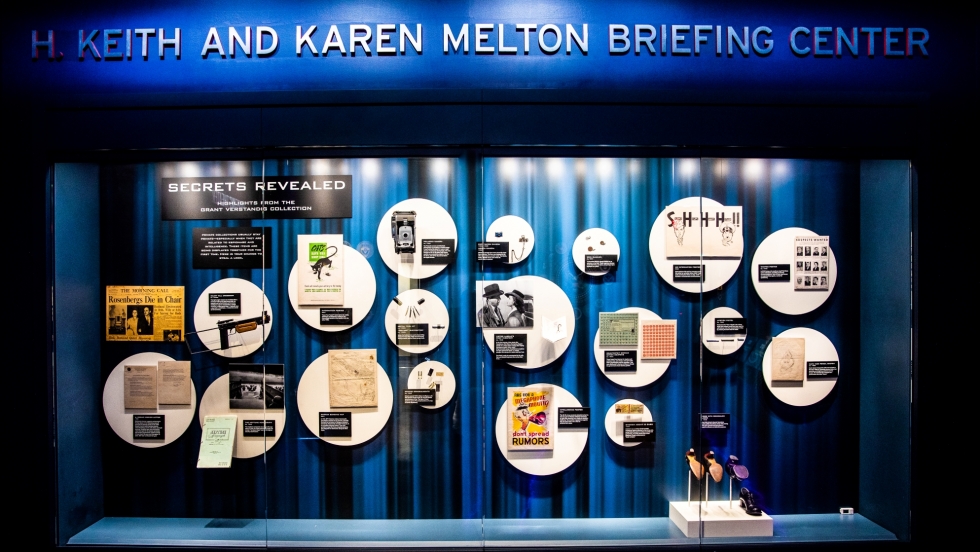
The passport was among the objects selected when the International Spy Museum put parts of Verstandig’s private collection on display in 2023. Other items had more practical assignments: a coin concealing a blade, dominos hiding pieces of a map, cameras small enough to pass as something else. Each involved a particular problem and somebody ingenious enough to make a useful object fit an inconvenient space.
Verstandig, founder and CEO of Red Cell Partners, spends his working life around problems of another scale. His companies deal with drone defense, military logistics, cybersecurity, and the installation of AI inside organizations with complicated rules. The collection offers an engaging entrance to that career. Before the financing announcements and executive titles, there is a question anyone can understand: what does this thing let someone do?
A passport with no real passenger
The curators’ research involved an unusually literal trip behind closed doors. Alexis Albion and Andrew Hammond visited Verstandig’s home to inspect the collection in his vault. They had inventories and photographs to guide their choices, but seeing the objects was another matter. Albion recalled gasping at the Casablanca passport. A familiar film had suddenly acquired weight, paper, and pages.
The selection moved between entertainment and operational history. A costume sketch by Mata Hari shared the larger collection with documents and concealed devices. The dominos were devised by Britain’s wartime MI9 for escape purposes; lifting their tops revealed sections of a map of Burma, now Myanmar. An ordinary game could carry directions out.
The 2023 exhibition ran for ten months. For a collector, allowing strangers to study the objects is a consequential choice. These things had been designed to evade attention. In a museum case, their ingenuity depended on getting it.
The family business of asking questions
Verstandig grew up in Washington, where government work was part of family life. Both parents served in federal government. In his own writing, he describes the respect they held for that service and the impression it left on him. Washington was where the family lived and where consequential institutions did their daily work.
Another example came from his grandmother, Ruth O’Block Grant. She and her husband co-founded an industrial business, Louis A. Grant Inc., which she helped lead for decades. She was also a Seton Hill graduate and trustee. Her grandson’s description of her emphasizes the habits that make a business less romantic and more likely to function: pragmatism, questions, attention to detail.
In describing his grandmother, he remembered her as “always asking the tough questions.” That is a useful inheritance for someone surrounded by people selling the future. An exciting idea still needs to survive a conversation about how it works.
In 2018, Verstandig and his family made a seven-figure commitment to establish the Ruth O’Block Grant Endowed Scholarship Program. Mentoring is part of its design. Students gain access to experienced people as well as educational support. The family’s tribute preserves a relationship that had mattered to him: a younger person bringing possibilities to someone willing to question them.
Office hours after midnight
That exchange runs through his professional relationships, too. Yisroel Brumer arrived at Red Cell after a long government career that included leading the Pentagon’s Cost Assessment and Program Evaluation office. He understood major investment programs. Starting a business required learning a different set of skills.
Brumer has described Verstandig spending substantial time teaching him the startup world, with conversations often occurring between midnight and six in the morning. Mentorship, apparently, did not always respect the calendar’s view of a sensible appointment.
“midnight and 6 a.m.”
The hours Yisroel Brumer recalled in his account of Verstandig’s startup mentoring.
The detail makes their relationship easier to picture than a board list does. One person brought deep knowledge of government problems; another helped him learn how to turn expertise into a company. Brumer would co-found DEFCON AI with Verstandig and retired General Paul Selva. The skills were complementary, and the education took time.
It also helps explain the practical appeal of a venture studio. A founder can know a customer’s problem intimately and still need help with recruiting, finance, legal work, and the mechanics of selling a product. Expertise arrives unevenly. The company has to work anyway.
Build the company around the problem
Verstandig founded Red Cell in 2020. The name draws on the CIA’s post-September 11 Red Cell concept: gather people with different kinds of expertise, challenge familiar assumptions, and examine a problem from another direction. He explains that connection in an essay about entrepreneurship and America’s founding.
The studio helps form businesses, develop initial products, find customer traction, and prepare for outside capital. Its platform supplies functions a young company would otherwise have to assemble while doing everything else. That arrangement gives Verstandig several jobs at once: creating companies, helping operate them, and bringing investors into the process.
Red Cell’s August 2026 figures give the arrangement some dimensions: 15 companies created, 12 publicly launched, and an average of 16 months from incubation funding to a first external financing round. It reported 74 full-time studio employees. Those distinctions matter. A company can exist before it is ready to announce itself, and a financing round marks one stage in its development.
- 01Frame the
problem - 02Build team
and product - 03Establish
traction - 04Bring in
outside capital
Red Cell’s reported figures, August 2026. Incubation measures the period from investment-committee funding to first external capital.
The people around him span operating experience and public service. Roger Ferguson, a former Federal Reserve vice chairman, is Red Cell’s chief investment officer. David Silverman serves as president. In July 2026, former Virginia governor and Carlyle co-CEO Glenn Youngkin joined as chairman. Verstandig remains founder and CEO, continuing the company-building role at the center of the operation.
The quiet work of keeping things moving
Some of the work sounds less cinematic than the objects in his collection. DEFCON AI, founded in 2022, tackles complex operations and disrupted networks. Its modeling, simulation, and optimization tools help decision-makers consider what happens when people, supplies, and infrastructure cannot move as expected. Logistics has a limited claim on glamour. Unfortunately for glamour, the operation still needs its supplies.
By September 29, 2026, the company reported more than $150 million in contracted revenue backlog across four large customers. It appointed Margo de Naray, previously CEO of space-technology company Solestial, as its new chief executive. Brumer remained a co-founder; Verstandig remained co-founder and executive chairman. A business that begins with three collaborators eventually needs leaders for a different stage.
Andesite, another company he co-founded, approaches security through the analyst’s work. Its software connects information scattered across tools and data systems, helping teams investigate and respond. The product is built around people making decisions with better context. Seen alongside DEFCON AI, it gives the studio’s broad talk of security a concrete form: help someone understand a complicated situation soon enough to act.
A different bargain with Washington
The next problem concerns how such work gets purchased. In September 2026, Red Cell announced an agreement with the Pentagon’s Chief Digital and Artificial Intelligence Office to pilot shared savings. The agreement carries a ceiling of up to $100 million in its first year.
Vendors would cover upfront costs and receive a percentage of the savings they generate. Red Cell would act as the prime contractor, handling contracting and project management, with portfolio companies providing technology and engineers. In Verstandig’s account, Trase and Andesite are examples of companies that could contribute.
In his argument for the pilot, he describes his underlying conviction as “you can do well by doing good.” Here, that belief becomes a payment mechanism. The commercial reward depends on producing a measurable result for the customer.
$100M is the first-year agreement ceiling. It is not a statement of revenue earned or savings already delivered.
The pilot makes delivery and measurement central to the business proposition. A percentage requires a baseline, an agreed calculation, and savings both sides accept. Those details will determine how the proposal works in practice. The announcement opens a test; the results will have to follow.
What leaves the vault
At Seton Hill’s May 2023 commencement, Verstandig received an honorary Doctor of Humane Letters and spoke about beginning, persevering, and accepting help. He also spoke about his grandmother. The college dropout had returned to a university whose place in his family’s history preceded his own career.
There is a pleasing circularity to that scene. He had received questions and encouragement, then helped create a program that supplies them to students. He had collected objects privately, then allowed visitors to inspect them. He had helped founders learn the work, then built an organization around supplying more of what a young business needs.
Return to the dominos. The ingenuity was hidden under an ordinary surface, waiting for someone who needed directions. In a display case, they invite admiration. In use, their value depended on helping a person get somewhere. That is a fair question to carry from Verstandig’s collection into his companies: where, exactly, does the tool help its user go?