THE LONG READ / A FOUNDER IN SEVEN SCENES
Einaras von Gravrock had passed the selection process for the American version of Shark Tank. He was standing on the carpet, facing five chairs and the prospect of a television audience for his device. Then the day ended. In his telling, the production stopped at eight in the evening, before he had begun speaking. The imagined commercial breakthrough had collided with something more dependable than entrepreneurial enthusiasm: a finishing time.
Years later, he became an investor on Rykliai. Lietuva, Lithuania’s version of the format. There is a pleasing symmetry in that return. The would-be pitcher now gets to listen. For someone whose business involves preventing events before they happen, his television anecdote is an unusually harmless example of an outcome stopped in advance.
The career between those two appearances is the real subject. CUJO AI, which he co-founded and led as founding CEO, made network security a service delivered through internet providers. Zenedge reached Oracle. CAST AI moved into cloud automation. Today he leads CUBE AI, pursuing financial-crime prevention. The companies change; an editorial reading of the sequence suggests a recurring interest in the places where a useful intervention can happen before a costly consequence.
A bridge built while studying
Born in Kaunas, he left Lithuania for school in Germany at eleven, returned, and later completed secondary schooling in Sweden. America followed. He has described taking an ecommerce job while studying and becoming a marketing chief in his third year. He and his brother wanted to hire in Lithuania while building businesses in the United States. Leaving home, in this account, also became a way of maintaining a working connection to it.
He studied at the University of Southern California’s Marshall School of Business from 2005 to 2009, graduating with honors. His early commercial career included Modnique, where he served as CEO from 2009 to 2014. A fashion retailer may seem an unexpected first chapter for a security founder. Yet selling across borders brings practical lessons about customers, distribution and the considerable distance between a product existing and a product being bought.
In 2013, Modnique acquired assets from Totsy, a private-sale shopping site for parents and children. Von Gravrock framed the transaction around international distribution for brands and broader access for customers. The vocabulary was retail, but the commercial question was already about access: who can reach whom, and through which channel? A founder can change industries without leaving every earlier lesson at the door.
His later cybersecurity origin was equally practical. He has said that hacks had cost him time, energy and money early in his career. An internal security product built to protect his own company became something the team sold to other companies. That account gives the technical ventures a recognizably commercial beginning. Before there was a security market to pursue, there was an unwelcome problem to remove.
“I’m a builder, and I’m drawn to industries at an inflection point.”
Einaras von Gravrock · 2023
The front door was the router
CUJO AI was founded in 2015. The household was filling with connected equipment, and each new connection enlarged the security problem. In a 2018 explanation of the business, von Gravrock pointed to cameras, tablets and televisions alongside computers. The common element was their route onto the internet. The gateway supplied by a network service provider offered one place to apply protection across that collection.
“There is one common touchpoint for all devices at risk,” he said. That observation makes the business intelligible without a tour of its algorithms. A household should not need to become a small IT department simply because its television acquired a network connection. Placing security at the shared entrance makes the customer’s circumstances part of the design.
CUJO AI worked with Technicolor’s HERO program to integrate its software into customer-premises equipment supplied to network operators. Von Gravrock described the partnership as a way to reach millions of consumers faster. Distribution was therefore part of the product’s effectiveness. A defense can be technically sound and still arrive at too few doors; working through an established provider changes that arithmetic.
By March 2019, CUJO AI was reported to serve more than 16 million users and protect 325 million devices worldwide. Those are figures from that period, rather than a live counter. His current World Economic Forum biography describes the business as subsequently acquired by Comcast and Charter. The significant personal achievement was helping take a household security idea into the infrastructure used to deliver connectivity.
ONE SHARED ENTRANCE
Conceptual illustration of the approach he described in 2018.
A place at the table, and a question about trust
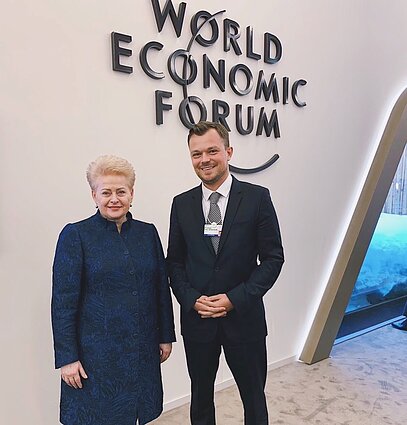
CUJO AI’s recognition as a World Economic Forum Technology Pioneer in 2018 brought von Gravrock to Davos the following year. He recalled participating in a group discussion with Angela Merkel, Tim Cook, Sheryl Sandberg and Ginni Rometty. He was precise about the encounter: a shared discussion, rather than a private meeting with Merkel. The distinction is small, but keeps a photograph from doing more work than the event warrants.
His account of that discussion centered on trust in artificial intelligence, privacy and the protection of personal data. He also met Lithuania’s then-president, Dalia Grybauskaitė, to discuss cybersecurity and the development of technology talent. He wanted Lithuania to give AI expertise enough attention to have a chance of creating its own Nokia. The aspiration linked the country’s education choices to its ability to build a recognizable technology business.
A gathering with political and technology leaders can furnish a handsome career photograph. Here, the more useful thread is the subject under discussion. Faster adoption creates obligations for the people building the systems. For a founder selling protection, trust is both a public question and a commercial one. A customer persuaded to connect another device also needs a reason to believe the connection will be safe.
The same colleagues, a different bill
Another of his ventures, Zenedge, addressed the enterprise side of internet security. Oracle announced an agreement to acquire it in February 2018. At the time, Zenedge’s web application firewall and denial-of-service mitigation products defended more than 800,000 web properties and networks. They protected applications, databases, networks and APIs across cloud, on-premises and hybrid environments. The scale was different from the household, but the intervention again concerned malicious traffic reaching something valuable.
CAST AI was incorporated in 2019. An early securities filing lists von Gravrock as a director alongside Yuri Frayman and Leonid Kuperman. Public profiles identify him as a co-founder. This part of the story has a team, not just a protagonist: Frayman and Kuperman recur in his professional network. Repeated collaboration is a more concrete connection than the generic founder mythology of doing everything alone.
At CAST AI the problem became cloud operations, including wasted capacity and the work involved in managing it. In April 2025, the company announced a $108 million Series C funding round led by G2 Venture Partners and SoftBank Vision Fund 2. It said more than 2,100 organizations used its platform. Its proposed answer was automation that acts on performance information to adjust cost, security and speed.
CAST AI subsequently reported achieving unicorn status in January 2026. That milestone belongs to the company and its founding team. For this profile, it also widens the picture of von Gravrock’s career: his interest in AI has extended beyond defending networks into making infrastructure operate more efficiently. An alert asks someone to do work; automation attempts to perform the work itself. That difference matters in both fields.
Series C financing
Organizational customers
When the buyer changed, the story had to change
CUBE3.AI emerged from stealth in August 2023 with $8.2 million in seed funding. Von Gravrock described its purpose as closing a gap in smart-contract security. Audits examined code, while monitoring and alerts helped identify trouble. The company wanted protection during the transaction itself. “I’m a builder, and I’m drawn to industries at an inflection point,” he said. The opportunity was exciting; the missing protection made it commercially interesting.
In an Enterprise Ethereum Alliance interview, he described a system assigning risk scores to transactions and blocking threats without pausing smart contracts. He wanted security to support business adoption of blockchain technology. The point was continuity as well as protection. Stopping an entire application can interrupt legitimate activity along with the attack, so the proposed product needed to distinguish between them.
By September 2026, he was explaining a change in buyers. Crypto security had offered working technology but a market he considered too small and fragmented. Banks had daily losses from scams and regulatory pressure. His lesson was to change direction on evidence, and to admit clearly when the original thesis had been wrong. The account gives the pivot an ordinary difficulty: founders must tell colleagues and investors that the story they previously defended needs replacing.
CUBE AI now describes an agentic crime-prevention platform serving banks, fintechs and other institutions. Its public pitch emphasizes intelligence about criminal activity and mule accounts before funds move. These are the company’s stated aims and capabilities. The appeal of the approach is easy to understand: a warning that reaches the payment process in time can matter more than a detailed explanation delivered after the transfer.
THE CUSTOMER CHANGED
Protection during blockchain transactions
Intelligence for banks and payment providers
The bridge is still in use
Von Gravrock’s present-day explanation of Lithuania’s role is succinct: “The US gives us customers and capital. Lithuania gives us the product.” He argues for engineering teams that stay together, so their experience accumulates. The small country in the opening chapters remains part of the operating model. His geography has changed repeatedly; his stated preference for linking Lithuanian product building with American commercial opportunity has endured.
His public writing also traces the interests between ventures. Forbes Council contributions have covered connected-device security, hybrid work, telecom data and blockchain fraud. A 2023 conversation with Jay Steinback ranged across AI, regulation and web3. More recently, a Sorainen discussion returned to global business building, market choice and the importance of spending time in a country before trying to understand its customers.
These activities give him several settings in which to explain a product: an interview, a boardroom, a public discussion, a television show. The settings reward different kinds of fluency. A technical explanation must survive questions about what actually happens. A commercial one must survive questions about who will pay. His own account of CUBE’s pivot is useful precisely because it separates having functioning technology from having a sufficiently urgent buyer.
The unfinished Shark Tank pitch is a good place to leave him. It punctures the temptation to turn a founder’s career into a succession of perfectly timed entrances. His companies have involved partners, distribution agreements, new markets and revised assumptions. Sometimes the work advances through a gateway manufacturer. Sometimes it requires changing the customer. And sometimes five chairs are waiting, the carpet is ready, and the clock has the final word.