Beenu Arora had encountered a particularly awkward kind of cyber incident: the trouble began somewhere else. A supplier’s weakness could become a customer’s problem. The organisation dealing with the consequences might have paid attention to its own systems, only to discover that its security depended on decisions made beyond its walls. Arora had managed such incidents before he founded Cyble. He wanted a better view of what was coming.
There is an unglamorous word at the centre of that ambition: sooner. An alert arriving after an incident can help explain the damage. An alert arriving before it may give someone a chance to change the outcome. The distance between those two moments is where Arora chose to build a business.
The warning that arrived late
His background was technical. Before Cyble, Arora worked across consulting, telecommunications and high-tech organisations, helping develop their cybersecurity capabilities. His experience included security engineering, cyber defence, threat management and intelligence. By 2020, he described nearly 15 years in the industry. He had spent enough time handling problems to have opinions about the tools intended to prevent them.
One frustration concerned the view of third parties. Existing approaches could miss information from the deep and dark web; risk scores could give customers a conclusion without enough visibility into the reasoning. Arora’s founding explanation was rooted in that professional experience. The gap had appeared in work he had actually done.
A supplier relationship makes this problem especially awkward. The commercial relationship may look perfectly orderly. The information needed to assess its security can be scattered elsewhere. A company can buy a service much more easily than it can acquire a complete understanding of the risks accompanying it. Arora wanted to narrow that difference.
“There is an opportunity to ensure organisations are better aware of these threats in advance.”
Beenu Arora, 2021
Two caps, one company
Arora enrolled in the joint executive MBA programme at Columbia Business School and London Business School. He knew cybersecurity; finance, pricing and marketing were areas he wanted to understand better. The programme placed him among people with different experience. An idea could be examined from more than one professional angle.
That setting brought him together with Manish Chachada, who had a finance background. They shared an interest in helping organisations understand cyber risk. Arora launched Cyble in April 2019, while his EMBA-Global graduating class was 2020. The business and the education overlapped.
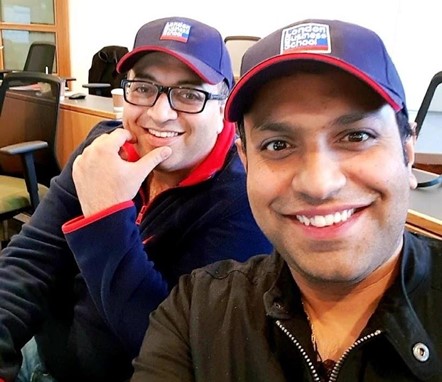
His account of that period includes classmates who became advisors and investors. He had worried about being regarded principally as the “tech guy”. Asking for guidance helped him develop the business around his technical skills. Confidence here came through other people’s experience, rather than a sudden discovery that he could do everything himself.
By 2021, the founders were working from opposite sides of the world. Chachada described check-ins during each person’s morning, backed by calls and team conversations. International business has a handsome vocabulary. Its daily maintenance can still involve finding a mutually tolerable hour.
A company learns to keep watch
Cyble entered Y Combinator’s Winter 2021 batch. In an interview that March, Arora described a company supported by enterprise customers and early investors, expanding its team as the customer base grew. He wanted clients to receive close attention even as the business became larger. That is an easy promise to print and a demanding one to organise.
The company’s task was to identify relevant activity and get intelligence to customers who could use it. Arora described a combination of artificial intelligence and human intelligence. The human part matters to the story: a monitoring company needs to understand what it is seeing, not simply collect more material.
In their joint account of Cyble’s development, Arora and Chachada returned to the difficulty of seeing threats clearly enough to act. Their remit widened to include attack surface management, third-party risk and brand monitoring. Cyble Hawk added a dedicated platform for government and law-enforcement users. The customers differed, but timely information remained the common requirement.
For Arora, this creates a recurring managerial test. A company can expand its products and still need to answer a small question for each customer: what should this person pay attention to now? The breadth of the platform has value only when the answer becomes easier to find.
The intelligence has to travel
Arora’s writing offers a useful view of how he thinks about that work. In 2021, he set out six stages for a threat intelligence programme, beginning with planning and ending with evaluation. The sequence gives collection a place within a larger process. Someone first has to decide what the organisation needs to know.
- PlanDecide what needs watching.
- CollectGather relevant signals.
- ProcessPrepare information for use.
- AnalyseWork out what it means.
- DisseminateGet it to the right people.
- EvaluateLearn from the response.
Dissemination is a particularly revealing stage. Security information has to leave the people who collected it and reach the people who can make decisions. A beautifully assembled finding that never changes anyone’s actions has travelled only part of the way. Evaluation then asks whether the process worked and what should change.
This is the less theatrical side of a business associated with the dark web. There are objectives to set, information to prepare, recipients to consider and results to review. Arora’s framework reads like an operating discipline. The dramatic material still needs a dependable delivery service.
An optimist with work to do
In July 2023, Arora opened an essay by declaring, “I’m an artificial intelligence (AI) optimist!” His case for the technology concentrated on security work: processing large amounts of information, recognising patterns and helping analysts devote more attention to difficult investigations.
He anticipated changes in the everyday duties of security operations teams. Routine triage could be automated; people could spend more time directing systems, investigating complicated threats and coordinating responses. He also acknowledged ethical, privacy and accuracy concerns. The attractive prospect was additional capacity for analysts, with questions about how that capacity should be used.
The same year brought resources to pursue those ambitions. Cyble completed an expanded Series B in November 2023, taking the round to $30.2 million after an initial $24 million tranche. The announced priorities included research and development, the threat intelligence portfolio and international expansion.
Company financing for research and expansion.
The number supplies a milestone in Arora’s career, but the intended use is more instructive. Research, engineering and expansion require choices about where a company’s attention should go. Investment gives a founder room to make those choices; customers eventually decide how useful the results are.
By February 2026, Arora was discussing AI deployment at India AI Impact Summit. His contribution emphasised red teaming and early security validation. That position fits an engineer’s interest in what happens when an appealing idea encounters actual use. Enthusiasm for adoption leaves plenty of room for testing.
Give the CISO a fighting chance
Arora’s 2024 writing about chief information security officers shifts attention from systems to the people responsible for them. He argues for adequate budgets, skilled staff and stronger relationships with other departments. The security leader needs cooperation from the rest of the organisation to carry out the job.
That includes colleagues in technology, legal, human resources and public relations, alongside corporate leadership. Cybersecurity decisions have consequences that cross departmental boundaries. The organisation needs ways to work across those boundaries before an incident makes the introductions urgent.
There is a practical connection to his original early-warning ambition. Extra time helps when someone has the authority and resources to use it. Intelligence can identify a problem; fixing it may require a team, a budget or a decision elsewhere in the company. An earlier alert cannot perform all of that work by itself.
His position also gives business leaders a question to ask before the next alert arrives. Have they created a route from a finding to a decision? Can the people responsible get the right colleagues involved? Those questions belong in ordinary management conversations. Waiting for a crisis to answer them would spend some of the time that early warning was meant to save.
This part of Arora’s public argument makes the profile more interesting than a product catalogue. He sells technology, yet his writing also asks companies to organise themselves around the responsibility they give their security teams. Tools become part of a working relationship between people.
A longer table in the UAE
In September 2026, Arora discussed Cyble’s partnership with the UAE Cyber Security Council. The collaboration centres on sharing proactive threat intelligence to help protect organisations, people and critical infrastructure. At GISEC Global, he also spoke about agentic platforms and remediation across endpoint and cloud environments.
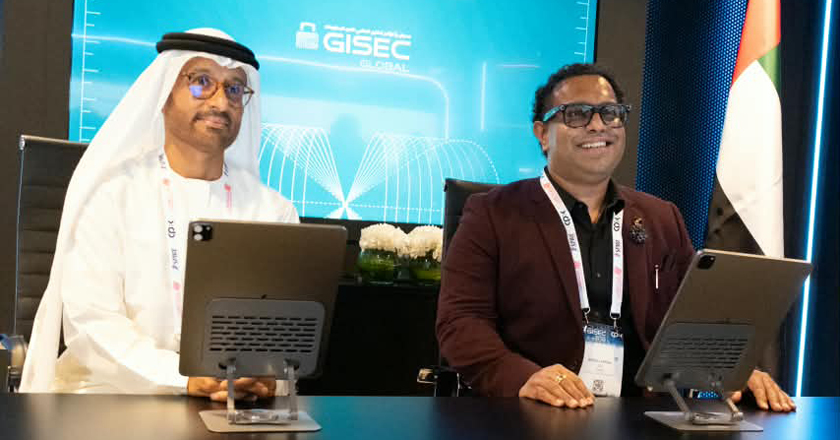
His message to the industry was cooperation: providers and other participants should exchange intelligence and ideas as attackers’ capabilities develop. The concern is recognisable from the beginning of his career story. Useful information should reach defenders while they still have options.
The scale has changed. A problem encountered through corporate security work became a business-school conversation, then a company with international customers and government partnerships. Arora’s responsibilities expanded with it. He now has to build the organisation that delivers on the idea, as well as explain why the idea matters.
The early photograph remains a good place to leave him: smiling beside his co-founder, both wearing their business-school caps. It catches a moment before the funding rounds and wider partnerships. What followed would demand engineering, judgement and a great many conversations. The purpose underneath all that activity remains modest enough to say plainly. Let the people defending the systems know a little sooner.