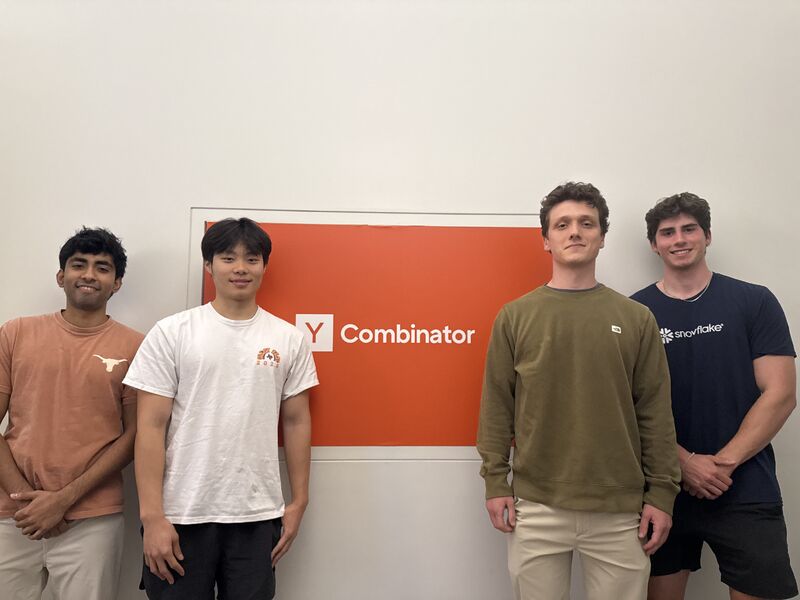
Drew Taylor announced two endings and a beginning in one breath. He had graduated. He and three friends had been accepted into Y Combinator. He promised to share more soon. The photograph beside the post supplied the rest of the grammar: four young founders standing in front of the accelerator's red sign, pleased but composed, as if the next deadline had already entered the room.
The friends were Matthew Fan, Shreyas Chennamaraja and Henry Quillin. Their company became Revere, a San Francisco startup led by Taylor as co-founder and CEO. Its chosen subject is price-to-win analysis for government contractors, a discipline devoted to a question whose short phrasing conceals a small republic of complications: at what price can this bid actually win?
A useful answer cannot come from arithmetic alone. It has to account for the customer's habits, the evaluation model, likely bidders, staffing realities, adjacent awards and the peculiar signals competitors shed while preparing. It must keep one eye on cost and another on behavior. This is forecasting with a filing cabinet, a calculator and a room full of people who have learned to distrust easy certainty.
The number that refuses to sit still
Revere calls its product an AI price-to-win analyst. The word “analyst” matters. Its public presentation does not promise a celestial number descending from a cloud. It shows evidence arriving, assumptions moving and consequences propagating through a pursuit. One customer pattern says that three of four adjacent awards favored the stronger technical offer even at a higher price. Pricing latitude grows. A labor-market update says cleared systems-engineer rates have climbed. The cost floor rises. A competitor posts award-contingent roles. The list of likely bidders gets longer.
Then comes the sort of detail that makes a proposal manager reach for stronger coffee. New solicitation questions and answers assign relocation and temporary lodging to the contractor. Revere's example adds $860,000 for the first and $540,000 for the second. A $1.4 million change has materialized from prose. The bid did not become a different project. It simply became a more accurately understood one.
Taylor has picked a market in which the software must show its work. Revere says it assembles and verifies the evidence behind each pursuit, identifies likely bidders, models how they may compete and builds the price-to-win view used for pursuit and pricing decisions. That chain is more interesting than a single output. It gives a team somewhere to disagree productively. If the modeled answer looks wrong, a person can challenge the evidence or the assumption instead of arguing with a mysterious score.
“Excited to share that I've graduated! Oh, and now backed by Y Combinator with my buddies Matthew Fan, Shreyas Chennamaraja, and Henry Quillin.”Drew Taylor, October 2025
A friendship becomes an operating system
Taylor's announcement called the co-founders his buddies. It is a small word with operational weight. Founding teams spend their early life making decisions faster than a job description can contain them. Friends arrive with accumulated context: how each person handles pressure, who spots a loose premise, who keeps working when the demo turns theatrical. Friendship is no guarantee of clean execution, but it begins with a shared archive.
The chronology is compressed. Taylor attended university in Austin from 2021 to 2025. By October 2025, he was celebrating graduation and the accelerator. The team entered YC's Fall 2025 batch. Revere now lists San Francisco as its home while Taylor's public profile places him in Austin. Those two cities make an apt early-founder axis: one where the friendship and education took shape, another where the company is presented to its market.
There is restraint in the public record Taylor has made so far. One personal post carries the graduation, the friends and the backing. The company's website carries the detailed argument. That allocation is sensible. Revere's customer is unlikely to be persuaded by founder mythology. Government contractors live among requirements, audits and review gates. They want to know what the system sees, what it changes and why.
The product language is correspondingly concrete. A likely bidder wins an adjacent task order and its past-performance score improves. A competitor hires the growth leader behind two nearby wins and becomes more likely to bid. Recent awards support a lower indirect-cost structure for an incumbent, tightening a pricing guardrail. Each vignette is a tiny detective story with the melodrama removed. Clue, inference, adjustment.
What the black hat knows
In capture work, a black hat review asks a proposal team to step outside its own enthusiasm and think like the competition. What would another bidder emphasize? Where is the incumbent strong? Which customer preference might outweigh a lower price? The exercise is valuable because it is adversarial. It is also vulnerable to the quality of the evidence in the room. A clever theory can feel persuasive long after its factual foundation has cracked.
Revere explicitly connects that competitive view to price-to-win. This closes a practical gap. A team can produce a vivid portrait of its rivals and still fail to carry the implications into the cost model. If an incumbent appears to have lower indirect rates, admiration for the insight is insufficient. The pricing guardrail must move. If the staffing mix favors bidders with an existing cleared workforce, the hiring plan should face a sterner review. Intelligence earns its keep when it changes a decision.
The company's examples also reveal the scale of the observation problem. Useful signals do not arrive in one tidy feed. They appear in solicitation language, questions and answers, job postings, award histories, evaluation records, labor markets and leadership moves. The analyst's task is partly collection and partly translation. A hiring post is interesting. A hiring post that matches the required location and clearance mix may alter bid likelihood. Revere is designed around that conversion from stray fact to modeled consequence.
For Taylor, this creates a demanding operating standard. The product cannot rely on novelty for long. It has to be dependable enough for people preparing consequential proposals, clear enough for reviewers to interrogate and current enough to catch an assumption before it hardens. The public site repeatedly returns to the word “evidence.” In a category crowded with artificial intelligence claims, that word behaves like a quiet contract. It says the answer must arrive with receipts.
The compound interest of a debrief
Revere's more ambitious idea appears near the end of its public case. Nothing the team learns should be left behind. Every pursuit produces a residue: customer preferences, market rates, competitor behavior, the final award and, sometimes, a debrief explaining where judgment failed. In ordinary workflows, that knowledge disperses across folders, slides and the memories of people already racing toward another deadline.
Taylor's company wants the next analysis to inherit the last one's education. That turns institutional memory from a noble aspiration into product architecture. The appeal travels beyond contracting. Any organization that repeats high-stakes decisions faces the same indignity. It pays dearly to learn, stores the lesson somewhere technically accessible and then behaves as though the lesson had left the firm.
- Assemble evidence
- Model the field
- Observe award
- Strengthen next pursuit
There is a fine product lesson here. AI becomes useful in consequential work when it can support revision rather than demand surrender. A bid model should change when the world changes. It should keep the source attached to the claim. It should let an experienced operator bring judgment to bear without forcing that judgment to begin from an empty page.
This also explains why Revere's examples look less like a chatbot conversation and more like an instrument panel. The interface depicts evidence cards, modeled changes and review prompts. It invites the user back into the decision. A machine can gather, connect and monitor. The team still owns the wager.
Positioned to keep learning
Taylor is at the early, unvarnished point of a founder's biography. The dates fit on a small card. The product has a focused claim. The company has four named founders, accelerator backing and an audience whose work is both specialized and economically consequential. There are no decades to summarize, and that is part of the pleasure. The decisions are still close enough to see.
One is the choice to start with price-to-win, where data can be incomplete and confidence can be expensive. Another is the decision to make evidence visible. A third is the bet that what an organization learns should survive the deadline that produced it. Together they describe a founder interested in the machinery behind a decision, not only the shine on its output.
The company's own sign-off is “Positioned to win.” The more durable position may be the one beneath it: positioned to notice, to revise and to remember. Taylor and his friends began with a graduation photo and a promise to share more soon. Revere's work now offers a fitting standard for whatever comes next. Bring the evidence. Keep the assumptions legible. Let the story improve when the facts do.