At fifteen, Snehal Antani stood behind the counter at Roman Delight Pizza in a New Hampshire mall and discovered that strangers could be more intimidating than computers. He was shy. The till required conversation. Conversation required practice. So he took orders, sold slices, earned enough to treat friends to ice cream, and slowly made the uncomfortable ordinary. The job was humble, but the lesson was durable: a useful career often begins at the edge of one's ease.
Antani now calls that instinct optimizing for learning. It sounds suspiciously tidy when applied backward to a life, yet his choices have been consistent. He began as a software engineer, learned how giant enterprises operate, became a CIO, crossed from customer to vendor, moved into national security, and finally started a company. Each job supplied a missing piece. Each title mattered less than the new problem behind it.
His other formative education arrived earlier. Antani's father was an electrical engineer, the person he wanted to resemble, and an early guide into hacking culture. By about twelve, Antani was captivated by the offensive side of computing: not merely how a system was intended to work, but how it could be persuaded to behave otherwise. Curiosity acquired a crowbar.
A career disguised as rehearsal
At Purdue, Antani studied computer science through the all-nighters familiar to anyone who has tried to make a stubborn program submit before breakfast. He graduated in 2002, then earned a master's in computer science from Rensselaer Polytechnic Institute part-time between 2004 and 2009. His research concerned the resilience of distributed systems. The theme would keep returning: what continues to work when conditions turn hostile?
Purdue eventually supplied a pleasing loop in the story. In 2023, its computer science department named him a Distinguished Alumnus. His parents, his brother, and his oldest son attended the ceremony. Antani later wrote that his son had become adamant about attending Purdue too, although he mischievously credited a late-night serving of Mad Mushroom cheesestix with ranch as the university's most effective recruiting device. In 2024, the school invited him back as an Old Master, part of a tradition built around accomplished guests sharing their philosophies with students. The former all-nighter had become the person at the front of the room.
Twenty years of accumulating the pieces
IBM gave him more than a decade across software engineering and product roles involving WebSphere, private cloud, virtualization, and enterprise computing. GE Capital put him in several CIO seats. There, security became an executive liability rather than an abstract technical concern. He could buy products, demand reports, and inspect dashboards, yet a simple question remained unanswered: would the defenses work against a determined attacker?
Splunk hired him as chief technology officer in 2015. The appointment had an agreeable twist: its chairman, Godfrey Sullivan, had already regarded Antani, then a customer, as a valuable source of product criticism. Antani was now helping shape the technology he had previously judged from the other side of the invoice. Data analytics at scale joined his collection of useful obsessions.
Then came Joint Special Operations Command. As its first CTO, Antani worked on data analytics, cloud and edge computing, and cybersecurity. The role gave him what he describes as a front-row seat to offensive and defensive cyber operations. It also introduced a more severe standard for preparedness. A mission cannot postpone reality until the quarterly review.
The question that would not go away
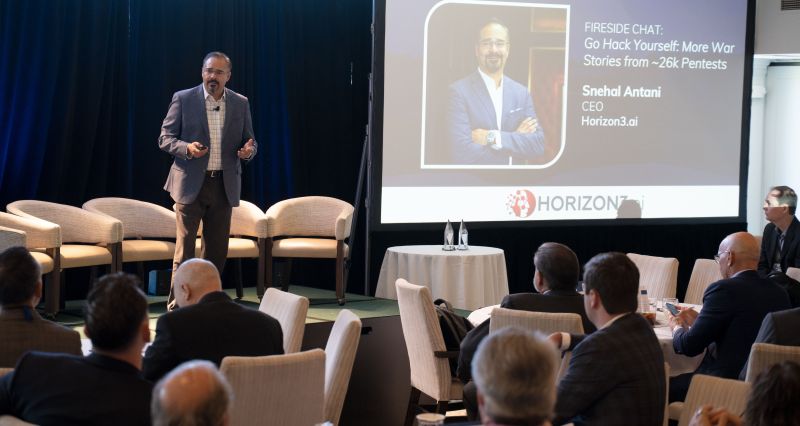
Horizon3 emerged from the overlap of those experiences. The CIO remembered not knowing. The Splunk CTO saw the same uncertainty across large customers. The JSOC operator saw what a continuous offensive posture could look like. The twelve-year-old still wanted to understand the attack.
“Every patch Tuesday, I wanted a pentest Wednesday.”Snehal Antani
Traditional penetration tests were often episodic, labor-intensive affairs. A consultant arrived, probed a slice of the environment, wrote a report, and left. The network continued changing before the ink had discovered whether it was dry. Antani and co-founder Anthony Pillitiere believed the process could run autonomously, at a frequency closer to the pace of modern infrastructure. They began Horizon3 in 2019 and built NodeZero to attack a customer's own production environment safely, find exploitable paths, explain what to repair, and then test the repair.
The distinction between a vulnerability and an attack path is central. A scanner can produce a lavish list of flaws, many of them theoretical or isolated. An attacker chains conditions together: a weak credential here, an exposed service there, an identity mistake around the corner. The meaningful question is not how many red marks appear on the page. It is which sequence reaches something valuable.
Antani's more consequential idea was that autonomous pentesting was not the destination. It was a sensor. Every test could generate telemetry about real configurations, identities, controls, and attack paths. In 2018, while involved with Project Maven, he had absorbed an observation that stayed with him: models and weights would keep changing, while the underlying training data could become the durable advantage. Horizon3 would therefore be a data company wearing a penetration tester's hoodie.
The operator enters the startup
Antani imported three habits from JSOC. Empower the people closest to the problem. Create shared understanding so they can make sound decisions. Use a steady cadence to expose news, especially bad news, while there is still room to act. None requires a camouflage metaphor. Together they form an operating system for teams under pressure.
He also brought a taste for blunt phrases. At Horizon3, he looks for “learn-it-alls” who master their craft, demand excellence, and obsess over the product. He says a person earns the right to remain on the team every day. The language is stern, though his public manner frequently salts severity with jokes. This is a CEO who can discuss training data, compare a competitor to a distraction for the Eye of Mordor, and remember the exact virtues of a better-than-Sbarro pizza counter.
The company learned its lessons in less charming ways. During an early hiring burst, Antani brought in managers and almost immediately asked them to recruit, before they understood the culture or product. Some hires did not fit. On the next expansion, Horizon3 hired player-coach managers first, gave them time to absorb the company, and only then opened the recruiting throttle. “Slow down to speed up” is familiar management advice. It becomes memorable after one has paid the tuition.
When Silicon Valley Bank failed while Horizon3 was funding payroll, Antani says he loaned the company money himself so employees would be paid. Valuation headlines are neat. Fridays rarely are.
His fundraising view is similarly unsentimental. Founders need to learn broadly, persist through trouble, and retain conviction when investors say no. A rejection may describe the investor's portfolio, timing, or taste more accurately than the founder's prospects. The task is to find alignment without lending strangers custody of one's nerve.
Scale without surrendering the plot
Horizon3 reached roughly $1 million in annual recurring revenue in 2021. Antani favored transaction velocity early: several smaller deals could reveal a repeatable sales motion better than one heroic contract. The company then moved quickly. By 2025, it ranked third on the Deloitte Technology Fast 500 after reporting 19,939 percent revenue growth over three years.
In August 2026, Horizon3 announced a $250 million Series E at a valuation above $2 billion. It reported more than 7,000 organizations using its platform, 310,000 tests run safely in production, and 120 percent year-over-year growth in annual recurring revenue. The numbers are substantial. More revealing is what they measure: thousands of customers allowing software to behave like an attacker inside environments where mistakes are expensive. Growth depended on technical ability, certainly, but also on accumulated permission.
The ambition now extends beyond finding weaknesses. Antani talks about a continuous learning loop between autonomous attackers and autonomous defenders, with people handling exceptions. Horizon3 is expanding internationally and moving toward automated remediation. The future he describes is algorithm against algorithm, operating at machine speed.
Such visions can become foggy very quickly. Antani keeps returning to the concrete language of proving. Do not merely say the company is secure. Demonstrate that it is defensible. Do not confuse a compliance snapshot with resilience. Test, repair, and return. The adversary, as one of his commanders used to remind him, always has a vote.
“You don't want to learn how to deal with a crisis in the middle of a crisis.”Snehal Antani
That sentence connects the career more cleanly than any list of jobs. Distributed systems research, enterprise software, a CIO's anxiety, data platforms, special operations, and an autonomous hacker all concern preparation before strain becomes catastrophe. Even the teenager at the pizza counter was practicing for a conversation before he knew which conversation it would be.
Security vendors often sell relief. Antani sells a recurring encounter with discomfort. Run the attack. Look at the path. Admit what worked. Fix it. Then invite the machine back in. It is not a soothing ritual, but soothing rituals have a poor record against curious intruders. Proof is ruder, and considerably more useful.