The Reality Defender
Piyush Verma
He builds machines that can tell whether the face on your video call is a person or a forgery.
Co-Founder & CEO · Neural Defend
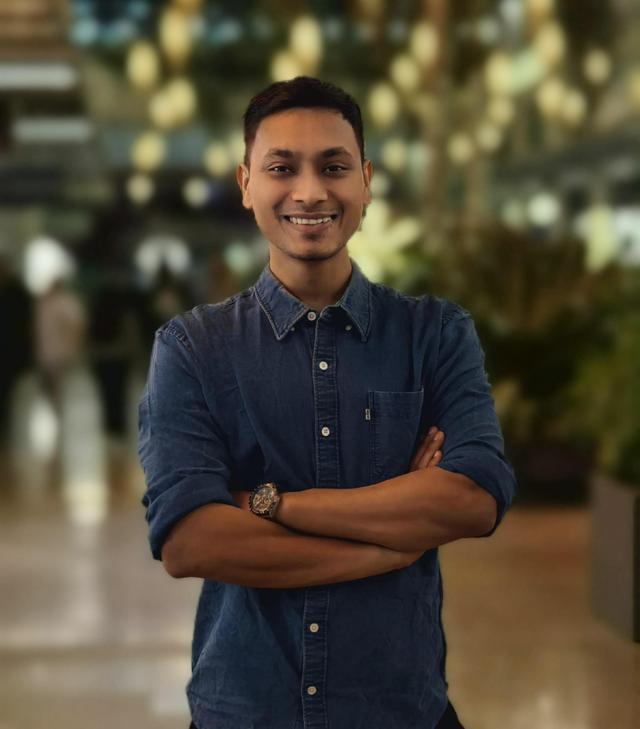 Piyush Verma // looking for the seams in a synthetic world
He builds machines that can tell whether the face on your video call is a person or a forgery.
Co-Founder & CEO · Neural Defend
Piyush Verma // looking for the seams in a synthetic world
A pixel that shouldn't be there. A voice that lands a half-frame too clean. Piyush Verma's company hunts the tells most eyes will never catch.
Somewhere on a video call right now, a finance executive is approving a wire transfer to a face that does not exist. That is the world Piyush Verma decided to defend. As co-founder and CEO of Neural Defend, a San Francisco cybersecurity startup he launched in 2024, Verma builds AI that scans video, images, audio, and live streams and returns a verdict in seconds: real, or manufactured.
The pitch is unglamorous and enormous. Deepfakes have stopped being a novelty and become a fraud vector. Cloned voices drain accounts. Forged executives authorize transfers. Synthetic anchors read fake news. Neural Defend's answer is what Verma calls agentic, multimodal, real-time detection - a system that reads a clip down to its pixels and its audio waveform, looks for the anomalies a generator leaves behind, and scores how likely the thing in front of you is a fabrication.
"Our goal is to protect real identities against digital deception through innovative AI agentic technology," Verma says. It is a tidy sentence for a messy problem. At the India AI Impact Summit in early 2026, experts on a panel argued that no model can reliably catch every deepfake yet. Verma is building anyway, on the bet that the defenders cannot afford to wait for certainty while the forgers ship daily.
Neural Defend grew out of MIT's Venture Mentoring Service and is registered in both India and the United States. Verma runs it alongside co-founders Sivashankar Selvarajan, the CTO, and Sumit Singh, the chief data officer - an AI engineer and a data engineer respectively. The company is still pre-revenue, but the early signal has been loud: pilots running in New York and Singapore, enterprise and fintech customers in the pipeline, and a debut at FinovateEurope 2025 in London.
Then there is the trophy shelf. At NYC Tech Week, Neural Defend was the only Indian startup among ten global finalists in an a16z-linked competition and walked away with first place and roughly $50,000 in equity-free prize money. In early 2026 it was named Best Cybersecurity Startup at the India AI Impact Summit. For a company barely two years old, the awards arrive faster than the revenue - which is exactly what you would expect from a team solving a problem the market only recently learned to fear.
Our goal is to protect real identities against digital deception.
- Piyush Verma, on why Neural Defend exists
Verma did not start in cybersecurity. He started in design. His first graduate degree was a Master of Design from IIT Delhi, and that training - human-computer interaction, product, the discipline of looking hard at how people actually use things - never left him. It is an unusual spine for a man who now talks about pixel-level anomaly detection. It is also, arguably, the point. Deepfakes are a design problem before they are a math problem: they work by exploiting what humans trust about a face.
He grew up in a tier-II city in India, far from the metro corridors where opportunity concentrates. That fact shaped everything that came next. When he won a full merit scholarship to MIT for a Master of Science and became an MIT Tata Fellow at the Tata Center for Technology and Design between 2018 and 2020, he did not treat it as an exit visa. He treated it as leverage.
"Covid has pushed back the development efforts of India by many years," Verma said in 2020. "To tackle such enormous socio-economic challenges, we would need scalable innovation and entrepreneurial ideas." So he built one. Manush Labs, a Section 8 non-profit impact accelerator backed by billionaire investor Desh Deshpande, set out to hand mentorship, markets, networks, and funding to founders from exactly the kind of smaller cities Verma came from. It grew into an operation that nurtured roughly three dozen startups, ran a team of more than fifty, and pulled in Fortune 500 clients.
Around the same stretch he founded the MIT India Initiative, mobilizing what became hundreds of people across the institute. The throughline is hard to miss: Verma keeps building the bridge he wished had existed for him. In 2021, Forbes put him on its 30 Under 30 list. His research has appeared in Frontiers, Springer Nature, and UC Berkeley publications, and his resume reads like a passport - research links to MIT, Harvard, and Tsinghua University in China.
To tackle such enormous socio-economic challenges, we would need scalable innovation and entrepreneurial ideas.- Piyush Verma, MIT Tata Center, 2020
Four surfaces where a fake can hide, one engine looking at all of them.
Pixel-level and pixel-anomaly analysis hunts the artifacts generators leave behind in frames and stills.
Deepfake voice detection flags cloned and synthesized audio - the weapon behind the rise of vishing fraud.
Live detection for video conferencing, so the verdict arrives during the call, not after the money is gone.
End-to-end encryption and on-prem deployment for finance and government clients who cannot send data out.
SDKs and APIs so banks and platforms can wire detection straight into existing fraud workflows.
Automated alerts and threat-level scoring turn a raw verdict into something a security team can act on.
Joins the MIT Tata Center for Technology and Design on a full merit scholarship.
Founds an impact accelerator backed by Desh Deshpande and mobilizes the MIT India Initiative.
Recognized for entrepreneurship and impact investing.
Co-founds the deepfake-detection startup out of MIT's Venture Mentoring Service.
Debuts in London; raises $600K led by Inflection Point Ventures with MIT SBXI, Techstars SF, and Soonicorn.
Launches India's first media-led deepfake verification system for the public.
Neural Defend takes the top startup honor at the India AI Impact Summit.
A designer who decided the most important thing to design was trust.
The most public test of Verma's technology did not happen in a bank. It happened in a newsroom. In 2025, Neural Defend partnered with Mumbai-based Zee News to launch what was billed as India's first media-led deepfake verification system. The mechanic is refreshingly simple: a viewer who suspects a clip has been doctored can upload the video, audio, or image, and Neural Defend's engine returns a judgment within seconds on whether it was artificially manipulated.
It is the kind of product that explains the mission better than any deck. A deepfake of a news anchor or a public figure can move markets and inflame mobs before a correction loads. Putting a verification button in front of millions of news consumers is a bet that the defense against synthetic media has to be as fast and as accessible as the fakes themselves. For a founder who built his early career widening access for people on the outside of the system, handing the public its own fraud-checking tool is right on brand.
The $600,000 pre-seed Neural Defend closed in March 2025 was led by Inflection Point Ventures, with a roster that reads like a map of Verma's life. MIT SBXI, the Boston-based fund tied to his alma mater, joined. So did Techstars San Francisco and Soonicorn Ventures. The amount is modest by Silicon Valley standards and deliberately so - this is the patient, early money that lets a pre-revenue team prove a hard technical claim before it scales. The fact that an MIT-linked fund and an a16z-adjacent prize both put their names next to a two-year-old company says something about how seriously the industry now takes synthetic-media fraud.
Verma's positioning is sharp because the enemy is concrete. The keywords around Neural Defend tell the story: impersonation attack prevention, real-time deepfake alerts, synthetic media for finance, deepfake voice detection, zero-trust architecture. These are not abstractions. They are the line items on a fraud team's nightmare list. By aiming squarely at financial services and enterprise security - the buyers with the most to lose and the deepest pockets - Verma sidestepped the trap of building a clever demo with no customer. He built a clever demo for the people writing the checks.
There is a contrarian streak in all of this. At the very summit where Neural Defend was crowned best cybersecurity startup, other experts were on record warning that no AI can yet reliably detect every deepfake. Verma's company exists in the gap between that caution and the market's urgent need. He is not promising perfection. He is promising speed, multi-format coverage, and a verdict that buys a security team the seconds it needs - on-premises, encrypted, wired into the workflow they already use. In a field where the forgers iterate constantly, a defender that ships and improves beats a defender that waits for a guarantee.
What makes Verma worth watching is not a single product. It is the pattern. A man from a small Indian city who got to MIT and immediately built a ladder for others. A designer who pivoted into one of the hardest problems in machine learning. A repeat founder who walked away from a successful accelerator to start over on something harder and more urgent. The technology may evolve, the deepfakes will certainly get better, but the instinct underneath stays constant - find the thing people are most afraid of, and build the tool that lets them stop being afraid of it.