A computer can propose something that a laboratory cannot make. It is an awkward fact for anyone selling computational ambition, and a useful place to begin with Kfir Schreiber. His career has taken him from mathematics in Israel to the MIT Media Lab and then into the chief executive’s job at DeepCure. Along the way, the question has widened: how does a promising calculation become work that other people can repeat?
DeepCure was founded in 2018 by Schreiber, Thrasyvoulos Karydis, and Joseph Jacobson. The names matter together. This company grew out of a research relationship, with the collaborators taking different responsibilities as the work moved beyond MIT. Schreiber became CEO; Karydis became CTO. A shared academic starting point became an organization with a budget, a platform, and a physical laboratory to build.
For a profile of an AI founder, that is a pleasantly inconvenient starting point. Software tends to photograph badly. Equipment is expensive. Coordination rarely gets applause. Yet those are precisely the pieces that give Schreiber’s story its shape.
A different set of instruments
Before the Boston company and the MIT research, Schreiber was a pilot and major in the Israeli Air Force. It is a striking entry in a technology executive’s biography. It also stands on its own: a real earlier career, rather than a ready-made explanation for every later decision.
There is no need to turn a cockpit into a metaphor for running a startup. A pilot and a CEO have different jobs. What the sequence establishes is that Schreiber had already occupied one professional world before moving through universities and into another. His record includes military service, mathematics, research, and management. Each brings its own kind of work.
His academic path ran through the Open University of Israel, where he completed an undergraduate degree in mathematics and computer science in 2006, and Tel Aviv University, where he completed graduate study in applied mathematics in 2015. The subjects put computation beside mathematical reasoning. Both would remain visible in the research that followed.
He joined the MIT Media Lab as a research assistant in 2016. His listed projects included Affinity, a deep learning API for molecular geometry. An API is a way for people to use software through defined interfaces. Even the project’s form is revealing: the research record includes a tool meant to be worked with, alongside investigations of molecular interactions.
At the Media Lab, Schreiber’s collaborators included Karydis and Jacobson. The company’s later origin can therefore be followed through actual working connections. There was a laboratory, there were shared projects, and there were people whose research relationship preceded their business titles.
Open University of Israel
Tel Aviv University
DeepCure founded
Announced April 11
The year the work changed shape
On August 10, 2018, Schreiber submitted his MIT master’s thesis, Net-PPI: Mapping the Human Interactome with Machine Learned Models. The formal degree was a Master of Science in Media Arts and Sciences. Jacobson served as academic adviser; Kevin Esvelt and Aditya Khosla were readers. The title places machine learning directly inside the research question.
The thesis supplies a precise marker in a career that is often compressed into a few credentials. Here was a completed piece of academic work, submitted to a named program, with an adviser and readers. In the same year, the next undertaking took a different form: DeepCure.
Karydis later recalled that Schreiber was thinking about leaving MIT to commercialize the research they had been doing. Karydis left his PhD program in late 2018 to join him. That recollection makes the founding decision more human than an incorporation date. It was a choice that affected two collaborators’ academic plans, and they chose to keep working together.
The move also changed what the work had to contain. A thesis can be completed and submitted. An operating company keeps acquiring new questions: which jobs belong in the team, how a technical system should be organized, and where money needs to go next. Research remains part of the story, but responsibilities gather around it.
Schreiber received the inaugural Minsky Fellowship for AI researchers. The credential belongs beside his academic work, rather than replacing it. A fellowship recognizes a researcher; a company asks that researcher to assemble people and systems that can continue working beyond an individual contribution.
A number with eighteen zeroes
In 2022, Schreiber described DeepCure’s MolDB database as covering more than a trillion compounds, with the capacity to expand to a quintillion. Written out, the second number has eighteen zeroes. It is the sort of figure that can make a reader briefly reconsider how much counting there is left to do.
The useful detail was the condition attached to that scale. Schreiber said the company knew how to synthesize the molecules in its database. In other words, the computational catalog was tied to a route for making things. A larger list alone would leave a rather large practical question unanswered.
His description also included evaluating multiple properties together. DeepCure was working with profiles that could include fifty properties per candidate, rather than treating every decision as a separate pass through the same process. This was an account of the company’s approach at that time, with the numbers attached to the 2022 description.
For Schreiber’s story, the distinction is useful. The scale shows the computational ambition. The synthesis requirement supplies the constraint. Between them is the founder’s problem: building a system that can handle both. An impressive number acquires meaning when it is connected to something a team can actually do.
Potential database scale described by Schreiber: one quintillion compounds. A stated expansion capacity, rather than a count of physical experiments.
Money for the parts you cannot download
DeepCure announced a $40 million Series A in November 2021, led by Morningside Ventures. Existing investors TLV Partners, Sapir Venture Partners, and Benon Group also participated. Schreiber shared the announcement publicly, placing the milestone alongside appreciation for the team doing the work.
Funding is a tempting shortcut in a founder profile. It offers a number, a date, and an apparent verdict. But a financing announcement records capital raised. The more interesting question is what the organization does with the room that capital creates. In DeepCure’s case, the public plans included an automated laboratory and an expansion of the team.
By January 2023, the physical side had a named collaborator. DeepCure and Biosero announced a chemistry synthesis platform using DeepCure’s AI engine and Biosero’s Green Button Go automation software. The project belonged to DeepCure’s Molecular Foundry in Rehovot, Israel. The geography added another concrete connection between the Boston company and work being built elsewhere.
The collaboration addressed a sequence of operations: synthesis, purification, and data analysis. For readers outside a laboratory, the details can sound like a list of departments. They are better understood as a series of dependencies. Getting one step right does not remove the need to organize what happens after it.
A later technical case study described Galactus, software that generates synthesis instructions and integrates with Biosero’s system. The name suggests a taste for a little drama; the documented job is thoroughly practical. Instructions have to become operations. Those operations have to yield information. The next design needs that information back.
Results return to the next design. The handoffs are part of the work.
A shared screen, a shared problem
The company’s DiscoveryHub platform puts another piece of the organization into view. It is designed to share data and molecular designs among specialists, with tools to visualize structures, evaluate alternatives, and plan synthesis routes. Project managers are included alongside engineers and scientists. The work has enough moving parts to need people who keep track of them.
This gives a CEO profile an unusually concrete object to examine. Shared software is an organizational decision made visible. Who can inspect a design? Who can find the data? How does an idea travel to the person responsible for the next step? An interface can make those questions easier to answer, although it cannot supply everyone’s judgment.
Schreiber describes close collaboration between machine learning specialists and domain experts, with newcomers learning alongside experienced colleagues. His account includes a requirement for humility about unfamiliar fields. That is an explicit hiring and working preference, rather than a reason to invent a personality behind the public record.
“Focus on the problem.”
Kfir Schreiber
It is compact advice, and the company’s infrastructure offers a way to examine it. A platform must serve the work that people are doing. An automated system must move a useful design forward. The test of either is practical. Beautiful software can still leave somebody waiting for a missing piece of information.
In April 2024, DeepCure announced another financing: a $24.6 million Series A-1 led by IAG Capital Partners, with existing investors participating. Schreiber welcomed Ehsan Jabbarzadeh to the board. By then, the company-building story included external capital, technical partnerships, and the continuing job of connecting different forms of expertise.
Taking the question into the room
Schreiber’s public appearances give the story another setting. In 2022, he spoke at the Broad Institute’s machine learning symposium. The program included researchers and executives such as Regina Barzilay, Pat Walters, and Steven Jerome. Schreiber was taking the company’s questions into a room occupied by people working on related technical problems.
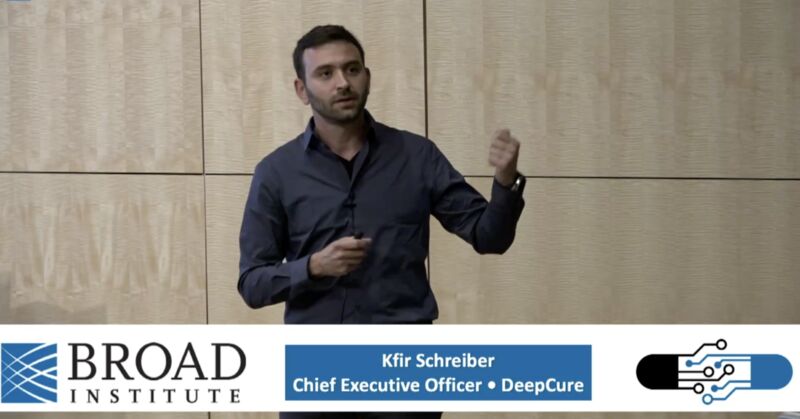
In October 2024, DeepCure reported his participation in a BioFuture panel in New York about the real use of AI. He was also listed for a June 2025 panel at the BIO International Convention in Boston. Public discussions brought the executive role back to a familiar task: explaining what the technical work might accomplish and what still needs to be built.
The career now has several recognizable chapters. The pilot. The mathematics graduate. The MIT researcher. The co-founder responsible for running a company. Their connection is visible in the decisions and the work, without requiring an imagined scene of revelation to tie them together.
The distance in this story is measurable in more than years. It lies between a research result and an operating organization, between a molecular design and instructions for making it, between specialists who need access to one another’s work. Schreiber has made those crossings part of his job. The machine is only useful when the pieces can work together.
Follow the work
Profiles, projects & conversations