Before the smartphones were ready, there were taxis. At Sense Networks, Christine Lemke and her colleagues wanted to understand movement: where people went, how patterns formed, what a city’s traffic of human decisions might reveal. This was around 2006. The iPhone had yet to arrive. The data that would eventually pour from pockets was still an awkward promise, so the team began with location records from taxicabs in New York and other American cities.
A taxi is an unexpectedly good opening character for a technology career. It has somewhere to go. It changes direction. It produces information almost incidentally, while doing the job people actually pay it to do. Lemke’s team used those records to develop its systems and algorithms before securing partnerships with telecommunications companies. The available material set the pace. The anticipated material could wait.
That sequence offers a useful way into Lemke’s story. Her résumé crosses gaming hardware, product analytics, mobile advertising, founding, investing, and now artificial intelligence. The job titles can make the journey look like a series of departures. Follow the information instead, and a more consistent route appears: find a stream of data, understand what it describes, and build something that gives it a purpose.
Today she is co-founder and CEO of GXL, while remaining an advisor and board member at Evidation, the company she helped establish in 2012. Getting there required more than spotting patterns in a spreadsheet. It required living with uncertainty, choosing colleagues, resisting advice, accepting other advice, and eventually handing an operating role to someone else. The taxis were merely the first passengers.
South Dakota, then a wider map
Lemke was adopted from South Korea as a baby and grew up in a strict Lutheran household in South Dakota. These are particulars of a childhood, rather than a convenient explanation for every business decision that followed. They do, however, put some distance between her beginnings and the familiar startup origin story of a founder raised within sight of a venture investor’s office.
“Being comfortable with different opens your mind,” she has said. It is a modest sentence with room inside it. Difference can mean a place, a set of assumptions, or a person whose experience makes your own expertise look rather incomplete. Her later career would involve all three. It would also involve the recurring inconvenience of discovering that being experienced in one setting does not make you experienced in the next.
Her education took her to the University of Washington, where she earned a BA in business, and to HEC Paris for an MBA. Her professional background includes a role at 3i Group in Paris. Seattle and Paris add two further coordinates to the map, and two institutions with different relationships to enterprise. The public record establishes the qualifications and the places. The work that followed shows how often she crossed between established organizations and companies still being assembled.
There is a temptation to turn this into a tidy itinerary, with each stop providing precisely the lesson needed for the next. Careers rarely oblige. Lemke’s is more interesting when the edges remain visible: an American upbringing, a French business school, a gaming division, several founding teams. The continuity lies in what she worked on, rather than in a single industry she stayed inside.
“Being comfortable with different opens your mind.”
Christine Lemke
An Xbox is also a source of clues
At Microsoft, Lemke worked with the Xbox hardware organization. She has described using Xbox data to identify problem areas and help fix them. She also co-founded Chicago-based Channel IQ, a product analytics platform. Across these jobs, she managed products or teams using analytics to improve a product or service. The vocabulary changed with the setting; the practical obligation stayed recognizable.
Think about what those assignments ask of a person. A console has to work for someone who has no interest in its internal reporting systems. Product information has to help a business make a decision. An elegant analysis that arrives too late, answers the wrong question, or leaves its recipient wondering what to do next is an expensive decoration. This is the operational side of a career often described in the language of data.
Sense Networks brought that interest into the movements of people and the business of advertising. Lemke was a co-founder and chief operating officer. The company’s work included grouping patterns of activity, rather than relying only on a static demographic description. In January 2014, YP acquired Sense Networks. The sale placed its location-based advertising capabilities inside a larger commercial operation.
The technical record has another small detail: Lemke is named alongside collaborators on patent applications concerning location analytics and the comparison of spatial-temporal trails. Those titles have the charm of furniture assembly instructions, but they describe a real preoccupation. How do separate observations become a meaningful pattern? How do you compare paths through a place? Long before her current AI venture, the question of how to organize messy information was already in the paperwork.
A kitchen table has limited seating
In 2012, Lemke, Mikki Nasch, Alessio Signorini, and Luca Foschini rented a house on Voluntario Street in Santa Barbara. The founding group initially considered making a device, then chose software. Meetings and coding happened in the living room and around the kitchen table. Early user rewards came out of the founders’ own bank accounts. Investors frequently declined. The setup was domestic; the commitment was financial.
The origin matters because the company now known as Evidation did not begin as a finished institutional proposition. The early venture, The Activity Exchange, later merged with Evidation. Its founders had to discover both what they could build and which version of the business people would support. A kitchen table is perfectly adequate for a discussion. It is less helpful when every person outside the house wants a different company.
Lemke wrote in 2013 about the pressure of conflicting recommendations from investors, partners, users, and colleagues. Her response was to launch something minimal and open, watch what happened, and choose opportunities that fitted the original purpose. She described discarding ineffective ideas even when the team had invested in them. That is a less glamorous form of conviction than insisting that the first sketch must be correct.
“There’s a fine line between stupidity and bravery,” she wrote. The line remains annoyingly unmarked. Her approach left room for revision while keeping a reason to revise toward something. For a serial founder, having experience did not remove the confusion. It supplied a way of working through it. The company could change its product without surrendering every decision to the latest persuasive visitor.
“There’s a fine line between stupidity and bravery.”
Christine Lemke, 2013
Making room for another CEO
Deborah Kilpatrick met Lemke in 2014 through GE Ventures. They initially led Evidation with Kilpatrick as CEO and Lemke as president, with Lemke leading the technology functions. Their backgrounds differed substantially. The partnership brought those differences into the same company, where they had to become useful rather than merely impressive on a slide.
In September 2020, Lemke became co-CEO alongside Kilpatrick. Kilpatrick has explained that recognizing them as equals mattered: customers and investors should understand the leadership relationship the way the leaders themselves did. Titles were catching up with how the company had been run. Sharing the position made the arrangement explicit to everyone outside their working partnership.
There is something refreshing about that detail. Business biographies tend to arrange people around a solitary figure at the top. Here, an important development involved making a second name equally visible. A shared title cannot settle every disagreement. It can, however, communicate where responsibility sits. The story becomes one of negotiated authority, complementary experience, and the deliberate public acknowledgment of another person’s contribution.
The business had grown far beyond its rented-house beginnings. In March 2021, Evidation announced a $153 million Series E, co-led by OMERS Growth Equity and Kaiser Permanente Group Trust. Its platform then comprised more than four million individuals across all 50 states. Each number describes a different obligation: capital to deploy, relationships to maintain, and a national operation to keep running. The kitchen table could finally retire from conference-room duty.
Her money, someone else’s beginning
Alongside building Evidation, Lemke co-founded Ensemble Labs with Malay Gandhi in 2016. Their angel investment fund uses their own capital. The assistance they describe is practical: company-building, product decisions, taking products to market, and introductions. For an entrepreneur, that is familiar terrain seen from the other side of the meeting.
The fund’s selected investments include Benchling, Flexport, and MìLà. A research-software company, a logistics platform, and a food business make a fairly varied guest list. There is no need to invent a unifying theory for every investment. The range does establish that Lemke’s public work extends beyond the operating company most closely associated with her name.
Investing also changes the relationship with uncertainty. As a founder, you must keep choosing a direction for your own organization. As an investor, you support another person who will make choices you cannot make for them. Experience can be offered, introductions arranged, and a product discussed. Ownership of the daily work still belongs to the team doing it. Ensemble’s description of its support stays close to those ordinary, useful interventions.
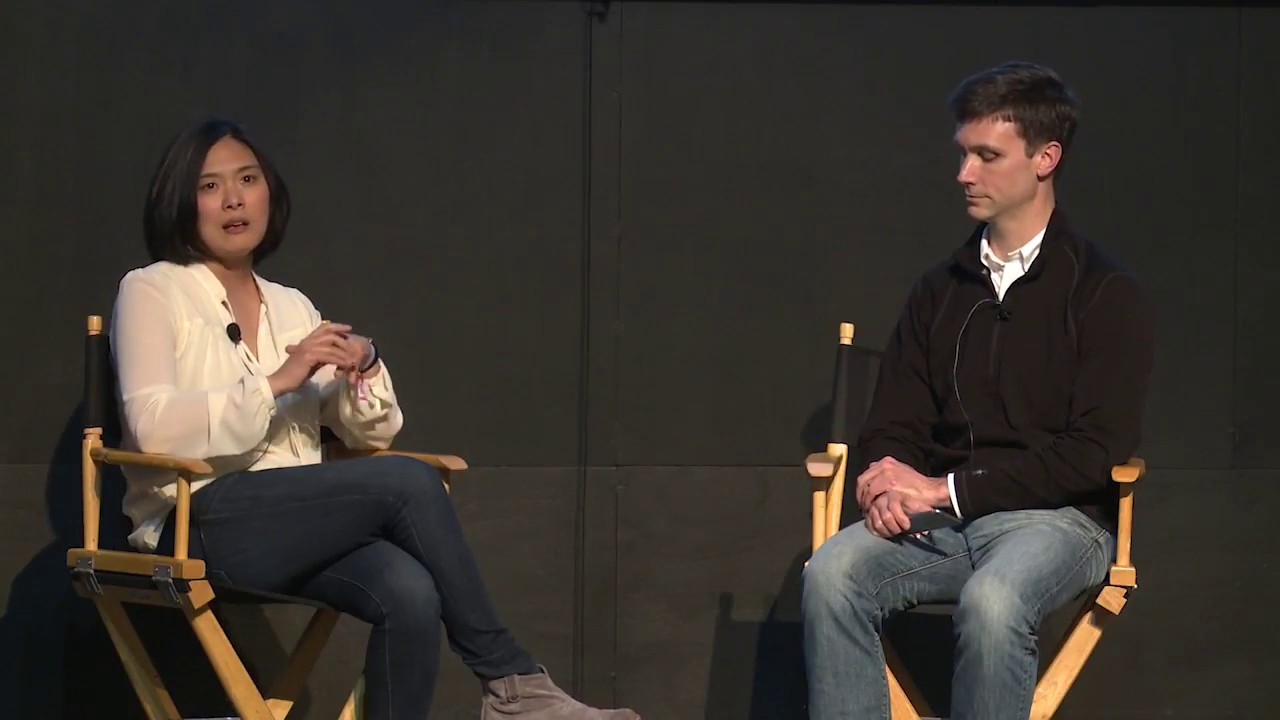
Lemke’s public conversations show the same willingness to discuss company-building outside her own office. She has appeared with Gandhi at Startup Grind and on the Village Global podcast. The image of her onstage is an apt counterpoint to the kitchen-table beginnings: the questions that once belonged to a small founding group can now be considered in front of a room. The setting changes. The difficulty of making a good decision remains.
The next pile of unfinished information
On March 6, 2025, Evidation appointed Leslie Oley Wilberforce as CEO. Lemke continued as an advisor and board member. Wilberforce had joined in 2015 and had served as president and chief operating officer. This was a transfer to someone with years inside the company, rather than an introduction made at the moment of the announcement.
Lemke expressed confidence in her successor, pointing to Wilberforce’s operational ability and contribution to the company’s growth. Leaving the chief executive role while retaining a board and advisory relationship creates a different kind of participation. A founder’s next useful decision may be to give another operator room to lead. The history remains hers; the daily agenda has a new owner.
Her own next chapter is GXL, co-founded with James Zou, its chief scientific officer. The company builds infrastructure that lets AI agents search and connect scientific information. Its Paperclip product brings different kinds of records into a structured environment and preserves a route back to the underlying evidence. The organizational challenge has a familiar outline: valuable information exists, but making it usable requires a system.
The parallel with Sense Networks is an editorial reading of the career, rather than a claim that these are identical businesses. Taxi trails and scientific papers present different problems. Still, both require attention to the gap between having information and being able to do something dependable with it. GXL’s stated philosophy includes helping people rule out weak ideas, as well as pursue promising ones. An answer that saves someone from a bad direction has value too.
So the story ends with another beginning, and a new collection of material waiting to be organized. Lemke has built, partnered, invested, handed over a role, and returned to founding. The next company gets the benefit of those earlier rooms: the hardware organization, the rented house, the shared executive office. What happens next will require the same unromantic act that started the taxi experiment: work with what is actually there, and see what it can become.
Keep following the questions
More from Lemke, her companies, and her public conversations.
- Christine on LinkedIn ↗
- Christine on X ↗
- Evidation biography ↗
- GXL and its founders ↗
- Ensemble Labs ↗
- Her essay on staying true to a mission ↗
- The 2025 leadership announcement ↗
- Startup Grind conversation on YouTube ↗
- Sense Networks acquisition ↗
- Secret Leaders: her upbringing and entrepreneurial journey ↗