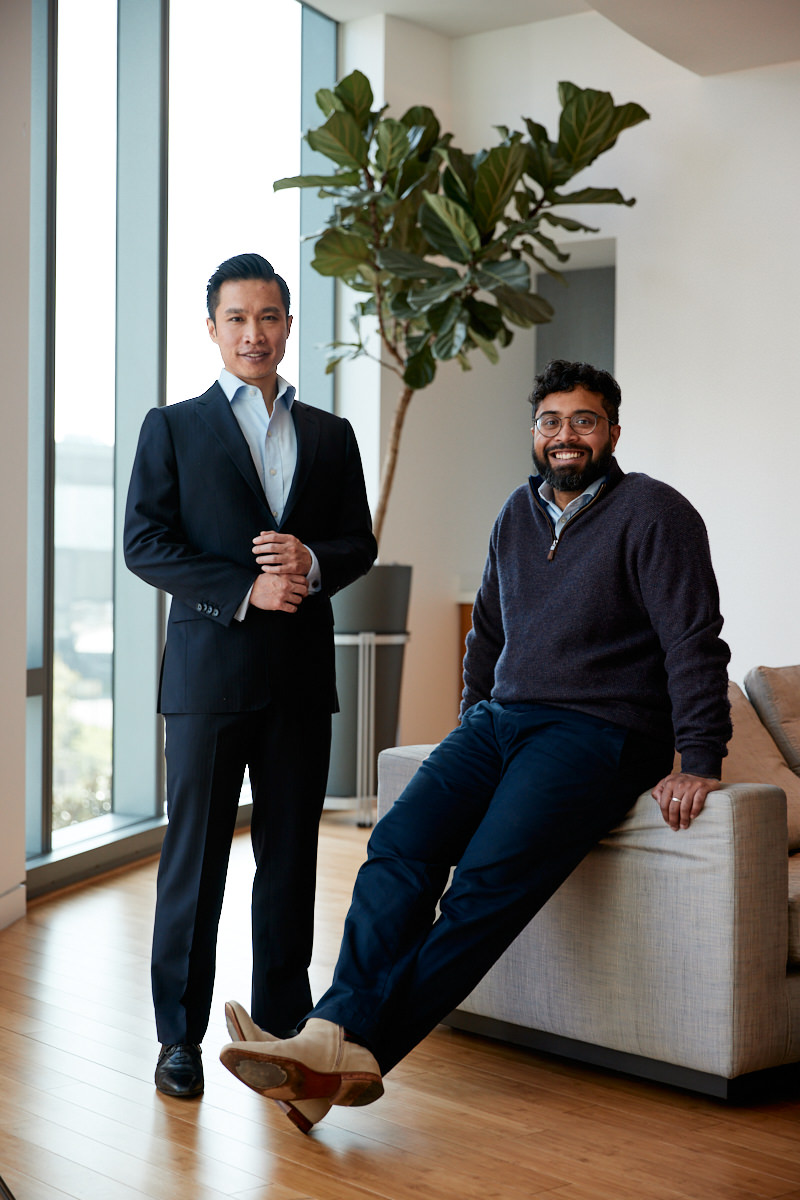
In September 2025, Mike Ng changed jobs inside the company he had helped create. Nikhil Buduma, his co-founder and chief scientist, became chief executive of Ambience Healthcare. Ng became its full-time president and chairman. The announcement arrived with the usual corporate vocabulary, but the arrangement itself deserves a closer look: two people who met at university, built two businesses together, and were now dividing the next stretch of work differently.
Ng had been CEO since Ambience began in 2020. By the time of the transition, the company reported more than 200 employees. A business that once depended on its founders had become an organization with enough people to make the question of who does what consequential. For Ng, the change meant concentrating on long-term vision and strategy. For Buduma, it meant responsibility for daily operations, growth, and product innovation.
The interesting part is the time horizon. Ng described his next assignment as shaping the company's path over five years. Most job descriptions can barely see past the next quarter. His asks him to look beyond the next product release, funding announcement, or crowded calendar. To understand how he arrived at that brief, it helps to go back to a commerce student in Sydney who wanted to know how the whole machine worked.
The student who kept adding subjects
Ng graduated from the University of Sydney with a Bachelor of Commerce in 2009. He had wanted to run a company, and he approached his education accordingly: economics, finance, marketing, and law all went into the mix. Rather than treating business as a single discipline, he assembled a working knowledge of several. An organization, after all, has an irritating habit of requiring more than the subject its founder happens to enjoy.
Statistics became a particular interest during his pre-honours studies. His thesis explored time-series modelling and prediction. In plain language, that means studying observations across time and using their patterns to estimate what may come next. It is a fitting early interest for someone whose current responsibilities include thinking about where a company should be several years from now. A forecast still needs a person to decide what to do with it.
An internship at Morgan Stanley in Sydney followed while he was studying. He later worked in investment banking at Morgan Stanley and private equity at Calera Capital. Those are distinct seats around the same table: one helps arrange transactions; the other invests in businesses. Neither automatically teaches someone to build a company, but both make the connection between an appealing account of a business and its underlying economics difficult to ignore.
By 2026, Ng was offering a simple piece of advice about those early interests: “You need to take time to follow your curiosity, even when you can’t yet see where it leads.” The sentence has room for uncertainty. He had a clear ambition to lead a business, but the route included subjects and experiences whose eventual usefulness took time to become apparent.
“You need to take time to follow your curiosity, even when you can’t yet see where it leads.”
Mike Ng · 2026
A first-week introduction, a decade of work
In 2014, Ng arrived at MIT Sloan to study for an MBA. During his first week, he attended t=0, the entrepreneurship celebration hosted by the Martin Trust Center for MIT Entrepreneurship. There he met Buduma. Universities advertise their networks as though friendship were a service with an enrollment fee. Here was the actual mechanism: turn up to an event, meet someone, and discover reasons to keep talking.
The two became friends and took entrepreneurship classes together, including Building an Entrepreneurial Venture and Scaling Entrepreneurial Ventures. Ng completed his MBA in 2016; Buduma is an MIT alumnus of the class of 2017. The partnership combined Ng's business training with Buduma's background in artificial intelligence. Their relationship developed before Ambience existed, a useful detail in a business culture fond of making everything begin with the pitch deck.
They founded Remedy Health in San Francisco in 2016. Ng served as co-founder and chief operating officer. The title matters: he was responsible for operating a business before becoming the CEO of their next one. Remedy gave the pair experience putting technology into use inside an organization they ran themselves. In 2020, they founded Ambience. Their second company carried forward a partnership already tested by the demands of their first.
The company beneath the announcement
Ambience's financing history gives some scale to Ng's years as CEO. In February 2024, it raised a $70 million Series B, co-led by Kleiner Perkins and the OpenAI Startup Fund. Ng told Reuters the round was pre-emptive. In July 2025, a $243 million Series C followed, co-led by Oak HC/FT and Andreessen Horowitz. These were investments in the company, with all the expectations that accompany outside capital.
The sequence is worth reading slowly. A large financing round supplies resources for hiring and development. It also makes more people parties to the company's future. Investors have a stake, employees have careers, and founders have an expanding set of obligations. The temptation is to let the dollar figure do all the storytelling. Ng's subsequent change in responsibilities puts attention back on the organization that must turn those resources into work.
Connections to the AI research community also run through the founders' history. Jeff Dean invested in Remedy and later Ambience. Buduma had written Fundamentals of Deep Learning, published by O'Reilly. By the September 2025 leadership transition, Buduma credited Ng with establishing partnerships with AI research labs and leading major commercial relationships. That account places him at the junction between technical capability and the agreements that allow a business to grow.
A strategy office with homework
Ng's current remit becomes more concrete in the work assigned to the Office of the President. A special-projects and strategic-finance position calls for partnership analysis, financial models, competitive research, and market sizing. The office also works on systems for knowledge management and organizational learning. This is strategy with documents attached: a case to examine, assumptions to test, and a decision somebody must eventually make.
The financial questions are familiar ones. What does a partnership create for each side? How do the economics change when companies invest together? What happens when the assumptions shift? The brief describes models being revised during negotiations and analysis prepared for consequential meetings. For a former banker and private-equity associate, the language carries an echo of earlier work, now applied to a company he helped found.
There is an unglamorous precision here. Market size is a number until someone explains which customers are included. A partnership is an agreeable noun until responsibilities and economics have been worked out. A memo earns its place when it helps a person choose. The office's stated preference for usable work gives Ng's five-year horizon a present-tense counterpart: someone has to do the arithmetic this week.
- ExploreMarkets & partnerships
- TestModels & assumptions
- DecideResources & direction
Delegation has a job to do
The same hiring brief connects Ng's management approach to Matt Mochary's The Great CEO Within. It emphasizes prioritization, clear agreements, and developing leaders who own outcomes. Taken as a description of the office's expectations, it offers a useful window into how work is meant to move around him. Decisions require preparation; responsibilities require an owner; a founder cannot remain the answer to every question indefinitely.
Ng has also spoken publicly about hiring support. In a testimonial for Pearl Talent, he described an executive assistant whose integrity, problem-solving ability, and capacity to learn allowed her to take on more work than he had initially expected. The detail is modest beside a funding announcement, which makes it valuable. Running a growing business includes recognizing what another person can do and allowing the assignment to expand.
An employee account from Lauren Weggeman adds a different perspective. She described having wanted to work with Ng for years before joining Ambience, then finding a team where colleagues explained difficult subjects and helped each other work through problems. That is one person's experience, rather than a universal verdict. Still, it brings an individual relationship into a profile otherwise crowded with institutions, investment firms, and executive titles.
The long partnership changes shape
The September 2025 transition did not end Ng and Buduma's collaboration. It rearranged it. Buduma took the CEO role after serving as chief scientist, while Ng remained a full-time executive. Their responsibilities now reflect a company at a different stage from the one they founded. A partnership can preserve its continuity while changing the work each person is expected to carry.
When Ng announced the change on LinkedIn, he wrote that they were “barely 10% of the way through on everything we hope to build.” It is a statement of ambition, not a measured completion rate. Read that way, it explains why a founder might welcome a different brief after five years as CEO. The work ahead, in his telling, is larger than the job title he previously held.
Their shared history gives the handover context. The first meeting was in 2014. Remedy followed in 2016. Ambience followed in 2020. By 2025, the pair had spent roughly a decade working together. Plenty of professional biographies compress a co-founder into a supporting name. Buduma's place in Ng's story is structural: a friend, a collaborator across two ventures, and now the chief executive of their company.
What survives the new title
In January 2026, Ng appeared on Rev Cycle Unscripted as Ambience's co-founder and president. In August, his University of Sydney alumni profile returned to his studies and early career. Those appearances bookend the public picture of his new role: still explaining what he is building, still connecting it to the education that preceded it. The line from statistics to strategy is especially easy to see.
A time-series model asks what patterns in the past might tell us about the future. A company asks a messier version of the question, because people can change the pattern. Ng's career contains both habits: studying businesses through numbers, then taking operating responsibility inside one. His current work brings them together in decisions about partnerships, resources, and where Ambience should go next.
The five-year question remains open. Ng has an established collaborator running daily operations, a finance background to draw on, and a mandate to think ahead. The next chapter will have to be built from choices, agreements, and work completed by other people as well as himself. For someone who once kept adding subjects to learn how companies function, that is a substantial syllabus. This time, there is no graduation date.