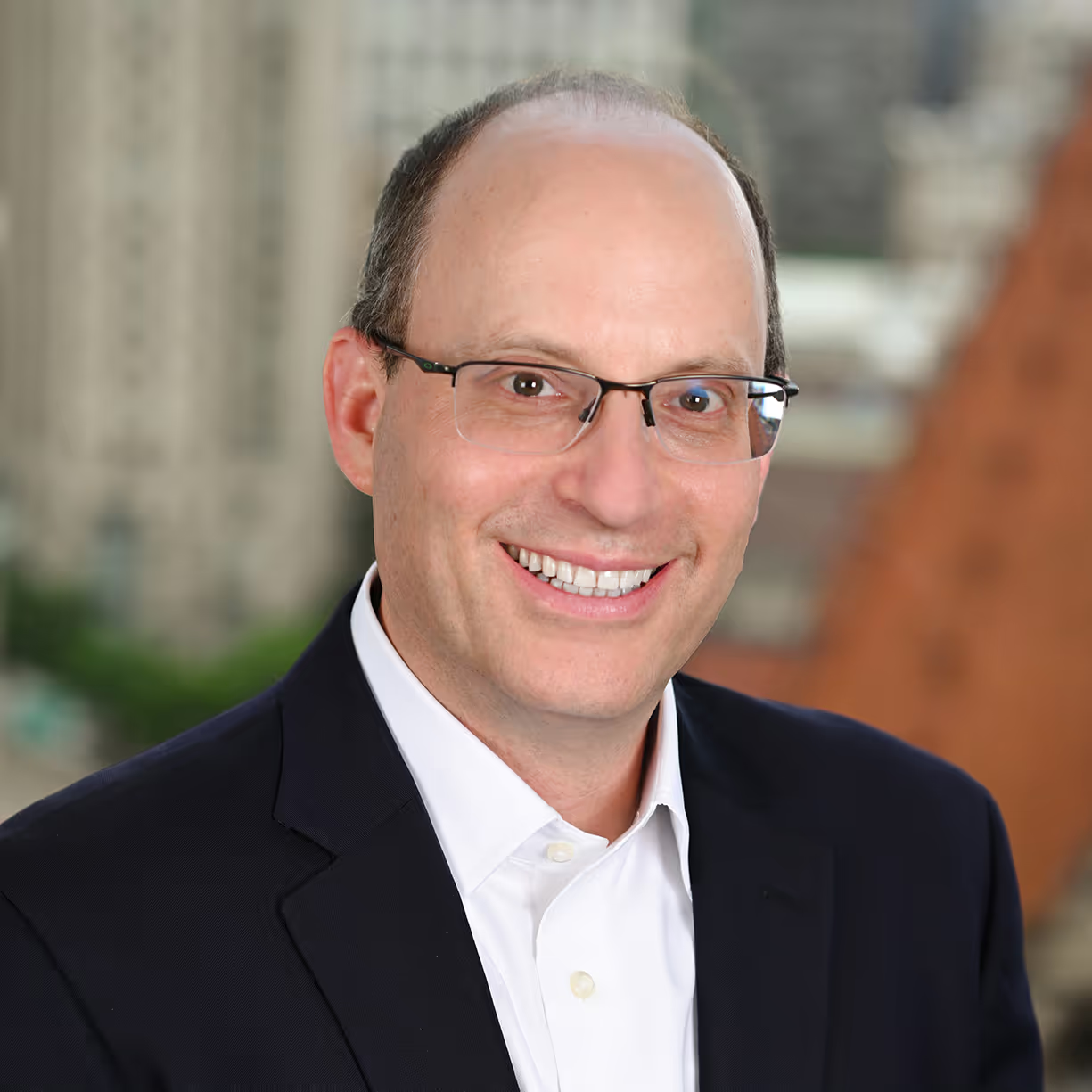
Profile
The Doctor Who Funds the Future
The office at 24 School Street, Boston, sits a short walk from Faneuil Hall. It's not where you'd expect to find a man making bets on chip-scale quantum sensors, satellite manufacturing, and passwordless authentication. But that's partly the point. Matt Goldman has spent a career in places that didn't yet have a blueprint for the thing he was building.
When the Defense Innovation Unit launched its medical portfolio in 2016, there was no Chief Medical Officer. Goldman became the first one. Not by appointment - by architecture. He designed the role, mapped its scope against the unit's commercial technology mandate, and spent six years proving that medicine and national security were not separate conversations.
Before that, he spent more than two decades as a U.S. Air Force Colonel. He ran the Human Systems Portfolio at DIU, where his job was to find commercial technologies - wearables, diagnostics, AI-driven triage tools - and wire them into defense applications. He served as Director at Walter Reed National Military Medical Center. He joined NATO's personalized medicine committee. The through-line in all of it: find where civilian innovation and government need intersect, then stand in that gap.
"Invest in technologies that advance both commercial markets and U.S. national security."J2 Ventures Mission Statement
Goldman still practices as a pediatric gastroenterologist - board certified since 2009. His clinic is in Los Gatos, California, where he also holds a Clinical Assistant Professor appointment at Stanford Children's Health. He introduced acupuncture for pediatric GI patients there. These are not the usual credentials on a venture capitalist's bio. Which is rather the point.
J2 Ventures was founded in 2020, built around a deliberate thesis: that the best early-stage companies serving national security interests will also have compelling commercial traction. The firm's partners include PhD scientists, combat veterans, practicing physicians, and successful operators. Goldman fits the profile - simultaneously all of those things.
The first fund raised $68 million. The second, named the Argonne Fund, closed at $150 million in 2024, reported by the Boston Globe. In November 2025, the Brookhaven Fund closed oversubscribed at $250 million. The limited partner list had grown to include JPMorgan Chase, MetLife, Upsher Management, Alpha Leonis Partners, and the State Investment Council of New Mexico. That's institutional confidence. Three funds totaling more than $468 million in four years is not a hobby.
Career Arc
From Med School to Managing Partner
The dual-use thesis is not a marketing position. It's a structural view about how the best defense technology actually gets built: by companies that have to prove themselves in the commercial market first. Goldman has seen both sides - he was the person at DIU evaluating which commercial products were ready for defense adoption. Now he's on the other side, backing companies that are building for both markets from day one.
The portfolio reflects that logic. Oura - now a globally recognized sleep and wellness tracker worn by professional athletes and military operators alike - is one of two unicorns the firm has backed. Apex Space, building next-generation satellite manufacturing, is the other. Between them and the broader portfolio, J2's companies have raised more than $1 billion in follow-on capital from other investors. The non-dilutive government funding secured by portfolio companies adds hundreds of millions more to that number.
Other portfolio companies include Redcoat AI in cyber threat defense, Nametag in passwordless authentication, Aalyria - a Google spin-out working on laser-based internet at planetary scale - Mesa Quantum in chip-scale quantum sensing, Parallel Fluidics in custom microfluidics, and InfiniG in private mobile coverage. The sectors span the full J2 thesis: advanced computing, cybersecurity, biomedical, infrastructure, satellite, and national security.
Goldman's background in medicine gives J2 a specific edge in the biomedical and human performance corners of the portfolio. He understands what it means to bring a product to a clinical environment, what regulatory pathways look like, and what the real barriers to adoption are. That's not a common VC skill set. Most health tech investors come from finance or operations. Goldman came from residency.
His NATO involvement - on the personalized medicine committee - adds another layer. He has seen how allied nations approach the intersection of technology, health, and national security. He understands that the defense technology conversation is not contained within U.S. borders, and that the best dual-use investments often have allies as potential customers, not just the U.S. government.
Capital Raised
Three Funds, One Thesis
Fund names reference U.S. national laboratories.
Goldman spoke at the VetsinTech Venture Summit in 2023 on two panels: "Investing in Aerospace, Space and National Security" and "Capitalizing on Dual-use Innovations in Defense and Aerospace." His public remarks focus on what he offers founders: guidance on regulatory strategy, government funding structures, and the real operational requirements of defense buyers. He's not pitching the market opportunity. He's describing the map he's already walked.
There's a version of the J2 story that focuses on the fund numbers and the unicorns. Goldman's version starts earlier - with the question of why the best defense technology so rarely came from the defense establishment. His years at DIU were an attempt to answer that question from inside the government. J2 Ventures is the attempt to answer it from outside, with capital.
He lives in Los Altos, California. The firm is headquartered in Boston. He keeps a clinical practice in Los Gatos. None of this is convenient. But Goldman has never organized his career around convenience. He organized it around problems that didn't have obvious solvers, then became the person who solved them.
Expertise Map
Depth Across Disciplines
Share This Profile