John Mengucci had already played Carnegie Hall when his father offered a review of his career prospects. The young drummer was thinking about a life in music. His father was thinking about a living. “You can’t make any money in music,” he told him. It was a brisk intervention in an otherwise promising opening act.
There was evidence for the son’s enthusiasm. In 1980, Mengucci had been one of two New York students selected for the McDonald’s All-American High School Band. A teenager with that experience could reasonably feel he was getting somewhere. The family conversation sent him toward computer science, and eventually toward a profession with rather different audiences.
Today, as president and chief executive of CACI International, Mengucci oversees a business working in national security, software, electronic warfare and space. His career contains two substantial changes of direction. One altered his own future. The other has helped alter what a long-established government contractor does for a living.
A different sort of audition
His father, John R. Mengucci, had graduated from Clarkson in 1951. A campus visit gave the younger Mengucci a chance to consider computing seriously. Music still came along: a scholarship helped him attend and revive the hockey pep band. The practical career decision retained a little percussion.
He completed his computer science degree in 1984 and later earned an MBA in organizational management from Syracuse in 1995. Those qualifications make a useful pairing for the career that followed. Knowing how a system works is one education; persuading a large organization to change how it works requires another.
Seven years before the corner office
Mengucci spent 27 years at Lockheed Martin and its predecessor businesses. From 2007 to 2010 he led its Information Systems and Global Solutions defense business, then led the civil product line from 2010 to 2012. His responsibilities crossed the boundary between military missions and the civilian machinery of government.
He joined CACI in February 2012 as chief operating officer of U.S. Operations. That July, his responsibilities included the presidency of U.S. Operations. Years of operating work followed before he became president and CEO on July 1, 2019. He arrived at the top with considerable knowledge of the plumbing.
The handoff from Ken Asbury was unusually explicit about continuity. In June 2019, Asbury credited Mengucci with helping deliver a strategy the two had developed years earlier. The incoming CEO had already been involved in shaping the company he was about to lead. A new name on the office door did not require a new theory of the business.
When the customer changes the question
The difficulty was that the customer’s questions were changing. Recalling his early CACI years, Mengucci described pressure from government spending constraints and procurement that emphasized price. A company could have decades of experience and still find itself competing over the cost of an hour. Experience became harder to distinguish on a spreadsheet.
His response was to change the mix of work. In a 2024 discussion, he described a business that had once been about 80 percent labor hours and 20 percent technology. By then, the balance was 55 percent technology and 45 percent expertise. The percentages express a decision about what customers should be buying.
From hours to outcomes
That shift also changed which opportunities CACI pursued. A contract could be large and still offer the wrong kind of future. Selecting the work became part of building the company, rather than simply keeping its people occupied. Mengucci’s description suggests an executive willing to leave some familiar business behind to make room for a different kind.
The preparation took time. By 2023, CACI was pointing to major contract wins after years of spending on software development, cloud computing, development tools and photonics. The order matters. Developing those capabilities first gave the company something to offer when opportunities arrived. Waiting for an invitation would have meant arriving with a proposal and considerably more homework.
The people behind the percentages
A technology strategy still needs people who understand the work. Mengucci has argued that employees alongside a customer can see needs that a distant product team might miss. In 2021 he put the relationship plainly: “I’m a firm believer that expertise informs technology.” That is a reason to preserve the connection between the two sides of CACI’s business.
“I’m a firm believer that expertise informs technology.”
John Mengucci · 2021
He has also spoken about employment as a choice people keep making. In his account, retaining talented staff requires attention to the working environment, recruiting and internships. University relationships belong in the same discussion as technical investment. There is little point in planning sophisticated work without making the company a place where people want to do it.
In an earlier earnings discussion, Mengucci described using employee surveys to find out how the company was actually doing. Senior leaders could have an impression; the workforce could supply a correction. He also described comparing CACI with technology employers when considering benefits, working conditions and challenging assignments. The competition for a programmer extends well beyond the next government contract.
A place to try things
At the opening of CACI’s new headquarters in 2021, Mengucci stood at a lectern in Reston. The company’s name filled the screen behind him. The move provided a physical setting for a business increasingly interested in putting its technical work in front of customers.
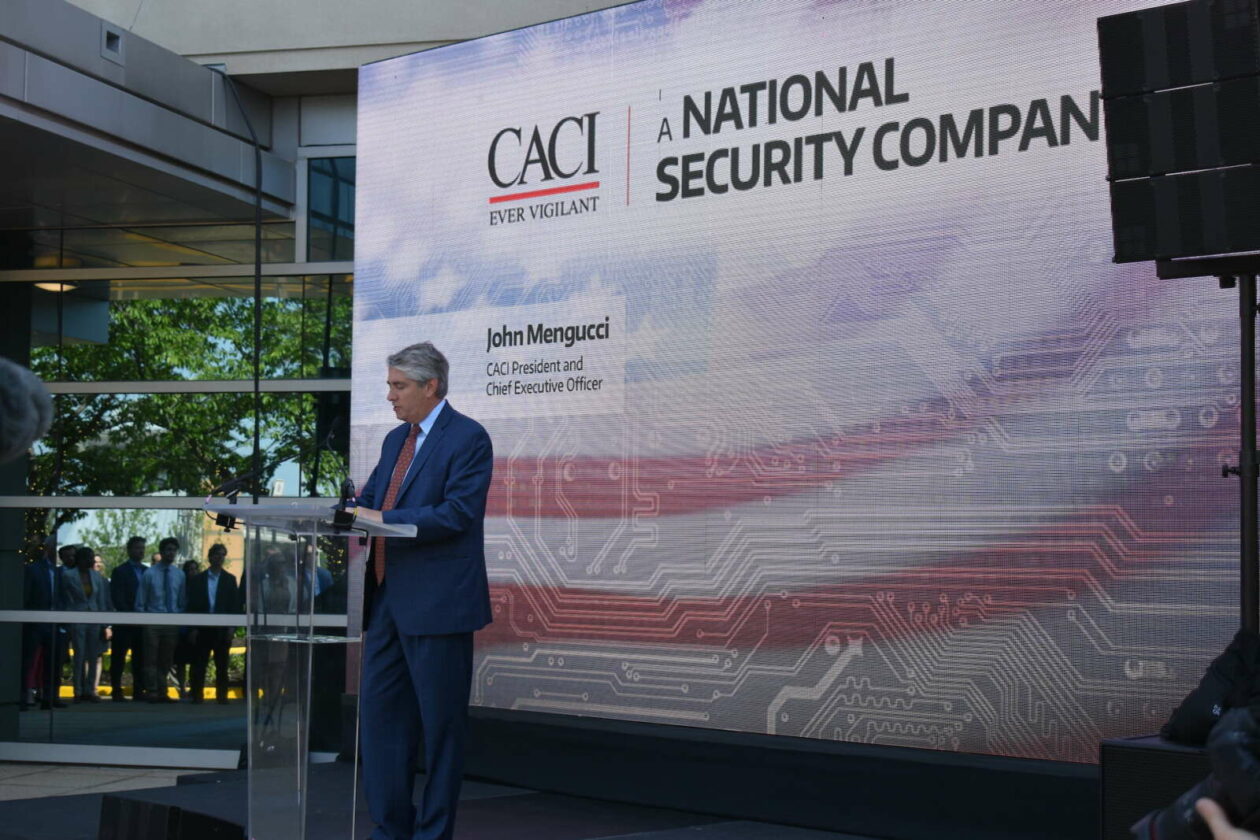
The headquarters included CRADLE, the Center for Research, Application, Development, Learning and Engagement. Even the acronym had a full working day. The idea was to give employees and customers a place to collaborate around difficult problems, and to make the conversation about what technology could accomplish more concrete.
That suits a recurring element of Mengucci’s approach: start with the problem the customer needs solved. A demonstration, a discussion with an engineer and a clearer understanding of the mission can turn an abstract investment plan into a useful decision. The building gave that process somewhere to happen.
The gap that points toward space
Acquisitions are another way to add what is missing. Mengucci has described a sequence that begins with the customer, examines CACI’s capabilities and identifies a gap. Time then affects the answer. Building may make sense when there is room to develop. Buying can shorten the journey. A partner may already have the right capability.
Invest
Develop the capability when there is time.
Acquire
Add capabilities the business needs sooner.
Partner
Work with a company that already does it well.
A visual summary of Mengucci’s public explanation of CACI’s approach.
On March 9, 2026, CACI completed its $2.6 billion purchase of ARKA Group. More than 1,100 employees joined. The acquisition added space sensors, imaging capabilities and AI software, extending a portfolio already concerned with collecting and interpreting information across different domains.
For Mengucci, the deal advanced an existing space strategy. Its significance lay in the combination: ARKA’s imaging and geospatial work alongside CACI’s signals intelligence and other technologies. A purchase of that size also makes the chief executive’s priorities legible. Space had become an area where the company was prepared to commit substantial money.
Other developments supplied more tangible measures of that ambition. In May 2026, CACI announced it was moving into Phase 3 of the U.S. Space Force’s Enterprise Space Terminal program. Its optical communications hardware had undergone interoperability testing at MIT Lincoln Laboratory. The next phase called for building and testing a proto-flight terminal.
There is something useful about that vocabulary. A terminal must be built. It must communicate with other equipment. It must pass tests. Those obligations bring an expansive corporate strategy back to the engineer’s desk, where a broad promise eventually has to become a working object.
The same logic appears closer to the ground. CACI’s TLS Manpack, a portable electronic warfare system for soldiers, received a silver Edison Award in April 2026. Mengucci presented it as an example of investing before formal requirements caught up. The equipment combines functions for working with signals in a software-defined system. His stated ambition has a practical test: can earlier investment put useful capabilities into service sooner?
A balance sheet with obligations attached
For fiscal 2026, CACI reported revenue of approximately $9.6 billion, an increase of 10.9 percent. Total backlog stood at $32 billion at June 30. These figures describe the scale of the organization Mengucci leads; they also raise the stakes for the choices he makes.
Annual revenue, up 10.9% from fiscal 2025.
Expansion carries costs. In the fourth quarter, higher interest expense associated with ARKA and a higher tax provision offset stronger operating income, leaving diluted earnings per share slightly lower than a year earlier. A company can become more capable while individual financial measures move in different directions. Integrating an acquisition and paying for it are part of the job, too.
Back to the campus
Mengucci’s university connection continued long after graduation. He became a Clarkson trustee in 2019, and the university announced his appointment as vice chair in November 2024. He also chaired the search committee for its nineteenth president. The former student had acquired responsibilities for the institution’s next chapter.
He supported Clarkson’s Innovation Hub, a place for students to collaborate and develop ideas. His public comments on talent put weight on attitude, integrity and drive alongside knowledge. That interest fits his wider emphasis on the people who will eventually do the work, before they have acquired impressive titles.
In 2024, he received the Technology Good Scout Award, recognizing technology leaders whose conduct reflects Scouting’s values. Two executive awards followed in 2025. Such recognitions mark chapters in a career; the more revealing thread is the attention he gives to preparation, whether in a company’s capabilities or in its future employees.
The drummer’s early career plan changed at a kitchen table. Decades later, Mengucci’s decisions reach into software teams, classrooms and space programs. His work now involves choosing what to prepare for, who to prepare with, and how much to commit before the next requirement arrives. The audience has changed considerably since Carnegie Hall. There is still a premium on coming in at the right time.
Follow the work
More on Mengucci’s career, conversations and CACI’s work.