electronic-warfare
(10)
CRFS Built a Map for the Invisible Battlefield
Its rugged blue-and-white boxes do not transmit. They listen - then turn crowded radio noise into locations, alerts and evidence for militaries, regulators and intelligence teams.

The Liverpool radar shop that turned a $151 billion missile-defense door into an open one
A 58-person shop in upstate New York builds software-defined radar - and just landed on a defense contract worth up to $151 billion.

Vector Sells the Pentagon a Subscription to Modern Warfare
A 14-month-old drone maker out of Salt Lake City wants to sell the U.S. military warfare the way Adobe sells Photoshop - as a service, updated constantly, billed like a subscription.

Alex Wulff
From high-school science fairs and campus walkie-talkie tests to a New York defense startup, Alex Wulff has spent a decade making invisible signals legible - and low-cost radio hardware useful in the field.
Distributed Spectrum
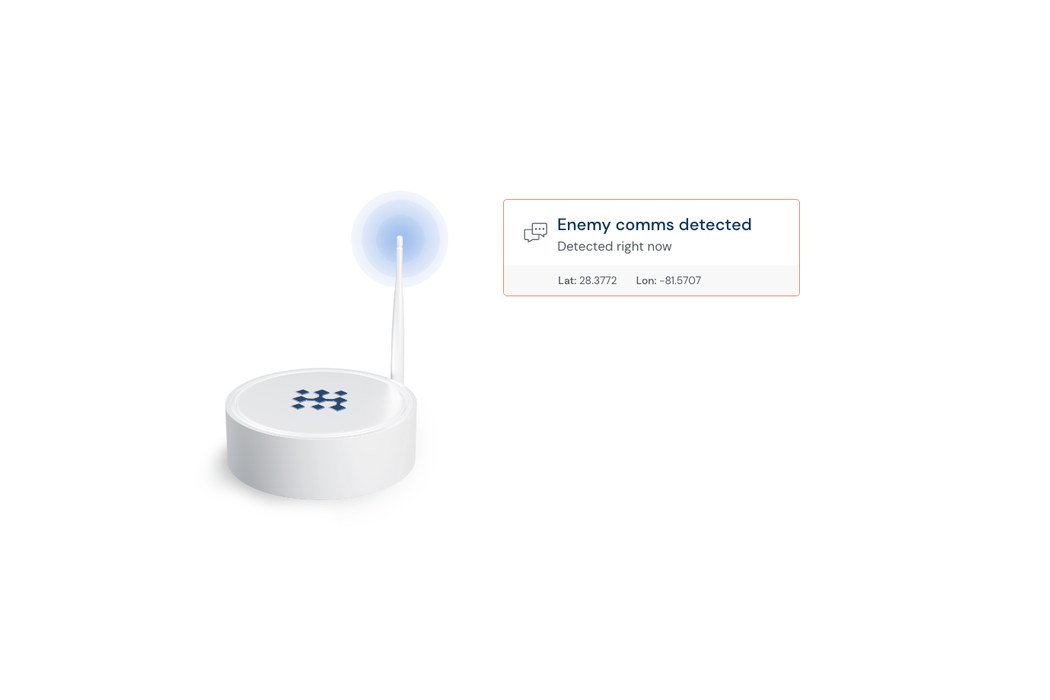
Distributed Spectrum builds AI-powered radio-frequency sensors and software that automatically detect, classify, and locate signals - drones, jammers, tactical radios, GPS spoofers - in real time. Founded by three Harvard engineers, the company packs commercial hardware and edge AI into sub-one-pound sensors that give soldiers and analysts persistent spectrum awareness without specialist RF expertise. It raised a $25M Series A in March 2025 and has fielded systems with US military branches and partners in Ukraine.

Chariot Defense
Chariot Defense is a South San Francisco defense-technology company building hybrid-electric power systems for the battlefield. Its Amphora platform delivers quiet, high-density, software-controlled power to distributed military hardware - drones, sensors, radios, electronic-warfare and directed-energy systems - so that energy never becomes the limiting factor in a fight. Founded in 2024 by former Anduril and Archer engineer Adam Warmoth, the company raised a $34M Series A led by Andreessen Horowitz in February 2026, bringing total funding to roughly $41-42M, and has fielded its systems with the U.S. Army and the Defense Innovation Unit.

S2 Corporation
S2 Corporation is a Bozeman, Montana photonics company that reads the radio spectrum the way a hologram stores an image - all at once. Its core technology, spatial-spectral (S2) holography, uses a cooled, sugar-cube-sized crystal doped with rare-earth atoms as an optical computer that captures and processes radio frequencies across enormous instantaneous bandwidths (0.03 to 110 GHz). Packaged as the Extreme Bandwidth Analyzer and Correlator (EBAC), the technology serves electronic warfare, signals intelligence, RF spectrum monitoring, emitter geolocation, and data mining for U.S. defense and intelligence customers including DARPA and IARPA.

Kris Merkel
Kris Merkel is the President and CEO of S2 Corporation, a Bozeman, Montana deep-tech firm turning rare-earth-doped crystals into an optical computer that watches the entire radio spectrum at once. A physicist by training and a patient operator by temperament, he has spent more than two decades pulling a niche piece of laboratory physics, spatial-spectral holography, out of Montana State University and into the hands of the U.S. Department of Defense, DARPA, and the intelligence community.

CX2
CX2 (CX2 Industries) is an El Segundo, California defense-technology startup building AI-enabled hardware and software for the electromagnetic spectrum. Its systems detect, classify, geolocate, and disrupt hostile RF emitters in jammed and GPS-denied environments, aiming to give allied forces an edge in electronic warfare at a fraction of the cost of legacy systems. Founded in 2024 by a team including Nathan Mintz, Porter Smith, Lee Thompson, and Mark Trefgarne, CX2 has raised about $46M, led by a $31M Series A from Point72 Ventures, and launched its Wraith airborne EW platform in December 2025.

Nathan Mintz
Nathan Mintz is the co-founder and CEO of CX2, an El Segundo defense-tech startup building AI-enabled hardware and software to detect, disrupt, and destroy threats in the electromagnetic spectrum. A Stanford-trained electrical engineer who spent 14 years designing radar and electronic-warfare systems at Raytheon and Boeing, he went on to co-found directed-energy unicorn Epirus and automotive-radar company Spartan Radar before launching CX2 in 2024. He argues modern warfare has reached 'consumer scale,' where multimillion-dollar missiles are wasted on cheap drones, and that control of the spectrum now matters as much as supply lines did in the 20th century. CX2 raised a $31M Series A led by Point72 Ventures in May 2025, part of $46M total funding.