A radio transmission is a confession with no name attached. It can reveal that a drone is approaching, a jammer is nearby, a broadcaster has wandered off license or a supposedly clean room contains a device that should not be there. The confession travels at light speed, crosses walls and leaves no footprint. CRFS has spent nearly two decades building the ears that catch it.
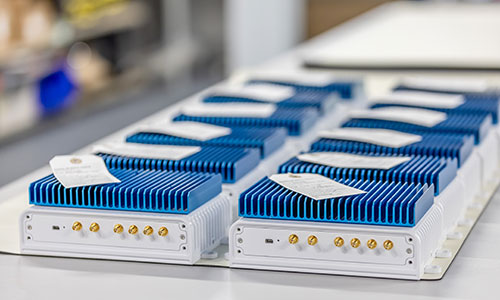
The Cambridge company makes radio-frequency receivers, direction-finding hardware and software under the RFeye name. One Node can sweep the spectrum, capture raw I/Q data and perform signal processing at the edge. Several synchronized Nodes can compare when a signal arrived, how strong it was and the direction it came from. The software turns those differences into a point on a map. More than 4,651 Nodes have been built or supplied, CRFS says, while 319-plus organizations use its software or APIs across six continents.
The useful trick is silence
Radar finds objects by sending energy out and waiting for a reflection. RFeye is passive: it listens for energy that is already there. That makes it useful when an operator does not want to advertise the sensor's position. It also means CRFS is not selling a universal drone detector. It is selling one revealing layer of a wider picture - the radio links, telemetry, navigation signals and other emissions around a target.
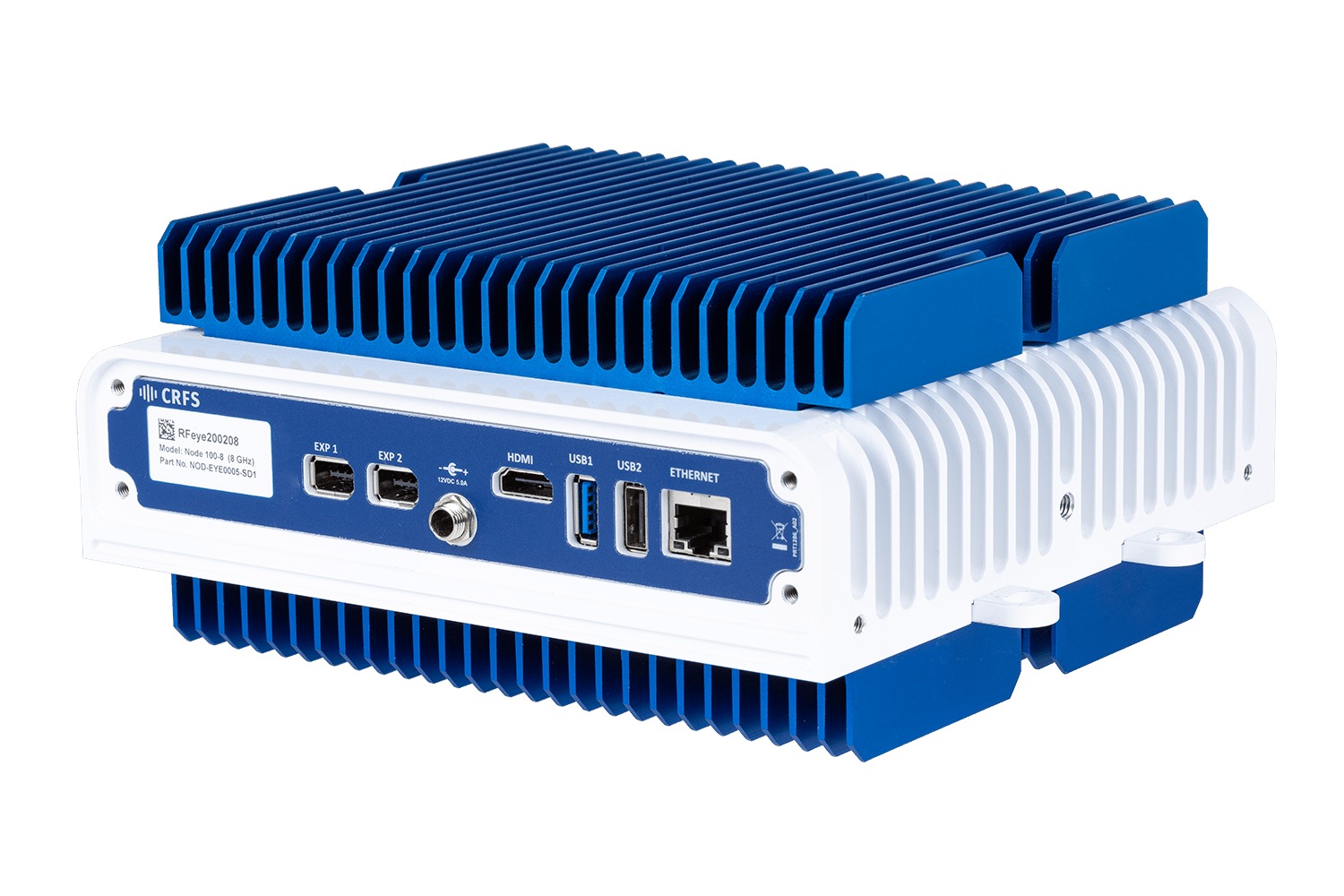
The distinction matters. A passive receiver can sit on a border, at an airbase, above a spaceport or inside a vehicle without adding another transmission to a congested environment. CRFS offers models from 9 kHz to 8, 18 or 40 GHz, with up to 100 MHz of instantaneous bandwidth. Its newest Node Plus 100-18 can sustain that full bandwidth while recording or streaming roughly 550 megabytes a second. That is not a tidy spreadsheet. It is a flood of raw radio evidence.
The product is not the box. The product is the moment an anonymous emission becomes a decision.
A regulator stopped waiting for the phone to ring
The Malta Communications Authority offers the cleanest account of what changes after installation. Its old equipment left officers working reactively: a complaint arrived, a team went out, analysis followed. The authority wanted to understand occupancy, find unused capacity, resolve interference and respond while an incident was happening. CRFS won the tender with an ITU-compliant, competitively priced proposal. The public case study does not disclose the contract value.
The rollout came in three stages. Fixed RFeye Nodes created a time-difference-of-arrival network. A vehicle-mounted RFeye Array added mobile angle-of-arrival direction finding. A Stormcase made the network tactical. RFeye Site handled live monitoring and location; Mission Manager scheduled continuous jobs and alerts. The operational change was simple and expensive to fake: Malta moved from waiting for trouble to spotting it.
No public price list and no disclosed project total. CRFS quotes systems around sensor count, frequency coverage, software, integration, training and support. Customers are buying fewer blind spots and fewer wasted field trips, not a commodity receiver by the kilogram.
The customer request that made the box lighter
CRFS's product development is easiest to understand when a constraint bites. A NATO member already used the 4.2 kg Node 100-18 but wanted comparable RF performance on an unmanned platform in a conflict zone. Weight was the first thing that failed. The resulting Node 100-18 LW weighs 1.95 kg. It won an Army Technology Excellence Award for Innovation in 2024 and can ride on air, ground or surface vehicles.
Another customer needed months of high-fidelity recording at an unattended outdoor site, but bulky laboratory equipment could not live beside the antenna and sensitive data could not remain in the receiver head. CRFS split the problem. The SenS Remote puts the RF head and antennas high on a mast, then sends data over armored fiber to ordinary rack servers and secure storage below. The customer constraint changed the architecture, not merely the brochure.
The most cinematic integration began with an elementary fact: Earth is curved. Ground receivers cannot see beyond the radio horizon. TEKEVER's AR5 unmanned aircraft can remain aloft for up to 20 hours, so a customer brought TEKEVER and CRFS together. Engineers placed RFeye Nodes on the aircraft, worked around interference from its own transmitters, selected antenna positions and filters, and used Silvus tactical radios for the downlink. Altitude extended line of sight; the flying receiver could help geolocate emitters farther away while remaining outside the most dangerous area.
One sensing core, several kinds of buyer
National regulators use RFeye to police licenses, hunt interference and watch major events. Defense and intelligence teams use it for electronic support, signals intelligence, border surveillance and passive air defense. Security services look for illicit transmitters inside protected sites. Space operators monitor frequencies that could interfere with payloads. Research teams record I/Q data in the field. Systems integrators take the hardware and open APIs, then fold RF results into command platforms, vehicles and programs of record.
This breadth is not the usual corporate claim that one product serves everyone. Radio is the shared substrate. The same receiver can listen, but the workflow changes. RFeye Site gives an expert live measurements, hybrid geolocation and simulation. Mission Manager automates repetitive jobs for multiple users. DeepView lets an experienced analyst comb through terabytes after the event, searching for a weak, brief or hopping signal. CRFS sells the hardware, software bundles, engineered integration, training and a support-and-updates subscription called SSUS. Prices stay behind the sales conversation.
The moat is a system, not a frequency chart
Rohde & Schwarz, Keysight, Anritsu, Tektronix, Aaronia and the major defense-electronics groups all sell credible ways to observe RF. CRFS's distinction is packaging: identical sensor DNA across fixed, mobile, tactical and airborne deployments; processing near the antenna to reduce backhaul; three complementary software layers; multiple location methods; and APIs that let another contractor treat RFeye as a subsystem rather than a closed console.
That position explains the 2025 deal. Motorola Solutions acquired Silvus Technologies for $4.4 billion upfront, plus potential earnouts, and announced the following month that CRFS Limited and CRFS, Inc. had joined it as part of the transaction. No standalone price for CRFS was published. The industrial logic is clearer than the accounting: Silvus moves mission data across resilient mesh networks, CRFS finds and interprets emissions, and Motorola supplies communications and command technology to many of the same security customers.
What a smaller company can copy
CRFS offers a useful industrial playbook. Start with one costly blind spot: spectrum teams could not afford continuous eyes everywhere. Put the difficult engineering into a reusable core. Make that core rugged enough to escape the laboratory. Separate expert, automated and forensic workflows instead of forcing every user into one interface. Expose APIs. Then let customer constraints - a mast, a drone, a secure recorder, a national network - shape the packaging around it.
The approach does not work by magic. Time-based geolocation needs synchronized sensors with good geometry and enough line of sight. Angle finding suffers around reflections. A passive RF system cannot detect an object that emits nothing in its observable bands. Raw I/Q recording devours storage and analyst attention. Machine-assisted filters reduce cognitive load, but an unfamiliar signal in heavy noise can still demand a trained operator. CRFS itself describes DeepView as a tool for experts, not novices.
Targets emit, sensors surround the area, timing is disciplined, terrain is understood and the RF layer can feed a broader operating picture.
Targets are radio-silent, propagation is blocked, receivers sit in a poor line, storage is thin or nobody has the expertise to interpret what was captured.
Alistair Massarella co-founded CRFS in 2007 with Cambridge entrepreneur David Cleevely. By 2014, the company was 45th on the Sunday Times Hiscox Tech Track 100 after average annual sales growth of 69 percent over three years. It had already received a Queen's Award for international trade and won major overseas contracts. The names of many later customers disappeared behind the discretion of defense work, but the device count kept climbing.
The achievement is less mysterious than the spectrum CRFS watches. It found a narrow problem with a growing cost, built the same answer in enough physical forms to travel, and turned signals into something a human or another machine can use. The battlefield may be invisible. The business is refreshingly concrete.