A defense technology demonstration can be a beautifully arranged disappointment. The screen works. The data appears. Everyone understands what the tool might do. Then comes the less photogenic question: can the people who need it actually use it, on their networks, with their permissions, during their working day?
Research Innovations has spent much of its life in that interval. In September 2026, the Army announced a $96.9 million contract for the company’s Dragonfly sensors integrated aboard Menet Aero’s Intrepid 1200 unmanned aircraft. It is a five-year ordering vehicle, rather than a statement of money already earned. Still, it gives a concrete shape to RII’s ambition: technology that gets beyond the demonstration table.
- The job: connect data, decisions and operators across defense missions.
- The tools: PRIISM command software, Dragonfly signal intelligence and cyber engineering.
- The method: reusable technology, mission-specific integration and experts beside users.
- The business: government and allied contracts that buy deployment and support as well as products.
A founder who missed the small company
Rich Briggs founded RII in 2009. He had already built and sold a business. In a 2016 interview, he explained the attraction of doing it again: he missed the freedom to shape an innovation-focused culture in a smaller organization. There is something appealingly unfashionable about that origin. The interesting object was the company itself - a place where technical decisions could be made close to the problem.
RII’s early assignments made that proximity practical. Its first DARPA contract, in 2010, supported TransApps, a program for getting mobile applications into operational use. In 2011 came a first prime contract through the Army Geospatial Center’s GRIDS II program and a first international contract supporting Canada’s Joint Warfare Centre. Software development and coalition work arrived together.
By 2019, RII was announcing a $40 million follow-on contract for the information environment, using task coordination and collaborative mission management frameworks. Its account of the development process emphasized experts embedded with users and continuous feedback. The recurring idea was to shorten the distance between the person describing a mission and the person writing the software.
The common picture has a permissions problem
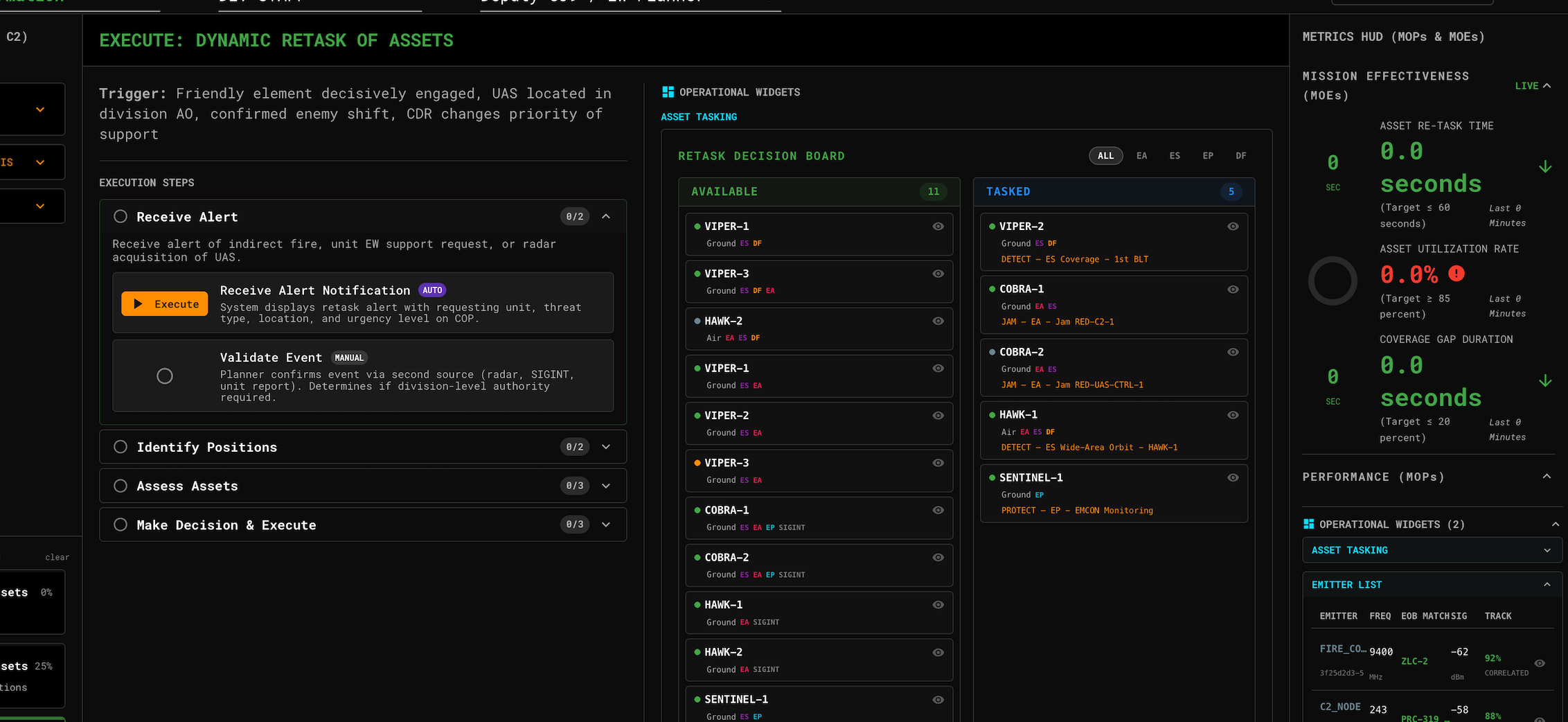
RII’s software answer is PRIISM, launched as a Decision Advantage Platform in 2023. Its current product page calls the suite PRIISM MAX. It combines command-and-control capabilities for tasks such as targeting, planning, network operations and coordination across allied forces. Command and control sounds forbidding; at its most ordinary, it means helping a large organization agree on what is happening and what to do next.
A shared picture becomes complicated when the participants belong to different services or countries. An ally may need a particular piece of information without being entitled to everything behind it. PRIISM supports configurable controls over what can be released across sovereign networks. Sharing and withholding have to coexist inside the same working system.
The company describes AI-assisted workflows that use doctrine, intelligence and available assets to generate recommendations. Its stated design keeps review checkpoints and commanders in the process. That is a consequential product choice. A recommendation must fit the rules of the institution using it, and someone must remain accountable for acting on it.
“The algorithm advises. The commander decides.”RII’s PRIISM product page
There is a less glamorous advantage in the workspaces. Users can arrange dashboards around the data and visualizations they need. RII’s UK marketplace description includes low-code and no-code querying. For planners and analysts, the appeal is practical: organize the relevant material without commissioning a fresh interface for every question.
The approval queue is part of the product
A working application still needs permission to enter an operational environment. RII’s 2025 partnership announcement with Second Front Systems identified deployment and accreditation as a persistent bottleneck. The response was to use Second Front’s Game Warden platform for the route onto government and allied networks.
In June 2026, the companies announced that PRIISM had been authorized for use in Impact Level 5 and 6 environments through Game Warden. RII said it inherited a baseline of security controls from the platform. The development is useful evidence of a deployment milestone; it does not establish blanket permission on every customer network.
- 01BuildReusable capabilities
- 02FitMission workflows
- 03AuthorizeNetwork controls
- 04FieldSupport operators
That sequence offers a lesson other enterprise builders can borrow. Authorization, integration and training deserve places in the product plan. A beautifully designed application cannot make an organization’s data-sharing policy disappear. RII’s approach treats those obstacles as work to be funded and completed.
A listening post that travels light
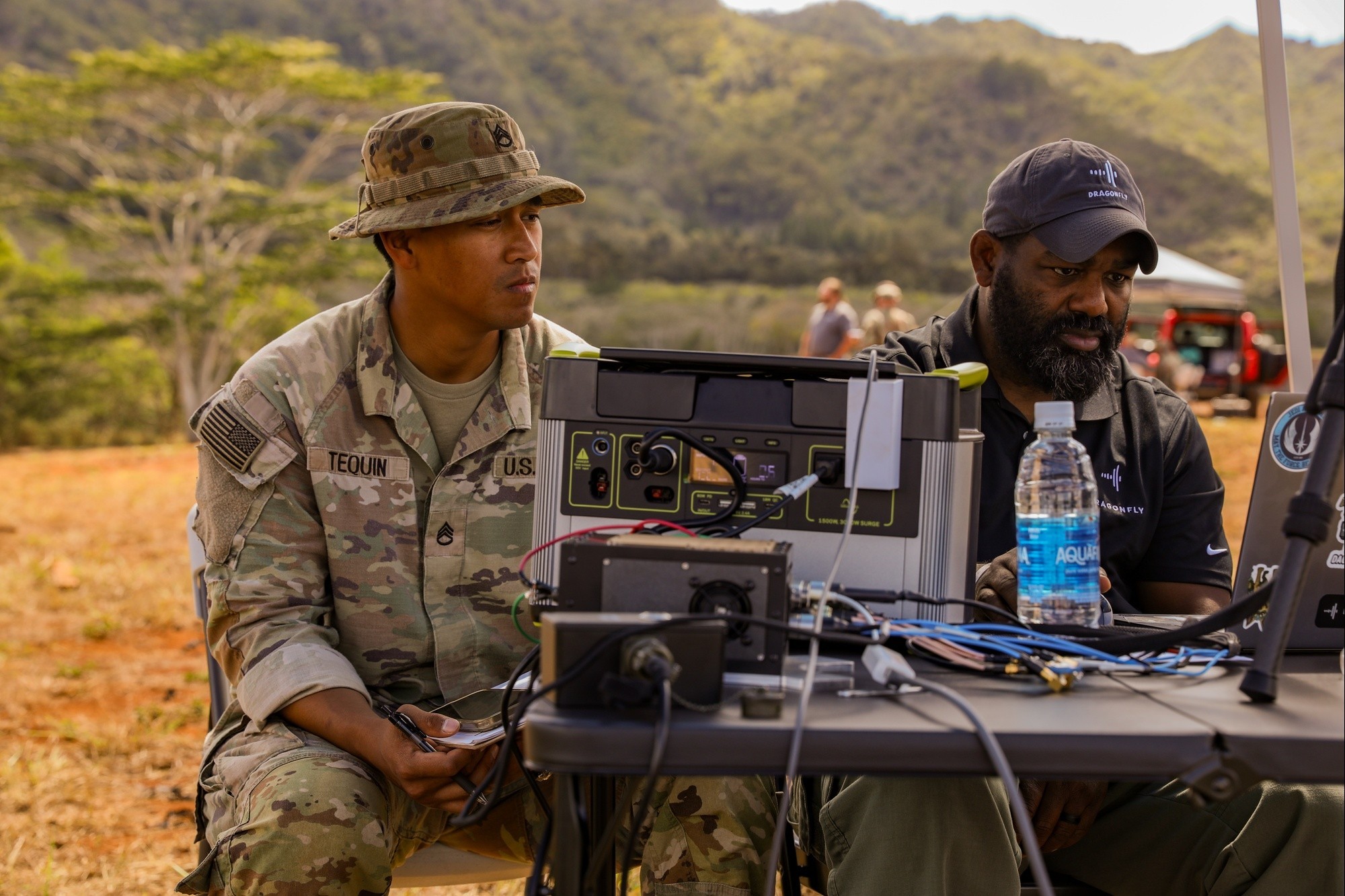
Dragonfly moves the story from the operations screen to the electromagnetic spectrum. RII describes a ruggedized, GPU-accelerated platform weighing 3.5 pounds, capable of processing signals onboard without requiring a connection back to the cloud. Its jobs include signal classification, direction finding, geolocation and spectrum survey.
One particularly useful detail is retrospective analysis. The company says Dragonfly retains a rolling record of up to an hour of spectrum data. A transmission can stop before an operator decides it matters. Keeping the record allows the investigation to continue after the signal has gone quiet. The memory is part of the instrument.
Portable processing. A rolling spectrum record. No cloud reachback required for onboard processing.
The Army’s September production announcement places Dragonfly aboard a named unmanned aircraft platform. In June, RII had also announced GSA purchasing availability in two configurations. These are distinct routes to buying equipment. They matter because the physical product and the purchasing machinery must both fit the customer.
Passive radio-frequency sensing has conditions of its own. As a matter of the sensing method, detection depends on observable emissions, coverage and geometry. Onboard processing helps where connectivity is constrained; it does not guarantee that every threat will produce an observable signal. Buyers still need trials suited to their mission.
The invoice includes the people
RII sells proprietary software access, hardware and services through government and allied-defense contracts. Its public 2024 G-Cloud pricing document is unusually revealing. A 12-month base PRIISM package, optimized for up to 250 users in one organization, was listed at $3,051,642. The package included management, configuration tailoring, testing, maintenance and operational support.
That dated figure describes a bundled organizational purchase. It is not a current universal subscription rate. The same document separately prices solution modules, additional training, network-node deployments and accreditation support. A buyer is paying to change a working process, with software and people supplied together.
The UK listing says RII had trained more than 10,000 users globally. Read that number carefully: cumulative training is different from active usage. What it does show is that instruction and adoption belong to the offering. The customer receives a tool and help making it useful.
Partners on one job, alternatives on another
RII occupies the ground where defense software products meet specialist engineering. Its cyber business adds vulnerability research, reverse engineering and offensive cyber capabilities. Its SIFT toolkit serves another kind of operator: Justice Department investigators working through documents and diverse data to understand financial crime.
In 2020, an RII-led team won a DOJ Money Laundering and Asset Recovery Section assignment that replaced the incumbent Palantir solution, according to teammate BreakForth Solutions. The team included DataWalk, Eastport Analytics and Ernst & Young. RII later announced a five-year extension for its SIFT-supported DOJ program in 2025. The comparison is specific to an assignment, rather than proof that one platform wins everywhere.
The market also rewards cooperation. RII joined Team Anduril for the Army’s Next Generation Command and Control prototype in 2025. Its separate Phase II Tactical NetOps team included CodeMettle, Resilient Cognitive Solutions and Sherpa 6, with planned operational events involving the 25th Infantry Division. Specialized products and partner expertise are assembled around the job.
Onesies, operators and a useful lesson
RII’s careers page says a third of its team has worn the uniform. It also advertises Onesie Tuesday, Pi Day and CanaRII, an internal program matching employee research ideas with customer needs. The spelling gets a workout. The details suggest a deliberate effort to give technically demanding work a less solemn office life.
The lesson to borrow is concrete: put experienced users near the builders, preserve a reusable technical core, and budget for the work around deployment. This is an interpretation of RII’s method, rather than a recipe for guaranteed results. It depends on access to users, suitable data, institutional permissions and the means to support adoption.
For a command, program office or investigative organization, RII offers a route from fragmented information to coordinated work. Its best test is equally concrete: run the product against the actual workflow, on the intended network, with the people expected to use it. The demonstration earns the meeting. Daily use earns the next one.