DEC 2025 CX2 launches Wraith, a 32-lb airborne EW platform for the jammed battlefieldSERIES A $31M raised, led by Point72 VenturesDIU ~$2M DRM3 contract; Vadris downselectedFIELD TEST Wraith held geolocation against a 300-watt GPS jammerNATO Flown at JMRC, Hohenfels, GermanyBUILT IN El Segundo, CaliforniaDEC 2025 CX2 launches Wraith, a 32-lb airborne EW platform for the jammed battlefieldSERIES A $31M raised, led by Point72 VenturesDIU ~$2M DRM3 contract; Vadris downselectedFIELD TEST Wraith held geolocation against a 300-watt GPS jammerNATO Flown at JMRC, Hohenfels, GermanyBUILT IN El Segundo, California
Defense / Electronic Warfare
CX2
Winning the war you cannot see - in the electromagnetic spectrum.
El Segundo, CA • Founded 2024 • ~$46M raised
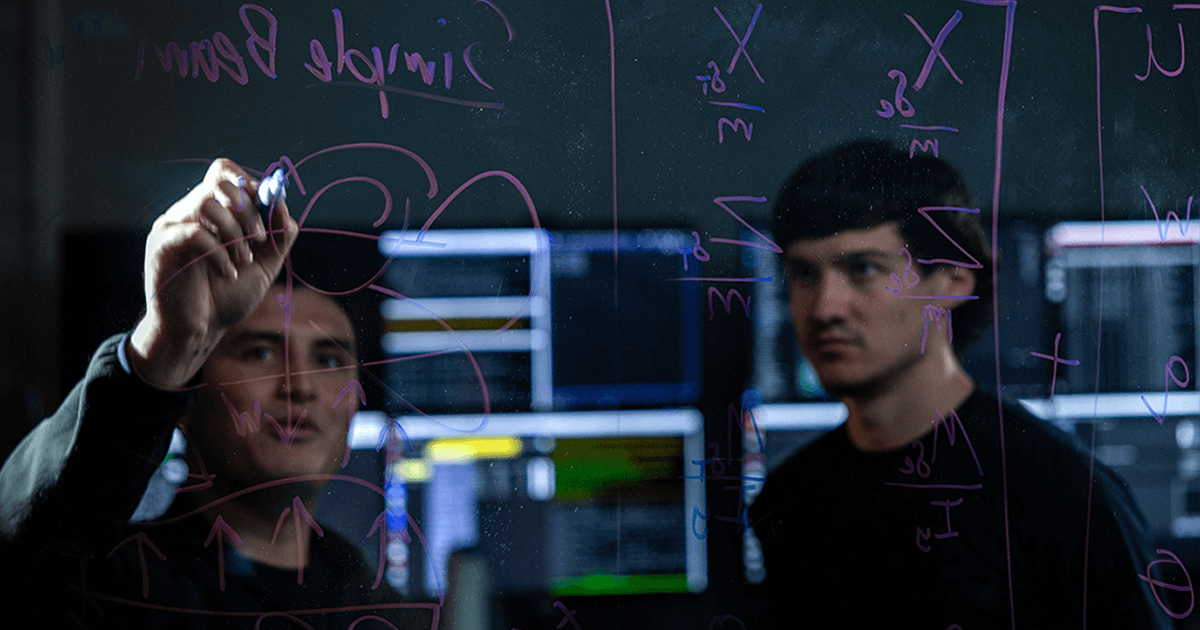
The CX2 lab in El Segundo, where the unglamorous parts of electronic warfare get soldered together. The spectrum is invisible; the workbench is not.
The Dispatch
A drone takes off, and the invisible battlefield lights up
Two people, a few minutes, a thirty-two-pound aircraft. It climbs into airspace where GPS has been jammed into uselessness and radios go to static. Most equipment up there goes blind. This one does the opposite. It listens. It draws a map of every hostile signal below - the jammers, the control links, the ground stations quietly running someone else's drones - and hands that map to the people who need it. The aircraft is called Wraith. The company that built it is CX2.
CX2 is a defense-technology startup in El Segundo, California, with roughly 58 employees and a fairly specific obsession: the electromagnetic spectrum, and who controls it. Not the trenches, not the airspace, but the invisible layer of radio energy that every modern weapon now depends on. CX2 builds AI-enabled hardware and software that detects, disrupts, and defends that layer. They call the goal "spectrum dominance." It sounds abstract until you realize that almost nothing on a battlefield works without it.
"Wraith allows ground forces to see the invisible battlefield. If you can find key emitters, you can initiate the kill chain."
Here is the uncomfortable arithmetic. A cheap first-person-view drone costs about two thousand dollars. The missile traditionally used to shoot one down can cost two million. You can win every engagement and still lose the war, simply by going bankrupt one interception at a time. Ukraine made this visible to anyone paying attention: the front line is increasingly defined by who jams whom, who sees whom first, and who can afford to keep doing it.
Legacy electronic-warfare systems were not built for this. They are expensive, slow to field, and tied to programs that take years and nine-figure budgets. They were designed for a world of large platforms fighting other large platforms, not swarms of disposable drones flooding the spectrum. The threat got cheap and fast. The defense stayed costly and slow. That gap is the thing CX2 exists to close.
"It no longer makes sense to fire a $2 million missile to take out a $2,000 drone."
It is a tidy irony of the current arms race that the most advanced militaries on earth can be drained by hardware you could assemble from a hobby catalog. CX2's wager is that the answer is not a bigger missile. It is better information, delivered cheaply, at the speed the spectrum actually moves.
The Bet
Four founders who had each seen the gap from a different angle
The genesis is almost too neat. Porter Smith, a military veteran and former investment partner at Andreessen Horowitz, went to Ukraine in 2023 and watched electronic warfare decide engagements in real time. He came back convinced the spectrum was the decisive domain - and called Nathan Mintz. Mintz is a Stanford-trained electrical engineer who spent roughly fourteen years on EW and radar systems at Raytheon and Boeing, then co-founded the directed-energy company Epirus, which became a defense unicorn, and later the automotive-radar startup Spartan Radar. He had spent his career on exactly this problem.
They were joined by Lee Thompson, who worked on radio and RF systems for SpaceX's Starship program and became CX2's CTO, and Mark Trefgarne, who had built the video ad exchange LiveRail and sold it to Meta for around $500 million before becoming the company's president. It is an unusual mix - directed-energy physics, rocket-grade radio engineering, and consumer software scaling - and that is rather the point. CX2's bet is that electronic warfare should look less like a defense program and more like a fast-moving hardware-plus-software company.
Nathan Mintz
Co-Founder & CEO
EW/radar engineer from Raytheon and Boeing; co-founded Epirus and Spartan Radar.
Porter Smith
Co-Founder & CSO
Military veteran and former a16z investment partner; the Ukraine trip that started it all.
Lee Thompson
Co-Founder & CTO
Radio/RF systems engineer who worked on SpaceX's Starship program.
Mark Trefgarne
Co-Founder & President
Built LiveRail and sold it to Meta; brings software-scaling instincts to hardware.
From a phone call to a flying platform in about two years
2023
Porter Smith's trip to Ukraine becomes the founding conversation: the spectrum is the decisive domain.
SEP 2024
CX2 emerges from stealth; founders publish "The Future of Warfare is Electronic" in the Wall Street Journal.
2024
Seed funding from 8VC, a16z, Joe Lonsdale, David Ulevitch and others gets the company moving.
MAY 2025
$31M Series A led by Point72 Ventures, with a16z, 8VC, 201 Ventures, Pax Ventures and Upfront Ventures.
2025
Wins ~$2M DIU DRM3 contract; Vadris RF-seeking payload downselected; Wraith flown at NATO's JMRC.
DEC 2025
Public launch of Wraith, the airborne EW platform built for the jammed battlefield.
The Product
A sensor that hunts, and a payload that finishes
CX2's core insight is a pairing it sums up as "Hunt the Archer, not the Arrow." Wraith is the hunter. It is a Group 2 unmanned aircraft, about thirty-two pounds, NDAA-compliant, deployable by two people in minutes. In environments where GPS has been jammed, it navigates by visual odometry and multiband GNSS rather than going dark. It detects, classifies, and geolocates hostile emitters and produces spectral heatmaps of the battlefield - turning invisible radio energy into something a commander can actually point at.
Platform • Sensor
Wraith™
A ~32-lb airborne EW platform that detects, classifies, and geolocates GPS jammers, FPV jammers, C2 links, and drone ground stations - even when GPS is denied. Launched December 2025.
Payload • Effector
Vadris™
An RF-seeking payload that turns a low-cost FPV drone into the "arrow" of the kill chain. Downselected by the Defense Innovation Unit for continued evaluation.
"Hunt the Archer, not the Arrow."
- The CX2 kill-chain doctrine, in five words
The economics are the real product. A Wraith finds the emitter; a cheap drone carrying Vadris flies to it. The expensive part is the information, not the explosive - and the information is reusable. It is a quietly subversive design: instead of matching an adversary's cheap drones with costly missiles, CX2 tries to make the defense cheaper than the offense. The spectrum, for once, on a budget.
The Proof
Money, contracts, and a 300-watt jammer that did not work
$46M
TOTAL RAISED
$31M
SERIES A
~58
EMPLOYEES
32 lb
WRAITH WEIGHT
In May 2025, CX2 closed a $31 million Series A led by Point72 Ventures, with participation from Andreessen Horowitz, 8VC, 201 Ventures, Pax Ventures, and Upfront Ventures - bringing total funding to roughly $46 million. That capital follows real customer signal. The Defense Innovation Unit awarded CX2 a roughly $2 million DRM3 contract and downselected Vadris for continued evaluation. Wraith was developed under a cooperative R&D agreement with a U.S. government partner, evaluated by the U.S. Army, and flown at NATO's Joint Multinational Readiness Center in Hohenfels, Germany.
Funding to date
CX2 / approximate, by round (USD millions)
Seed (2024)
~$15M
Series A (2025)
$31M
Total raised
~$46M
Seed amount is approximate / implied from public reporting. Series A and total are reported figures.
The most telling data point is not financial. In testing, Wraith held accurate geolocation against a 300-watt GPS jammer - the kind of brute-force interference designed to make exactly this sort of aircraft useless. It kept working. For a company whose entire thesis is "we operate where others go blind," that is the proof that matters.
"CX2 delivers spectrum dominance to the battlefield - hardware and software that see, disrupt, and defend the electromagnetic domain in contested environments."
- CX2 mission statement
The Mission
Make sure the right side can always see
CX2's stated mission is to ensure its allies always have the upper hand in the electromagnetic spectrum: to illuminate the unseen battlefield, outmaneuver adversaries, and enable decisive action anywhere, anytime.
Strip away the defense vocabulary and the idea is simple. The spectrum has become contested space, and most of the systems guarding it were designed for a slower, more expensive era. CX2 wants the people it works with to keep their senses when an adversary tries to take them away - and to do it without spending a fortune per engagement. It is a hardware company, but its real output is awareness.
Why It Matters Tomorrow
Cheap drones are not going away. Neither is the spectrum.
The trend that created CX2 is not reversing. Drones get cheaper and more numerous every year, and every one of them lives or dies by radio. Whoever can read and shape the spectrum - quickly, cheaply, at scale - holds the advantage. CX2 is betting that this advantage belongs to companies that ship like software firms and think like RF engineers, rather than to programs measured in decades. Whether they are right is the open question. The contracts, the field tests, and the jammer that failed to blind them suggest they are at least asking it seriously.
"The threat got cheap and fast. CX2's bet is that the defense can too."
- The whole thesis, in one line
Return to that drone over the jammed field. Two years ago, the spectrum below it was a fog: everyone's signals, hidden, equal, unreadable. Now a thirty-two-pound aircraft turns that fog into a map, hands it to the people who need it, and points a cheap interceptor at the thing that was hiding. The invisible battlefield is still invisible. CX2 just decided that should not be an excuse.
Compiled from public sources, including CX2's website and newsroom, LA Business Journal, Axios, Defence Blog, and Tracxn. Funding figures are reported or approximate; the seed amount is implied from public reporting. Some details (valuation, exact founding date) remain unconfirmed.