Breaking $25M Series A led by Conviction & Shield Capital Sensors deployed on drones in Ukraine Contracts with US Army, Navy & Air Force One-pound AI sensor built from ~$1,500 of commercial parts Founded by three Harvard engineers Backed by Nat Friedman & Gen. Stanley McChrystal Breaking $25M Series A led by Conviction & Shield Capital Sensors deployed on drones in Ukraine Contracts with US Army, Navy & Air Force One-pound AI sensor built from ~$1,500 of commercial parts Founded by three Harvard engineers Backed by Nat Friedman & Gen. Stanley McChrystal
Company Profile — Defense · AI · RF Sensing

Distributed Spectrum

The radio spectrum is invisible, crowded, and increasingly weaponized. This New York startup builds one-pound, AI-driven sensors that find the signals that matter - drones, jammers, tactical radios - and pin them to a map in real time.

$25M
Series A · 2025
<1 lb
Smallest sensor
~38
Employees
2020
Founded
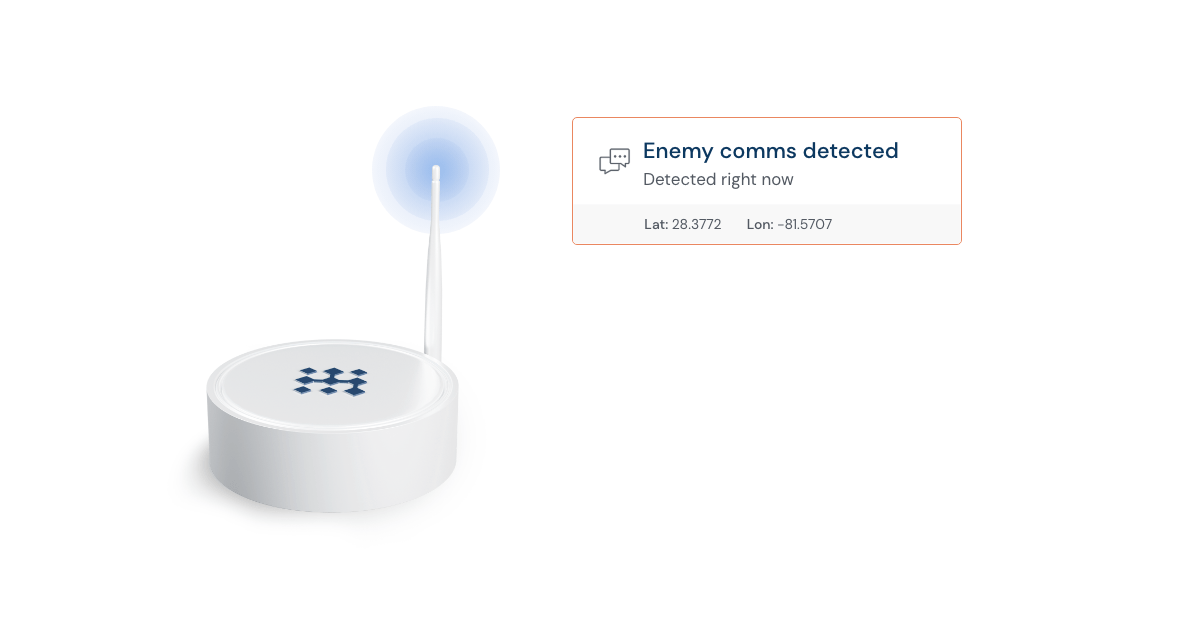
A Distributed Spectrum RF sensor detecting enemy communications, with a real-time alert reading 'Enemy comms detected' and a location fix.
THE DETECTOR. A palm-sized Distributed Spectrum sensor flags an emitter and returns a location fix - "enemy comms detected," latitude and longitude, right now. Product image: Distributed Spectrum.
The Dispatch

Making the Invisible Legible

On a modern battlefield, the most consequential things in the air are the ones nobody can see. Drones fly on radio links. Missiles and munitions lean on GPS. Soldiers talk on tactical radios, and adversaries jam all of it with directed bursts of noise. Every one of those systems announces itself in the radio spectrum - if you have something that can listen. Distributed Spectrum builds that something.

The company makes small, ruggedized radio-frequency sensors paired with edge artificial intelligence that automatically detect, classify, and geolocate signals in real time. It calls the result "the world's first AI signals expert," and the pitch on its homepage is blunt: "Radio signals are everywhere - we find the ones that matter." A sensor no larger than a hockey puck can register an emitter, decide what it is, and push an alert - "enemy comms detected," with coordinates attached - to an operator who never had to open a manual on electronic warfare.

That last part is the point. Traditionally, reading the spectrum has been the province of expensive equipment and a thin bench of specialists who knew how to run it. Distributed Spectrum's wager is that machine learning can do the interpreting, cheap commercial hardware can do the sensing, and the whole capability can be handed to a soldier, an analyst, or a base security team without a graduate degree in signal processing.

"Radio Signals Are Everywhere - We Find The Ones That Matter." — Distributed Spectrum, company tagline
The Problem

Persistent Awareness at the Tactical Edge

The gap Distributed Spectrum set out to close is what the defense world calls the lack of persistent spectrum awareness at the tactical level. Legacy electronic-warfare gear tends to be large, costly, and scarce - a few high-end systems guarded by a few trained operators. That works when threats are rare and predictable. It works badly against a war saturated with cheap drones and radio-controlled weapons, where the emitters are everywhere and the question is not whether you own one exquisite sensor but whether you can blanket an area with many.

The company's answer is a mesh of inexpensive sensors that each carry their own intelligence. Because processing happens locally - on the device, at the edge - the network doesn't depend on a fragile connection back to a data center to decide that a signal is a jammer or a drone controller. Detections, classifications, and location fixes are produced on the spot and shared across the mesh.

How it differs from the incumbents

Advisor and investor Gen. Stanley McChrystal, the retired four-star, frames Distributed Spectrum as "cheaper, more nimble" than the traditional defense primes such as Raytheon and L3Harris. The contrast is deliberate. Where the incumbents sell integrated systems that a program office procures over years, Distributed Spectrum builds units from hot-swappable commercial components - software-defined radios and Nvidia Jetson minicomputers - that reportedly cost roughly $1,500 to $2,000 in hardware apiece and can be repaired or upgraded in the field.

Sensor weight (smallest unit)< 1 lb
Approx. hardware cost per unit~$1,500–$2,000
Human RF expertise required to operateMinimal
Autonomy: on-device edge AI processingHigh

Bars illustrate the company's design priorities described in public reporting - low weight, low cost, low operator burden, high autonomy. Values approximate.

Products & Services

What Ships in the Field

Flagship

AI RF Sensor Network

A mesh of small, ruggedized sensors built from software-defined radios and Nvidia Jetson edge computers that autonomously detect, classify, and geolocate signals across an area.

Software

Edge AI Detection

Machine-learning software running locally on each sensor identifies communications, jamming, drone-control, and GPS-interference signals and issues real-time alerts.

Dismounted

Soldier-Portable Devices

Handheld and wearable units that warn dismounted troops of approaching drones or nearby enemy cellular and radio activity.

Fixed site

Base Spectrum Monitoring

Stationary systems that continuously watch the radio environment around military bases and critical sites for anomalies and threats.

The business model

Distributed Spectrum sells to governments. Its revenue comes from development and production contracts with US military branches and intelligence agencies - hardware sensors plus the edge-AI software that makes them useful - positioned as a lower-cost, distributed alternative to legacy electronic-warfare equipment. In the year before its Series A, the company reported roughly $7 million in contracts from the Department of Defense and an undisclosed intelligence agency, and it holds development contracts across the Army, Air Force, and Navy.

Who uses it

The customers are frontline and force-protection users: soldiers who need to know a drone is inbound, base teams monitoring for unusual emissions, and analysts mapping the radio environment across wide areas. The company's sensors have also been used operationally in Ukraine, where a partner strapped them to drones to hunt adversarial jammers and drone-control signals under live-fire conditions.

The Founders

A Thesis That Became a Company

Distributed Spectrum began in 2020 as an undergraduate thesis idea at Harvard and turned into a startup during a COVID-19 gap year. Its three founders - all engineers, all around 25 - built the first version, won a Department of Defense hackathon prize, and kept going.

AW

Alex Wulff

Co-Founder & CEO
BH

Ben Harpe

Co-Founder
IS

Isaac Struhl

Co-Founder
"The World's First AI Signals Expert." — Distributed Spectrum, on what the product is meant to replace
Funding & Backing

The $25 Million Round

In March 2025 Distributed Spectrum closed an oversubscribed $25 million Series A led by the venture firms Conviction and Shield Capital, with tech entrepreneur Nat Friedman. Existing investors Felicis and XFund joined, alongside angels spanning technology, defense, and AI - including Gen. Stanley McChrystal, Ramp's Eric Glyman, researcher Chris Re, Dropbox co-founder Arash Ferdowsi, Matt MacInnis, Zak Stone, and executives from Palantir.

Series A (Mar 2025)$25.0M
DoD & intel contracts (prior year)~$7.0M
Indo-Pacific EW competition prize$150K
DoD hackathon prize (2021)$25K

Total funding to date: roughly $25.2M. Bars scaled to the Series A.

Timeline

From Gap Year to Live-Fire

2020

Founded during a COVID gap year

Harvard engineers Alex Wulff, Ben Harpe, and Isaac Struhl turn a thesis idea into Distributed Spectrum.

2021

DoD hackathon win

A $25,000 Department of Defense prize helps launch the company and validate the approach.

2024

Contracts and competition wins

Roughly $7M in DoD and intelligence contracts, plus a $150,000 Indo-Pacific electronic-warfare competition.

2025

$25M Series A

Oversubscribed round led by Conviction and Shield Capital; sensors deployed with a partner in Ukraine.

The Market

Where It Fits

Distributed Spectrum sits at the intersection of three currents: the surge of venture capital into defense technology, the spread of cheap drones that has made the radio spectrum a live front in every conflict, and the arrival of edge AI capable enough to interpret signals on a device that fits in a hand. It competes on one side with the established electronic-warfare divisions of primes like Raytheon and L3Harris, and on the other with a wave of newer defense-AI startups. Its differentiation is consistent across public reporting: smaller, cheaper, more autonomous, and usable by non-specialists.

Whether that thesis scales from a handful of contracts into a durable business is the open question every early defense startup faces. What is verifiable today is narrower and more concrete - a young company with a working product, real contracts, real deployments, and $25 million to find out.

Fast facts

Cocktail-napkin scale

Founders have compared the smallest sensor's size to a stack of cocktail napkins - under a pound.

Off-the-shelf inside

Each unit uses about $1,500–$2,000 of commercial hardware, including Nvidia Jetson minicomputers.

A four-star on the cap table

Retired Gen. Stanley McChrystal is both an investor and an advisor.

Watch & Listen

Interviews & Demos

FAQ

Common Questions

What does Distributed Spectrum do?

It builds AI-powered radio-frequency sensors and software that automatically detect, classify, and locate signals such as drones, jammers, and tactical radios in real time.

Who founded Distributed Spectrum?

Harvard engineering students Alex Wulff (CEO), Ben Harpe, and Isaac Struhl, who started the company in 2020.

How much funding has it raised?

A $25 million Series A closed in March 2025, led by Conviction and Shield Capital with investor Nat Friedman, bringing total funding to roughly $25.2 million.

Who are its customers?

US military branches (Army, Navy, Air Force), an undisclosed intelligence agency, and frontline partners in Ukraine.

How is it different from legacy defense contractors?

Instead of large, expensive systems, it uses small, sub-one-pound sensors built from about $1,500–$2,000 of commercial hardware plus edge AI - making spectrum sensing cheaper, more distributed, and usable without RF specialists.

Connect

Links & Resources