A sensor can see something a person cannot. That sounds like the end of a problem. For EOIR Technologies, it was the beginning of a business. Once the image arrived, someone still had to interpret it, connect it to other information, put it into a working system, and help an operator use it. The Virginia company made its living along that awkward stretch between a technical possibility and a useful result.
- EOIR combined sensor science with software, systems engineering, intelligence analysis, and field support.
- Its principal customers were U.S. defense and intelligence organizations, including Army research and engineering groups.
- Arlington bought EOIR in 2016, then merged it with two other specialists to form Polaris Alpha.
- Parsons bought that larger group in 2018. The disclosed $489.1 million price belongs to Polaris Alpha as a whole.
Founded in 1981, EOIR belonged to a part of the technology economy that rarely gets a consumer launch event. Its work included custom remote-sensing systems, data exploitation, and training. A 2006 securities filing described a business serving defense, intelligence, and homeland-security applications. The customer wanted a particular capability, and EOIR supplied the engineering and people to make it happen.
The camera was only the first job
The initials refer to electro-optical and infrared technology. The company’s historical engineering catalog is unusually revealing: detector research sits alongside calibration, image processing, mechanical fabrication, and computer-based instruction. One entry names WinProc, EOIR’s image-processing tool. Others describe evaluating a sensor’s performance and fitting laboratory prototypes into existing equipment.
These jobs belong together. A promising instrument can still produce data that requires careful analysis. A prototype may need a different physical arrangement before it fits the equipment carrying it. A user may need training before the new capability becomes useful. EOIR offered services at each of those handoffs, making integration a substantial part of the proposition.
A patent application originally assigned to EOIR gives a more specific glimpse of the physics. Its comparative interferogram spectrometry work concerned identifying chemicals at a distance. The practical attraction is easy to grasp: investigators would prefer to learn about a potentially hazardous release without walking into it. The record documents an invention and its assignment history; it does not establish a widely sold commercial product.
A map must survive the missing network
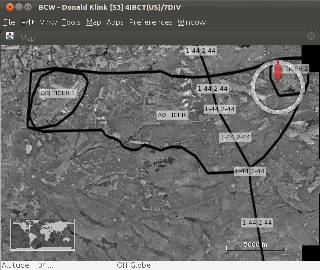
Command software adds another difficulty. Information has to move among systems whose designers did not necessarily work together. Drexel University’s Mission Command Gateway brief listed EOIR as a partner alongside Cougaar Software, Sagem, and Diehl. Its capabilities included collaborative digital orders, a shared operational picture, and interfaces to other command systems.
One detail deserves attention: users could continue working during network outages or splits, with changes synchronized after connectivity returned. The brief also recorded interoperability testing with German, French, Israeli, and Italian military systems. That is a concrete illustration of the environment surrounding EOIR’s work. A tidy screen is useful only if the information behind it can travel through a rather untidy world.
 MISSION COMMAND
GATEWAY
Partner project
EOIR’s own 2016 Army software announcement described support for Tactical Mission Command Applications, including Command Post of the Future and TacApps. The assignment covered design, coding, testing, integration, and fielding. The company said its team had supported CPOF and related applications since 1999. These were customer programs with continuing engineering needs, a useful distinction for anyone expecting a catalog of EOIR-branded gadgets.
Radar work broadened the picture further. A May 2016 task order supported the Army’s Radar Systems and Identification Division at Aberdeen Proving Ground. EOIR’s stated responsibilities stretched from program management and systems engineering through development, testing, and performance assessment. The company’s optical roots had grown into a wider defense engineering business.
The enormous number and the small print
The business model followed the assignments: win a contract position, compete for or receive orders, and deliver the specified technical work. Government procurement vehicles gave customers a route to buy services. They also generated headlines whose numbers require a little supervision.
Contract-vehicle ceilings reported by Arlington, not EOIR revenue, backlog, or guaranteed payments. *Rounded in the acquisition announcement; EOIR’s July release gives $249m.
Arlington’s June 2016 acquisition announcement listed prime positions on those three vehicles. Their ceilings describe the potential size of the procurement route. EOIR’s subsequent Army ISR release explicitly said task orders would be issued under the vehicle. The ceiling and the order are different pieces of the transaction; celebrating the first as cash earned would make the accounts unusually optimistic.
There is a smaller, more tangible cost in the historical record. EOIR’s GSA schedule listed a senior project manager at $122.20 per hour and a Principal Engineer I at $167.01 for the March 2014 to March 2015 period. Those are old schedule rates, not present-day quotations or complete project prices. They nevertheless reveal what a buyer was purchasing: named kinds of expertise, priced by the hour.
The software did not all have to be theirs
EOIR’s integration work included other companies’ technology. In January 2014 it announced a Red Hat relationship covering data-center, middleware, and cloud services. The release described plans to serve financial, retail, and pharmaceutical customers. That was an expansion proposal beyond its familiar national-security market, rather than proof of a large commercial customer base.
Later that month, EOIR joined Hortonworks’ systems-integrator program to offer professional services around its Hadoop platform. The logic was practical: an established software platform still needs people who can implement it for a particular organization. EOIR was selling that technical work. Its distinctive combination was the span from sensors and mission requirements to software and operations, rather than an assertion that every component had to carry its name.
When the specialist became part of the bundle
Ownership changed the scale. Banyan Investment Partners records a December 2009 investment combining subordinated debt and equity. Arlington Capital Partners acquired EOIR in June 2016. That November, it combined EOIR with Intelligent Software Solutions and PROTEUS Technologies to create Polaris Alpha.
The merger announcement emphasized complementary capabilities and customers. EOIR brought its defense engineering experience into a group covering analytics, software, cyber, and other national-security work. This is how a specialist can become more valuable inside a broader offering: the customer has related problems, and the combined supplier has more ways to address them. That is the announced commercial rationale, not evidence that every promised benefit followed.
Parsons acquired Polaris Alpha in 2018. Its announcement described more than 1,300 employees in the successor group, nearly 90 percent with security clearances. Subsequent SEC reporting put the purchase price at $489.1 million. Both numbers concern Polaris Alpha, including businesses added after the original merger. Neither is an EOIR-only measure.
A surprisingly useful piece of office stationery
EOIR also changed something much smaller. Facility security officer Diane Moulton wrote that purchased seven-to-eight-page newsletters were too generic. The replacement, a one-page PDF called The Bullet, carried concise, relevant guidance. She reported increased communication to the security department after the change. Management also expanded security staffing. EOIR received a 2016 Cogswell industrial-security award.
The copyable lesson is modest: make instructions specific enough to act on, then check whether people respond. A short bulletin can support deeper training; it cannot replace it. Nor does a good document remove the need for people to handle reports.
At the successor company, another adjustment arrived in 2018. Polaris Alpha’s network-security team adopted a DoD/DISA model and moved toward proactive detection across its network. The initiative earned a CSO50 award, and Parsons said it was adopting the approach.
“If you’re in a reactive stance, it’s already too late.”Eric Schlesinger · Polaris Alpha CISO · 2018
There were signs of investment in technical people, too: Parsons merged its Fellows Program with Polaris Alpha’s in June 2018. And EOIR’s 2016 TAPS golf outing raised $94,260 for military bereavement support, bringing its reported nine-year total to $520,260. A company can reveal a fair amount about its priorities away from the product brochure.
For a defense buyer, EOIR’s history offers a useful procurement question: who owns the handoffs between the instrument, the analysis, the software, and the operator? For another business, it offers a reason to examine those same handoffs before adding another tool. This approach fits work that needs custom integration and continuing support. A simple, standardized purchase may need far less engineering. EOIR’s opportunity lay in the complications that remained after the sensor had done its job.
Follow the engineering
Explore the legacy company, its successor, and the work behind the story.