A company can change in a legal instant. Signatures land, the transaction closes, a ticker symbol begins moving across a screen. The human version happens more slowly. Employees want to know where they fit. Customers want to know what remains dependable. Leaders need language that can survive an earnings call, a team meeting and a hallway conversation. Roela Santos has spent much of her career in that interval between a corporate event and a shared understanding of what it means.
At Amentum, where she serves as chief marketing and communications officer, the scale of that assignment is unusually visible. In September 2024, Amentum combined with the Critical Mission Solutions and Cyber & Intelligence businesses spun out of Jacobs. The result began regular trading on the New York Stock Exchange under AMTM. The company said it had more than 53,000 employees in roughly 80 countries, working across environment, space, intelligence, defense and civilian markets.
Those numbers describe an enterprise. They also describe a communications problem. Five markets, dozens of countries and several corporate family trees had to become one account of the future. Santos's remit covers the places where that account gets tested: brand and reputation, advertising, employee engagement, executive communications, corporate social responsibility, social and digital media, and the events where customers meet the company in person.
The work behind the announcement
The useful part of Santos's career is not simply that she has held senior titles. It is that the same hard situation keeps finding her: an organization has changed, and the old shorthand no longer works. At Computer Sciences Corporation, she led marketing programs for a $3.5 billion global IT and outsourcing unit. At Raytheon, she worked on the global reputation of its cybersecurity business. At Engility, she joined a leadership effort to move the company away from being understood as a lowest-price contractor and toward being seen as a provider of higher-end engineering solutions.
Then came a transaction that made the communication challenge literal. In September 2018, Engility announced that SAIC intended to acquire it in a $2.5 billion all-stock deal. Santos, then Engility's vice president of communications, opened the employee call. The transcript shows the mechanics of merger communication in plain view: set expectations, distinguish what has happened from what has not, point people toward reliable channels, and repeat the practical facts most likely to be lost in the emotional noise.
She told employees to stay connected and engaged. It was not a grand line, but it was an operational one. A merger announcement gives people more information than they can absorb and less certainty than they want. The communicator's job is to build a path between those two conditions without filling the gap with false confidence.
“Behind the scenes, we have analytics and data to better inform decisions on channels and timing.”Roela Santos, on the changing communications toolkit
After the Engility deal closed, Santos became SAIC's chief communications and marketing officer. There, she rebranded the company and built account- and deal-based marketing functions. Amentum's biography of Santos links that work to improved proposal win rates as well as stronger awareness and favorability. The distinction matters. Corporate communications is easy to treat as atmosphere. Her record presents it as business infrastructure: reputation supports a pursuit, a clear position helps a proposal, and an employee who understands the strategy can explain it without a script.
Global marketing for a large IT and business outsourcing unit.
Global communications work focused in part on cybersecurity reputation.
Engility's repositioning and announced acquisition by SAIC.
SAIC rebrand and WashingtonExec communications award.
BAE Systems Intelligence & Security and an ISC2 volunteer award.
Joined Amentum and co-founded VOICES for AAPI.
Amentum merger, public listing and post-integration brand work.
A brand people can operate
Santos moved from SAIC to BAE Systems Intelligence & Security, then joined Amentum's senior leadership team in June 2022. Amentum had launched two years earlier, when the pandemic limited the usual theater of a new corporate identity. By the time she arrived, it had completed more acquisitions and become a different company from the one initially introduced.
Her team began with foundational language: vision, mission and values for a workforce then numbering more than 36,000. She described the longer project as building a unified culture. That is a more demanding standard than rolling out assets. A logo can be distributed. Culture has to be recognized in choices, incentives, stories and the daily vocabulary of managers who were not in the room when the brand deck was approved.
The post-pandemic environment made the channel question harder. In a 2022 interview, Santos described watching whether commuting, business travel and in-person conferences would return strongly enough to justify spending on transit ads, radio, airports and events. The answers kept moving. Her response was to follow the audience, stay flexible and use metrics to change tactics.
This is the less glamorous half of storytelling: distribution. A beautiful message in the wrong place is a private thought. Santos's comments suggest a communications department that treats channel, timing and measurement as part of the creative decision. The audience's habits are not an inconvenience to the plan. They are the plan's raw material.
Separate the permanent story from the changing channel. Keep the promise consistent, then let audience behavior determine where, when and how it appears.
Representation with an address
Santos's public work extends beyond the companies on her résumé. She is a co-founder and board member of VOICES for AAPI, an organization created to advance representation and opportunity for Asian Americans and Pacific Islanders in communications, marketing and creative industries. Its mission is concrete: build professional networks, contribute to public discussion, and create development opportunities that can move people toward positions of greater influence.
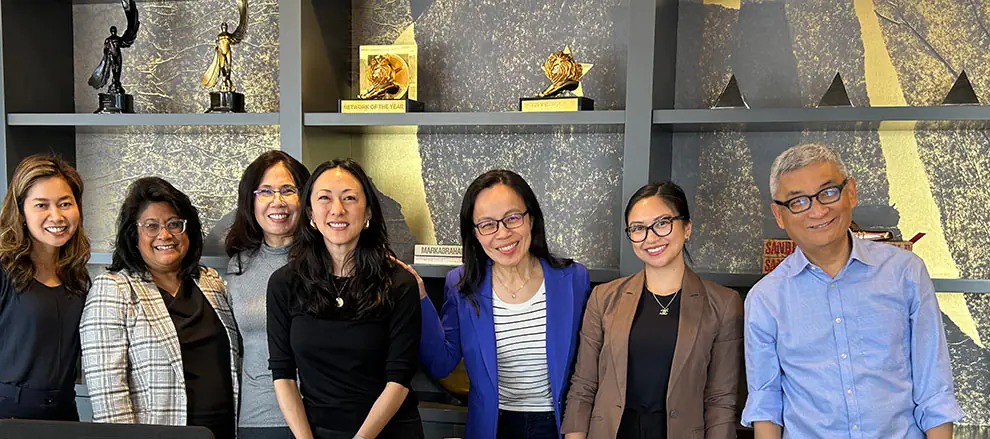
The organization began during the pandemic, so its earliest meetings and programs were virtual. In May 2024, the board finally met in person at McCann Worldgroup's New York office. The group photograph is ordinary in the most satisfying way: colleagues standing shoulder to shoulder after years of appearing in separate rectangles. For an organization built around visibility and connection, simply occupying the same frame carried its own meaning.
Santos has also applied the resources of corporate communications to cybersecurity education. ISC2 recognized her in 2021 for long-term support of its Center for Cyber Safety and Education and for helping develop scholarships associated with Raytheon and SAIC, formerly Engility. Over six years, those scholarships awarded $424,000 to 56 students. The figure is modest beside a multibillion-dollar merger and intimate beside a 53,000-person workforce. It is also unusually legible. Fifty-six people received help entering a field that needed them.
That work reveals a broader version of what a communications leader can build. Networks, scholarships and representation programs are not statements about a future workforce. They are pieces of the future workforce, given names, budgets and places to gather.
What enters the frame
In 2026, after Amentum's first full year as a newly merged public company, Santos described her team's focus as establishing a brand that reflected the strengths of the combined organization. The company story now had to hold nuclear power, space exploration, missile defense, digitalization and other technical work without collapsing into a catalog. Her team, she said, would keep leaning on creativity, collaboration and agility as government demands and technologies continued to move.
She has a personal phrase for that posture: focus on what you do with what you have. Santos connects it to resources, talent and opportunities that can be seized. The thought avoids the fantasy of perfect conditions. It starts with the people and tools already in the room, then asks what they can make together.
There is a fitting detail at the edge of her professional biography. Santos paints landscapes and pet portraits in her spare time. Painting is its own exercise in narrative discipline. The world offers too much information, so the painter chooses a frame, decides where the eye should go and keeps enough detail for the subject to feel true.
That is also the quiet work inside a corporate story. Not every fact can lead. Not every legacy can become the headline. Yet people notice when the picture has omitted something essential. Across Engility, SAIC and Amentum, Santos has worked on making the frame wide enough for change and specific enough to guide action. The finished product is not merely language about a company. It is language that helps a company recognize itself.