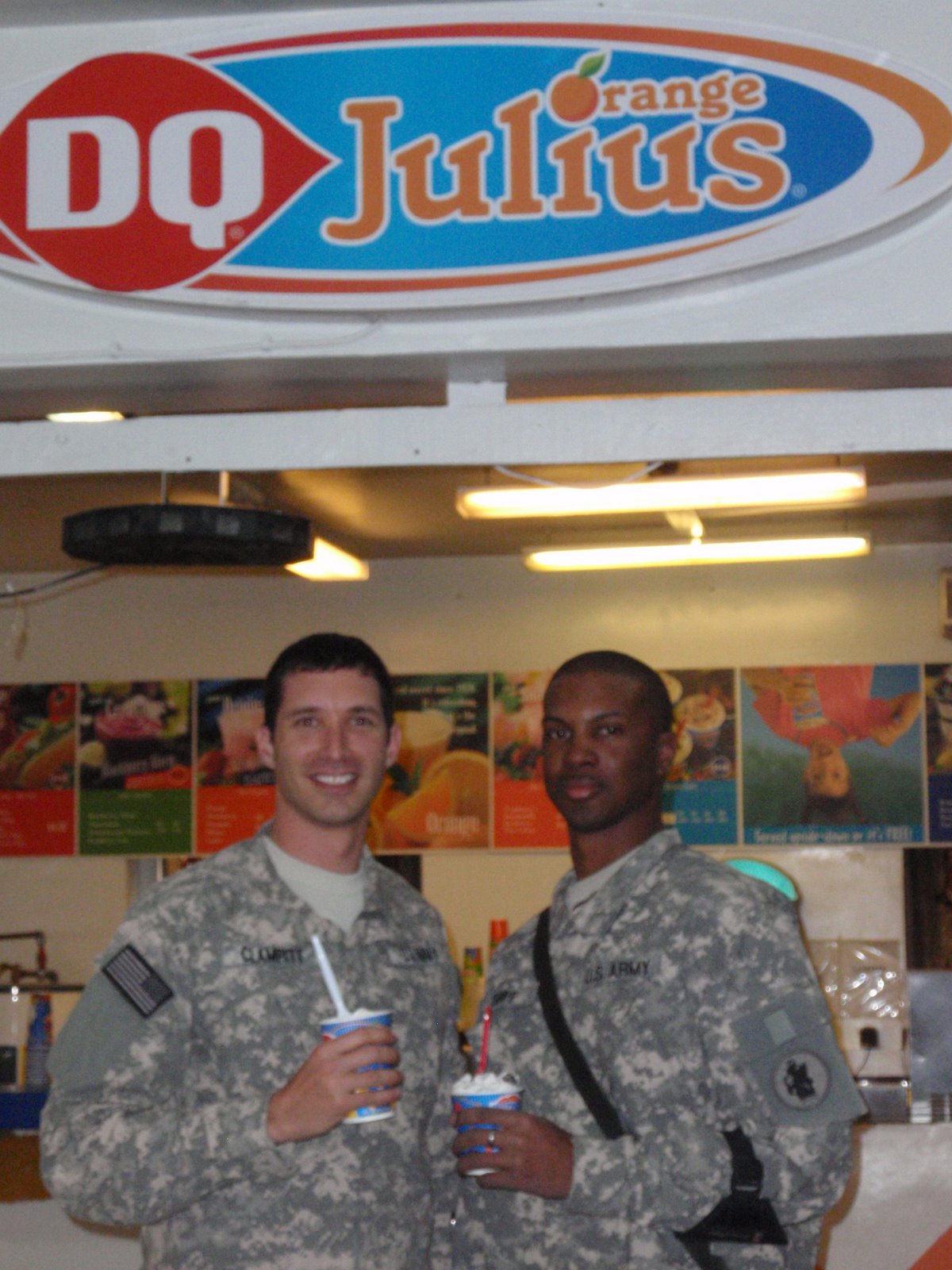
In Kabul, Adam Clampitt found a Dairy Queen. It was March 2009, he was serving in Afghanistan, and there in the Post Exchange at Camp Phoenix was a familiar answer to a very ordinary longing. He and Specialist Shipp ordered Blizzards. The photograph records two servicemen enjoying ice cream, a small pleasure with a considerable distance attached.
For Clampitt, the stop brought back his grandfather, who used to spirit him away to Dairy Queen while his grandmother remained at home with a bowl of granola. It also recalled a ritual with his friend Tommy: stopping for ice cream on journeys to and from Navy Reserve duty in Norfolk. A franchise counter had become a compact family archive. Even public affairs officers, paid to explain events to other people, sometimes find their own lives explained by dessert.
His career is easier to understand with these smaller scenes left in. The founder and CEO of DCG has worked in corporate communications, coalition public affairs, and federal contracting. But his writing returns to people: a friend, a grandfather, a colonel who trusted him, colleagues who could be trusted in turn. The company he started in Washington in 2010 carries some of those relationships into its way of working.
A colonel who let the message leave the room
Clampitt was recalled to active duty in 2008 for Operation Enduring Freedom. His assignment took him to Kabul and Kandahar. As a junior officer, he led a small group of Army public affairs soldiers, working to communicate the coalition’s account of the war accurately and promptly. He later described thirteen months of long days and a seven-day working week.
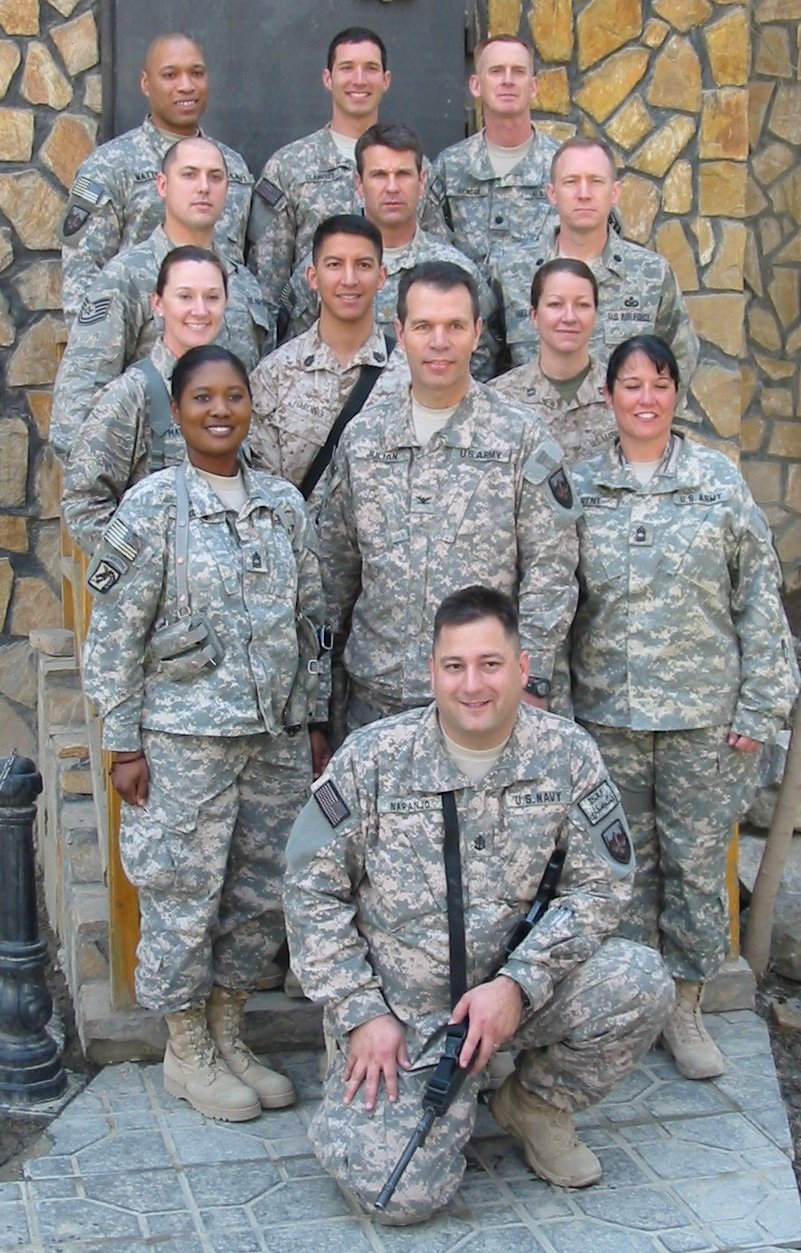
His boss, Colonel Greg Julian, made a lasting impression. In February 2009, Clampitt introduced Julian in his blog as both a professional he admired and a mentor. The office was growing, its command was only four months old, and its responsibilities included being a spokesperson and managing outreach. The entry describes colleagues from several military services. There was plenty to coordinate before anyone could explain anything.
Years later, Clampitt singled out Julian’s willingness to let officers decide. The colonel accepted risk and backed people doing the work. Information could move without being passed through so many reviewers that the message lost its usefulness. For a communications officer, that was an operational lesson. Speed and clarity depended partly on where authority sat.
In 2022, Clampitt wrote that he had carried this approach into DCG. Professional communicators could, in most instances, make decisions without his direct approval. He also acknowledged the friction: government clients could take weeks or months to approve a post. A founder can delegate within his firm; he cannot wish away the client’s process. The challenge is to preserve useful judgment while working inside those boundaries.
A Washington upbringing, an overseas audience
Washington was home well before it became the setting for his business. Clampitt moved there in 1987, at twelve, and attended the Edmund Burke School before Walt Whitman High School in nearby Bethesda. He earned a political science degree at the University of Michigan and a Master of Public Policy at UCLA. Those subjects would sit comfortably beside his later work explaining institutions to the people affected by them.
Before founding DCG, he spent four years at the public relations firms then known as Burson-Marsteller and Hill & Knowlton. His military work put those communications skills into a different setting. In Kabul, he served as director of public affairs planning and social media for the NATO-led International Security Assistance Force, working for General Stanley McChrystal. The job included building a social media network to communicate the mission to service members and the public.
His service brought decorations including the Defense Meritorious Service Medal, the Navy and Marine Corps Commendation Medal, and three Navy and Marine Corps Achievement Medals. These belong to the military chapter of his life. The connection to his business career is more practical: experience managing messages, teams, and audiences when the work could not simply wait for a convenient meeting.
The honorary pirate writes home
There was another audience in California. A third-grade class at Carlthorp School in Santa Monica adopted Clampitt as an honorary pirate aboard its class ship. One pupil, Jack, was the son of Amy Zegart, his former UCLA professor. In March 2009, Clampitt thanked the children for their letters and told them that grown-ups and Navy officers could get homesick too.
The note changes scale. A coalition mission with international attention becomes a person addressing a classroom. He explains the distance from home, thanks the pupils for remembering the servicemen, and encourages them to help people in need whatever occupations they eventually choose. He ends with the hope of visiting their class after returning to the United States.
The exchange gives his communications work a human-sized counterpart. The children had supplied something he could receive rather than issue: attention. His reply, cheerful enough to end with a nautical greeting, allowed the officer to be a guest on somebody else’s ship. That is a pleasant reversal for someone whose job involved explaining a military mission.
“Don’t get distracted, focus on the task at hand and do it to the best of your ability.”
Adam Clampitt, recalling advice from his military service, 2021
The firm that began without a conference room
Returning from Afghanistan in February 2010, Clampitt resumed corporate PR and found it less satisfying. A friend’s consulting business introduced him to government contracting. An opportunity to start his own firm followed. DCG’s early workplace was his living room or Peregrine Espresso on Capitol Hill. There was one employee: Clampitt.
He remained on his own for a little over a year. As work arrived and colleagues joined, he offered the flexibility he valued himself, including working from home. In October 2020, he described a company approaching a hundred employees. That anniversary supplied an amusing before-and-after: the early founder rode a motorcycle to client meetings; fatherhood had since persuaded him to retire it.
A growing remote company still needs ways for people to meet. DCG’s 2022 onboarding account describes small-group conversations with founders Clampitt and Caitlin Donovan, giving new employees a chance to hear the company’s history and introduce their own interests. It also describes a buddy program offering an informal guide through the first days. These are modest mechanisms for a familiar problem: joining an organization is easier when someone knows your name.
That year, employees helped revise the company’s benefits. The announced changes included a minimum of twenty paid-time-off days and a floating Heritage Day alongside federal holidays. Whatever an organization says about flexibility, the calendar is where employees encounter it. A day that can actually be taken is rather more persuasive than a paragraph that says it may be.
A public mission, built by colleagues
By 2015, Clampitt was introducing DCG’s work to the National Assessment Governing Board. The firm had won a communications contract after a market-research and selection process. At an August committee meeting, he spoke about his interest in education and the company’s federal outreach and social media experience. It is a useful glimpse of the business in practice: a founder explaining why his team belonged on a public assignment.
Other work made the company’s interests more visible. DCG developed the #WearBlueDay awareness campaign for the Department of Homeland Security’s Blue Campaign against human trafficking. The initiative invited people to wear blue and share photographs on January 11. It received a PRDaily corporate social responsibility award for its social media work.
DCG also received an honorable mention for its 2020 National Veterans Small Business Week campaign for the Small Business Administration. Alana Johnson and Taylor Starkman managed that campaign, with graphics by Alissa Lorentz. Naming them matters. The outreach kits, event logistics, releases, and designs were team work, and their recognition belongs alongside the founder’s account of delegation.
Military communications remained part of the firm’s portfolio. In October 2025, DCG described Army playbooks, leadership training, Pentagon exhibits, and event support. The same update reported that Clampitt had recently completed an interim public affairs and communications assignment for Navy Secretary John Phelan. His civilian company and Reserve service continued to have points of contact.
More capability, the same question about trust
In April 2024, Granite Creek Capital Partners and Boathouse Capital announced an investment in DCG. Clampitt described the additional resources as a way to expand its federal communications work. The announcement placed market research and strategic communications at the center of the business. It also made the next stage of company building a more public affair, with investment partners attached.
On August 13, 2026, Granite Creek announced DCG’s acquisition of Urban Emu. DCG called the combination a merger. The digital agency brought application design, data analytics, and AI development capabilities; its CEO, Patrick Kesler, was announced as DCG’s incoming chief technology officer, with responsibility for research and development and integrating customized AI solutions.
“Client needs are evolving rapidly,” Clampitt said in the announcement. The stated direction is to bring research, strategy, communications, and technology closer together. These are plans and capabilities, with their results still to be made through client work. For a founder who has argued for decisions close to the task, the expansion adds more kinds of expertise to trust.
There is a satisfying continuity here. The 2009 blog contains an officer thanking his colleagues and a classroom. The later company accounts contain a founder crediting a team and giving newcomers a way in. Between those moments, DCG grew, attracted investment, and added a technical business. The settings became larger. The work still required people to understand one another, make decisions, and get the message out.