David Li had earned a summer off. In 2022, CMC Materials had completed its sale to Entegris, bringing his long run at the company to a close. His farewell to colleagues contained the expected appreciation and pride, a little sadness, and a wonderfully provisional plan: “a summer of downtime.” Then came the small print: “stay tuned!”
There is a whole executive biography in that exclamation mark. Li had spent years helping a supplier of semiconductor materials grow, acquire businesses and navigate an industry in which customers kept asking chemistry to do more. The sale offered an ending with a very large number attached. His farewell, though, left the door on the latch.
By April 7, 2025, he was president and chief executive officer of Ingevity. The new assignment brought him into activated carbon, pavement technologies and specialty polymers. Alongside it sat university teaching, board work and a charitable foundation with a family history in chemical engineering. The summer had become a rather crowded calendar.
Before the corner office, a map of the factory
Li studied chemical engineering at Purdue University and began his career at UOP, the petrochemical technology company. He later earned an MBA at Northwestern University’s Kellogg School of Management. That combination gave him two sets of questions to ask: how a process works, and how a business built around it should be run.
His early years at Cabot Microelectronics took him through operations, sourcing, investor relations and product management. These jobs occupy different corners of an organization. Operations asks whether something can be made reliably. Sourcing asks where its ingredients will come from. Investor relations asks why anyone should believe the plan. A future CEO could do worse than spend time answering all three.
The regional work mattered too. Li led the Asia Pacific business and was based in Shanghai. His responsibilities included China and Korea; he also ran the global tungsten and advanced dielectrics business. These were specific jobs involving specific customers and products, long before the broader language of corporate transformation entered his biography.
He became CEO in January 2015. The promotion followed years inside the business, rather than a sudden arrival from another industry. For colleagues who had known him in earlier roles, the new chief executive had already been part of the machinery.
The business behind the chips
Cabot Microelectronics sold materials used to make semiconductors. Its chemical mechanical planarization products helped smooth silicon wafers during manufacturing. The phrase is a mouthful; the underlying proposition is exacting. As chip structures become more complex, the materials used between manufacturing steps have to keep up. A small ingredient can carry a large responsibility.
When Li joined the microelectronics materials division in the late 1990s, it had about 100 employees. After its 2000 spin-off, annual sales were below $200 million. By the time of his 2019 chemistry-industry profile, annual revenue had passed $1 billion and the workforce was about 2,000. Those figures describe the company’s expansion across many years and many people. They also show how much the scale of his job had changed.
One consequential decision was the acquisition of KMG Chemicals. Announced in August 2018 at an enterprise value of about $1.6 billion, the transaction was completed that November. KMG added high-purity electronic chemicals and other specialty materials, extending the company’s reach beyond its established polishing products.
The practical logic was breadth: more materials to offer customers, more technical capabilities inside the same company. The transaction also brought the ordinary obligations that follow an extraordinary purchase price. Businesses had to be integrated. Customer relationships had to survive. Buying additional capabilities and making them work together are separate appointments in the diary.
- 2015Becomes CEO of Cabot Microelectronics
- 2022CMC sale to Entegris closes
- 2025Starts as Ingevity president and CEO
A sale, a farewell, a pause
The next large transaction put CMC on the other side of the table. Entegris agreed to acquire it in a cash-and-stock deal announced at an enterprise value of approximately $6.5 billion. The acquisition closed on July 6, 2022. That distinction between announcement and completion matters: the announced valuation belongs to the proposed transaction, rather than a fixed cash amount paid on closing day.
CMC shareholders received $133 in cash and 0.4506 Entegris shares for each CMC share. The precision is a useful antidote to the rounded billions that tend to dominate merger stories. Behind the headline was a defined exchange, approved by shareholders and completed after regulatory review.
Li’s farewell turned away from the arithmetic. He thanked colleagues for the relationships, experiences and accomplishments they had shared. “You all have taught me so much,” he wrote. It is an appealing sentence from someone leaving the top job: the chief executive casting himself, briefly and plainly, as a student.
The next public appearances gave that thought a physical address. In October 2022, he returned to Purdue for a lecture on semiconductor growth and career opportunities. The following day, a session with chemical engineering master’s students covered his move into management. He emphasized adaptability and a willingness to keep learning. Retirement was already accumulating homework.
“You all have taught me so much.”David Li, farewell to CMC colleagues, 2022
The names on the research area
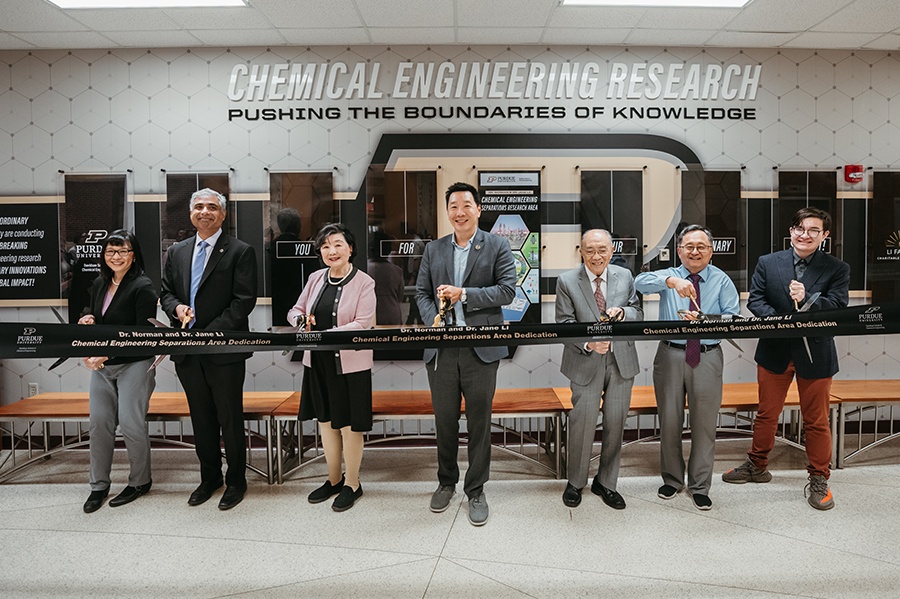
On April 14, 2023, Purdue dedicated the Dr. Norman and Jane Li Chemical Engineering Separations Area. David and his sister Rebecca had worked with their family’s foundation to honor their parents. The setting was Forney Hall’s Robert T. Henson Atrium, with faculty, alumni and family members gathered for the dedication.
The names on the research area belonged to people with careers of their own. Norman Li worked in separation science and technology. Jane Li held chemical-industry leadership roles, including at Exxon and Honeywell UOP. Together, they launched NL Chemical Technology, developing and commercializing membrane technology for water purification.
That history makes the gift unusually specific. It supports a field in which the family had worked, at the university where David trained. The connection runs from research to industrial application and back into education. A ribbon-cutting photograph can make such an event look ceremonial; the laboratories and students give the ceremony its purpose.
A university naming proposal detailed a $3.25 million commitment from David and the foundation, combining planned giving with a foundation contribution paid over ten years. Its provisions included a professorship, student support in separations and a semiconductor scholarship endowment. Each element addressed a different part of an engineering education: the person teaching, the work being done and the student able to participate.
Twenty percent, and a short meeting
Li’s advice to younger professionals is unusually schedulable. He recommends spending at least 20 percent of one’s time building relationships with people who excel in areas one hopes to enter. He suggests asking for 15 or 20 minutes with the company’s CEO. It is a small meeting request with an ambitious recipient.
The second instruction is to keep learning deliberately. He has credited his parents with that principle and pointed to the availability of podcasts, seminars and books. Read together, the recommendations describe an education that continues after the diploma: seek people with experience, make time for them, and remain willing to revise what you know.
His own university connections extend beyond alumni ceremonies. He has served as a visiting scholar and guest lecturer at Purdue and as an adjunct professor at Kellogg. With his wife, Sophia, he supported Purdue chemical engineering scholarships in 2019. He has also mentored Asian American students interested in industrial leadership.
There is a useful symmetry here. Early in his career, a company moved him through jobs that widened his understanding. Later, he began helping students see routes beyond their first technical assignment. A chemical engineering degree can lead to a plant, a product business, a regional operation or a boardroom. His career provides examples of each kind of transition.
The return to an operating job
At Ingevity, Li succeeded interim CEO Luis Fernandez-Moreno, who remained on the board. His employment offer placed the position at the company’s North Charleston headquarters. Singapore is another established connection: Purdue has described him as a permanent resident there. His professional geography has never fitted neatly inside one city label.
The work now concerns materials used in everyday systems: activated carbon for emissions control and filtration, pavement products and engineered polymers. These are businesses where the finished product often conceals the chemistry that makes it perform. Roads and vehicles offer more familiar reference points than semiconductor wafers, but customers still purchase a material because of what it enables.
His arrival was followed by changes to Ingevity’s portfolio. The company completed the sale of its North Charleston refinery assets and most of its Industrial Specialties product line on January 1, 2026. The Road Markings sale followed on April 15. For a leader with acquisition experience, the current job has also required deciding which businesses should leave.
In the second quarter of 2026, Ingevity reported $314.1 million in sales and $39.8 million in net income from continuing operations. Sales fell 5 percent overall; excluding Road Markings, they rose 5 percent. Adjusted EBITDA margin reached 36.6 percent. The paired sales figures explain why a smaller portfolio requires careful reading: the boundary of the company has changed as well as its performance.
The next lesson is still in progress
Li also serves on the boards of Hexcel and CoorsTek, extending his work into advanced composites and technical ceramics. These connections keep his career close to materials whose usefulness depends on demanding applications. The subject changes; the need to connect technical judgment with commercial decisions persists.
In September 2026, Ingevity announced his participation in a Water Tower Research conference fireside chat. The public calendar once again placed him in front of investors, explaining a business and its direction. It is familiar territory for someone whose route to CEO included investor relations.
The summer farewell now reads like a pause between assignments. What followed included teaching, giving and another operating role, each with its own demands. The most revealing detail may still be the advice about asking for a short conversation with a CEO. Li has spent years occupying that office. He continues to make a case for knocking on its door.