Mark Costa met his future wife in an airplane seat that did not belong to him. He boarded late, sat beside Gita, and found they had a connection: her close friend at work was dating his college roommate. Conversation became courtship. Three months into dating, he disclosed the small matter of the seating assignment. An airline might call this a compliance problem. Costa remembers an excellent decision.
His early working life had less room for improvisation. At fourteen, he spent summers doing maintenance in truck yards in California. By his final year of high school, he had moved into the business office. His father’s agriculture and trucking business eventually failed while Costa was a college senior. He went to work to help support the family. The first person in his extended family to attend college had reached a future that required revision.
Today, as Eastman’s chairman and chief executive, Costa is overseeing another exercise in reconsidering value. Polyester that would otherwise be discarded can become raw material. A company associated with an older industrial era can put its accumulated knowledge to a different use. Neither proposition becomes a business simply because it sounds sensible. That is where his current story gets interesting.
When a client becomes a life’s work
Costa grew up around Carmel and Salinas, away from the version of California usually advertised to the rest of the world. His family’s rural working life made the eventual move to northeastern Tennessee feel familiar. He studied economics at Berkeley and earned an MBA at Harvard Business School. Consulting gave him exposure to companies and industries before he took responsibility for one of them.
At Monitor, he became a senior partner and came to know Eastman as a client. In 2006, he crossed over, joining the executive team to lead marketing, strategy, and business development. By 2008, his remit included the profits and losses of specialty plastics and performance polymers. Responsibility expanded again the following year. The person advising the business now had to live with its operating results.
- 2006Joins Eastman
- 2013President & director
- 2014Becomes CEO
- 2024Kingsport starts production
The succession announcement arrived in May 2013. Costa became president and a director immediately; the CEO job would follow on January 1, 2014. Jim Rogers would remain involved as executive chairman. There is something revealing about that arrangement. It gave the incoming leader time alongside the outgoing one, and it treated leadership as work that could be handed over deliberately. Costa publicly thanked Rogers and pointed to the executives with whom he would implement the growth strategy.
He inherited a company already changing its portfolio. Acquisitions and departures from commodity businesses were moving Eastman toward specialty materials. These are products sold for particular properties and applications, where understanding a customer’s problem can matter as much as producing volume. Costa’s background in marketing had a practical destination: deciding which technical differences someone would actually pay for.
The uncomfortable value of a truthful answer
A CEO can collect reassuring answers without learning very much. Amy Edmondson, the Harvard Business School professor, recalls Costa explaining his concern to her students:
“My greatest fear as CEO is that people won’t be telling me the truth.”
Mark Costa, as recalled by Amy Edmondson
The remark helps explain why listening belongs in an industrial biography. A research result, a customer objection, or a problem on a production line reaches the chief executive through other people. Each person can soften it a little. By the time it gets upstairs, the news may have acquired manners and lost its meaning. Costa’s admission recognizes the risk created by his own position. Being approachable is useful only if people believe they can approach you with something inconvenient.
This is a demanding standard for innovation. A project needs advocates, but it also needs people prepared to say that an assumption is wrong. Encouraging both requires more patience than delivering a speech about teamwork. The speech usually finishes on time. The awkward discussion can run through lunch.
His attention to specific applications was already visible early in his CEO tenure. In 2014, he talked about Tritan and acoustic interlayers for automotive glass, including their contribution to a quieter cabin. He also urged regional leaders to maintain the Tri-Cities’ quality of life so Eastman could recruit and retain people. The materials business, in that account, extended from the windshield to the place an employee wanted to live.
Sustainability was part of the same commercial argument. In his 2014 stakeholder letter, Costa connected environmental improvements with efficiency, product performance, and relationships with employees and communities. The useful question was how these aims changed the work. By the time he discussed the innovation portfolio in a later interview, he described sustainability as a requirement that had shaped it since 2009. The idea had a longer history inside Eastman than the newest recycling facility might suggest.
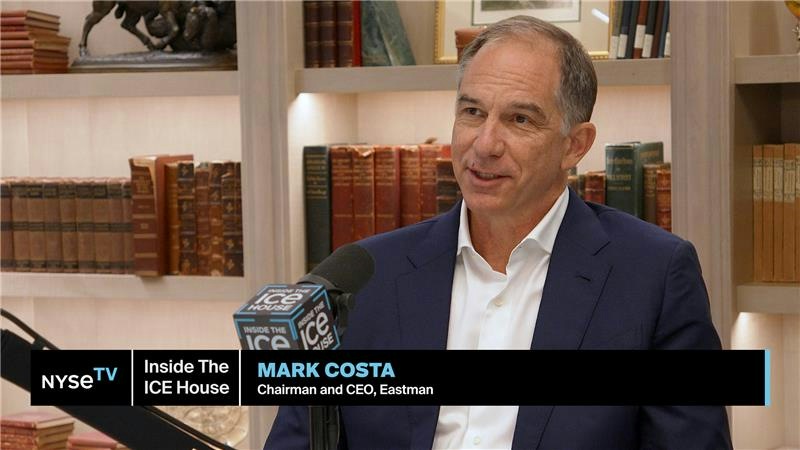
An old process gets a new assignment
There is a pleasing wrinkle in Eastman’s recycling story: some of the relevant know-how predates the current conversation. Kodak had commercial methanolysis operations in the 1970s. That facility operated until 2007. Eastman’s later development drew on decades of experience, rather than a discovery that arrived fully formed with a new environmental vocabulary. Industrial memory can be a useful asset when someone finds the right question to ask of it.
The chemistry deals with a particular family of materials: polyesters. Through methanolysis, polyester waste is broken into the smaller molecular building blocks called monomers. Those can be used to make material again. The distinction matters because the claim concerns a defined process and feedstock. It should be understood on those terms. A plant designed for polyester has a more specific job than the broad word “plastic” suggests.
A polyester second act
Costa and Tennessee governor Bill Lee announced plans for the Kingsport investment in 2021. The project joined an existing manufacturing site, giving the new operation a setting with industrial infrastructure and experience. In March 2024, the facility reached initial production. Eastman lists its annual recycling capacity at 110,000 metric tons. Capacity is a design measure. It does not tell us how much material passed through the plant in a particular year.
metric tons of annual recycling capacity
Eastman’s stated facility capacity. Initial production: March 2024.For Costa, a working plant brings the discussion into the realm where an operator can answer back. Technical knowledge must survive continuous operation, variable incoming waste, and the expectations of customers buying the output. The transition from explanation to production is part of the achievement. It also creates a new set of questions. A commissioning milestone closes one chapter and opens the daily business of running the equipment.
Recognition had come before that opening. Costa was selected for the 2022 International Palladium Medal of the Société de Chimie Industrielle, whose announcement highlighted his work on innovation and the circular economy. An award can mark a direction of travel. A factory has to keep demonstrating that the journey makes commercial sense after the dinner is over.
The invoice arrives, eventually
Costa has been blunt about the obstacle. “Everyone wants to save the planet, no one wants to pay for it.” The line, delivered in his 2024 recycling conversation, compresses a complicated financing problem into an observation recognizable to anyone who has split a restaurant bill. Plants require substantial investment. Their customers, suppliers, and investors need reasons to accept the costs.
The consequences became tangible in 2025. Eastman disclosed that the Department of Energy had terminated an award related to its planned recycling decarbonization project in Longview, Texas. The filing also described reimbursement for eligible costs incurred before termination. It is a reminder that an announced funding package and an operating facility occupy different points in a project’s life. Expansion depends on decisions beyond the laboratory and beyond the CEO’s office.
There were customer developments to consider as well. In May 2026, Eastman described Gatorade bottles made with PET Renew through its multiyear PepsiCo agreement. A bottle gives the circular-economy argument an ordinary destination. Someone buys a drink; somewhere upstream, a brand has agreed to buy a material. That relationship provides a more concrete test of demand than a statement of shared enthusiasm.
By July, Costa was discussing Kingsport’s commercial ramp in Eastman’s second-quarter results. The company reported quarterly revenue of $2.513 billion, compared with $2.287 billion a year earlier, and said its circular platform had doubled revenue in the first half. Those are different measures: company-wide sales and platform growth. Keeping them distinct helps preserve the scale of the undertaking. Recycling is developing inside a company with many products, customers, and financial obligations.
The next useful question
The quieter work continues alongside the plants. In July 2026, Eastman and the University of Tennessee, Knoxville, extended a research partnership through 2032. Eastman committed at least $3 million over six years. Their collaboration covers subjects including polymer chemistry, catalysis, and manufacturing, and has included an innovation center on campus since 2020. These arrangements help connect a company’s immediate problems with people who can investigate what comes next.
They also make the biography less solitary. Costa can set priorities and take responsibility for investments. Scientists, operators, customers, and research partners carry the decisions into practice. His public emphasis on candid information fits that dependence: the chief executive needs access to what other people know, including the parts that complicate the plan.
Costa’s life contains a few unusually convenient illustrations of changed plans, starting with a seat map. His working challenge is less romantic. He has to turn technical possibility into repeatable production and repeatable purchases. The interesting ending will be written in material moving through plants and customers choosing to buy it again. For now, there is a facility in Tennessee, a business still being built around it, and plenty of reason to keep asking questions.