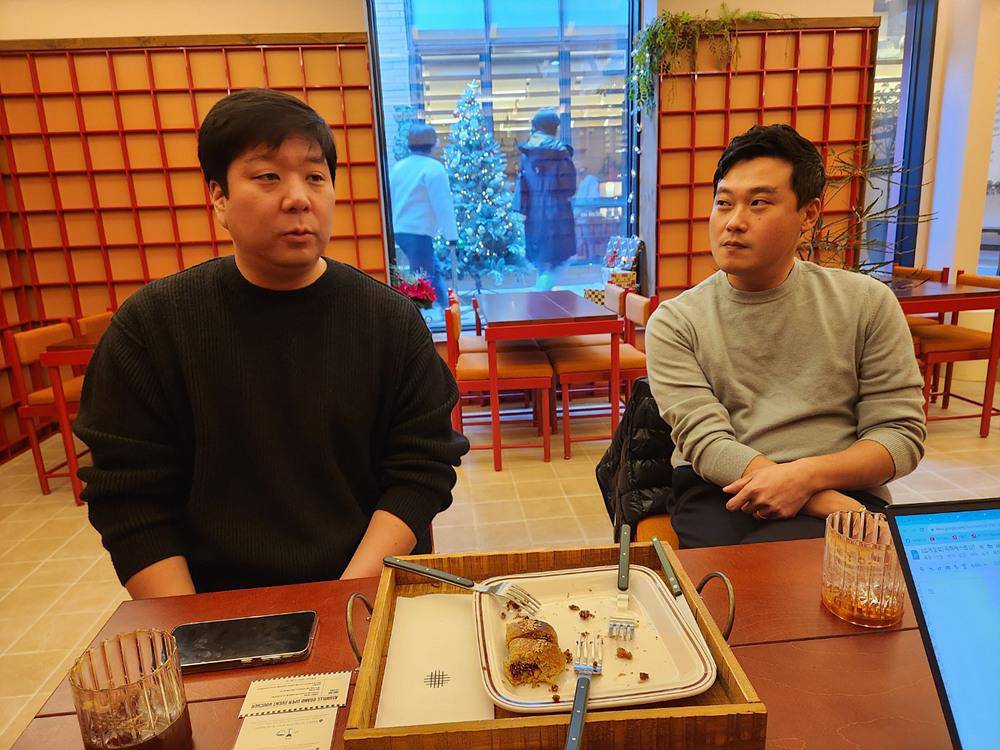
At a bakery café in Seoul, Alexander Min and Moon Dong-jin had something more substantial than a networking opportunity between them. They had bread. Min supplied an ingredient made from grain left over after food production; Moon’s company, The Bread Blue, worked out how to turn it into things people would buy. In November 2023, the two sat down at Ashville Bakery to discuss their collaboration. They had been at it for about two years. The products were taking shape. The commercial rewards were taking longer.
Min was frank about that gap. He admired what his partner had made and regretted that their work had yet to translate into a large effect on sales. The admission makes him more interesting than a founder equipped only with a mission statement. He could believe in an ingredient, enjoy the friendship it had produced, and still acknowledge the unfinished business on the table.
That table is a useful place to meet Alexander Myoung Joon Min, the California-raised founder and CEO of South Korea’s RE:harvest. His subject is a material usually encountered at the unglamorous end of somebody else’s production line. His challenge is to get it invited back to dinner. A bakery is an excellent test: the customer is allowed to care mainly about the bread.
When does a grain stop being useful?
Min built a business around asking again.An accountant notices the leftovers
Min studied accounting at Pepperdine University and earned a Global MBA at Seoul National University. Before RE:harvest, he worked in strategy consulting at PwC Korea, including food and beverage assignments. His company biography also lists work in investment analysis and corporate M&A, alongside experience as a founding member and CFO of restaurant businesses in the United States. He approached food with a background in costs, transactions and operations.
Consulting gave him access to the machinery behind a meal. It also put him in a position to notice an awkward expense: manufacturers paid to dispose of materials that still had potential uses. For someone trained to look for business improvements, a recurring disposal bill could be an invitation. The question was whether a material treated as a cost could support another business.
Travel added another perspective. Min has described how experiences in Rwanda and France sharpened his awareness of the distance between scarcity and extravagance. A meal at a Michelin-starred restaurant in France prompted him to think about the byproducts required to produce such elaborate food. The finished plate told only part of the story. He became interested in the rest of the harvest.
In August 2019, he established RE:harvest with Han Sang-hyun and Kim Dae-hyun. Han brought food-industry consulting experience; Kim had worked across sales and operations. The name means harvesting again. It is an unusually practical promise for a company name: return to something already grown, already transported and already processed, and ask whether the first use has exhausted its value.
The difficult word was “waste”
The idea encountered a vocabulary problem before it could become a manufacturing business. In 2021, Min recalled the early reaction: “how could anyone use food waste and turn it into food?” The objection was understandable. A person hearing that phrase might imagine leftovers from a dinner plate. RE:harvest was working with byproducts generated inside food manufacturing, including the grain remaining after brewing and after the production of sikhye, the Korean sweet rice drink.
A brewery has extracted what it needs to make its drink. What remains requires collection and processing if it is to become a useful ingredient. RE:harvest developed RE:nergy powder by cleaning, dehydrating, drying and milling those materials. Min described roughly a year of experimentation to get the process right. The second harvest required considerably more effort than the name suggested.
By 2022, the company had agreements with Vietnamese brewer Bia Hai Phong and Indonesia’s Multi Bintang, alongside its work with Korean manufacturers. Those relationships mattered because access to a dependable stream of byproducts comes before any dependable stream of products. A flour business needs something to mill; an upcycling business must first persuade another business to let it collect.
Min’s attention keeps returning to that first step. In 2025, he described collection as the beginning of food upcycling. RE:harvest had designed dedicated collection trucks and obtained a design patent. Transport, handling and the demands placed on the supplier all affect whether a partnership works. The circular economy has a loading bay. Somebody has to make that part convenient.
The mechanics also shape his role. Explaining the idea is necessary, but an explanation cannot carry a wet load of grain. The founder has to connect the people who generate the material with the people who can process it and the people prepared to purchase it. Each has a different reason to say yes. Making those reasons fit together is much of the job.
A friend who knows what to bake
Moon offered a different kind of expertise. The Bread Blue knew how to develop bakery products and reach customers. Min’s company knew its raw material. Their collaboration divided the work accordingly: RE:harvest concentrated on supplying the ingredient, while The Bread Blue took the lead in product development and production. The arrangement gave each side room to do work it understood.
The personal connection helped. Moon said they discovered similarities in their age, business interests and values, and became friends as well as partners. Min spoke warmly about finding someone in the startup world with whom he could share a direction. He also described unusually smooth discussions, including over money. That last detail deserves its place in any account of entrepreneurial friendship.
There was no suggestion that goodwill alone settled the market question. Min acknowledged that they needed a better understanding of customers and market conditions. Developing a product, placing it in front of a buyer and getting that buyer to return are separate tasks. Their café conversation captured a founder learning to give each task its due.
It also showed a capacity to give someone else credit. Min’s description of the partnership placed considerable weight on Moon’s contribution to commercialization. For a business built around an ingredient, that dependence is structural. The flour can leave the factory ready for use; a partner still has to give it a form that makes sense to a shopper. The second life of a grain often depends on another person’s recipe.
An overseas ambition meets the paperwork
Min’s ambitions have extended beyond Korea for years. In April 2023, he taught students and young people in Vietnam about food upcycling as part of a program linked to innovation and Earth Day. The events reached more than 120 children and young people. It was a small, direct version of the education he had said the market needed: explain the material, show the products and let an unfamiliar idea become less unfamiliar.
Indonesia has demanded another kind of education. RE:harvest’s partnership with the ASEM SMEs Eco-Innovation Center and Multi Bintang connected its processing approach to a local brewery’s byproducts. Across funding rounds in 2021 and 2024, P4G awarded the partnership $385,000 in grants. The project brought manufacturing possibilities into contact with certification requirements, buyer expectations and the realities of entering a new country.
The work encountered difficulties obtaining BPOM and Halal certification and developing a production facility that met the required standards. RE:harvest shifted toward premixed products and pursued relationships with local manufacturers. Cookies received the most positive response in product testing and were added to a restaurant partner’s menu. The company also established an Indonesian corporation.
Those are useful details because overseas expansion can sound effortless when reduced to a map with arrows. Here, it involved changing the product approach and learning what a new market would accept. A familiar-looking cookie could open a conversation that a bag of unfamiliar powder could not. Min’s original idea remained, but its route to the customer needed revision.
“I am always wondering whether I am going in the right direction.”
Alexander Min · 2022 interview · translated from Korean
The cracker and the next harvest
By February 2026, another piece of Min’s work had appeared in a different format: a research paper. Listed as Alexander Myung Jun Min, he co-authored a study with Eun-Ha Park and Hee-Yeon Jin examining crackers made with upcycled wheat bran. The team tested replacement levels from zero to 30 percent. Increasing the proportion changed the crackers’ texture and color, including making them harder and chewier.
The experiment offers a pleasingly concrete view of the business. A circular food system eventually has to answer a question as ordinary as how a cracker breaks. Replacing a material changes the product. Understanding that change gives a manufacturer something more useful than a general argument for reducing waste: it gives them information they can work with.
Min is also looking beyond food. In 2025, he described development work with Professor Nam-Joon Cho at Singapore’s Nanyang Technological University on cellulose materials made using RE:nergy powder. He presented industrial applications as a next stage, with feasibility work and pilot development still ahead. The ambition was to find additional uses for the same overlooked resources, extending the idea of another harvest beyond the bakery.
Meanwhile, the food business continues to occupy a public stage. RE:harvest was among the Best Prize recipients exhibited at the World Food Tech ConfEx in June 2026. Recognition gives Min another opportunity to explain his approach. The longer task is making that approach routine enough to require less explanation.
His stated aspiration is for food upcycling to become a “new normal.” That would be a curious success for someone who has spent so much time introducing it. The stranger the ingredient seems today, the more ordinary he wants its future to be. At the bakery table, the terms are already clear: make something people want, learn why they buy it, and give the grain a reason to come back.