A bag of spent brewery grain is a contradiction you can hold. Its sugar has done its job, helping make the beer. What remains is warm, wet, bulky and quick to spoil. It is also full of protein and fiber. To a brewery, that residue can be a disposal problem. To Alex Min, it looked like the beginning of another production line.
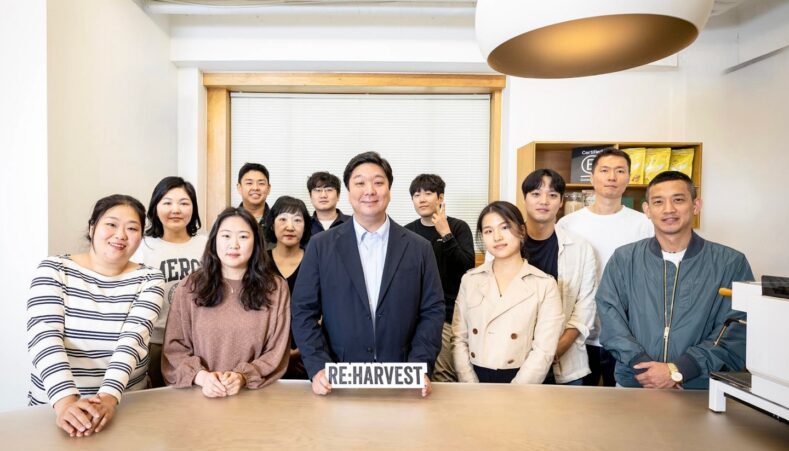
Min is the founder and CEO of RE:harvest, the Seoul company he started in 2019 to turn food-manufacturing byproducts into ingredients. The company calls its powders RE:nergy. They have appeared in pizza dough, baked goods, cereal, snacks and protein bars. By 2025, RE:harvest said it was working with 12 kinds of byproducts, including brewery grain, residue from the Korean rice drink sikhye, wheat bran, kale and carrot pulp, and cacao shells.
The products make the idea legible. The harder work sits earlier in the chain, when a potentially useful material is still perishable and inconsistent. Grain must be collected before it deteriorates, transported under controlled conditions, cleaned, dried, sterilized, milled and inspected. Every handoff decides whether it remains food or becomes a disposal bill. The business is less a clever recipe than an operating system for rescuing value on a deadline.
01 / The question behind the companyTwo trips, one stubborn contradiction
Min was born in New York and spent his early childhood in Northern California. He has described food as an intimate tie to home. His neighborhood did not have a large Asian community, so the dishes his mother cooked carried extra weight. Food also became a family profession: his younger sister built a career as a chef in the United States.
He eventually moved into a very different part of the industry. After completing an MBA at Seoul National University in 2011, Min worked as a strategy consultant in Korea, including at PwC. His projects put him inside the economics of big food and beverage companies: factory efficiency, cost reduction, new ventures and the quiet expense of getting rid of what production left behind.
Travel made the spreadsheets difficult to ignore. On a business trip to Rwanda, Min saw the immediacy of hunger. Soon afterward, he visited a Michelin-starred restaurant and asked the chef how much edible material the kitchen discarded. The reported daily number ran into hundreds of kilograms. One place lacked food; another paid to remove usable nutrition from its premises.
“It was just so ironic - one part of the world is literally tossing out kilograms of edible byproducts, while for another, starvation and undernutrition are an immediate reality.”Alex Min, reflecting on the trips that shaped RE:harvest
The contradiction suggested a business problem with moral stakes. Food manufacturers had already paid for the grain, water, energy and labor inside those byproducts. Then they paid again to dispose of them. Min left consulting after nearly a decade and founded RE:harvest, a name built around the possibility of harvesting the same resource twice.
02 / The machinery of reuseThe race begins while the grain is still warm
The word “waste” makes the material sound inert. Brewery grain is anything but. When it leaves production, it is hot and wet. Without fast handling, bacteria grow and quality slips. RE:harvest's answer starts at collection, with dedicated containers and sensors that track conditions. Material moves through a temperature-controlled chain to the factory, where the company adjusts drying and sterilization to the condition of each batch.
The byproduct journey, compressed
Selection happens before machinery. Min has laid out four tests for a promising byproduct: there must be enough of it, it must retain useful nutrition, it must arrive clean enough to process, and regulations must allow it to re-enter the food system. The criteria prevent a worthy experiment from becoming an uneconomic factory routine.
This is where Min's consultant habits are most visible. He describes food upcycling through quantities, bottlenecks and control points. A smart collection bin checks temperature and humidity. A truck keeps the load stable. Feedback-controlled drying responds to a raw material whose moisture and texture change from batch to batch. In 2025, RE:harvest described the whole path as a 60-step process.
The first powders came from sikhye and brewery residue. Wheat bran later became a major input, joined by fruit and vegetable streams. Each source behaves differently. A stable system must cope with those differences while producing an ingredient a commercial baker can trust. Environmental intent opens the door; repeatable specifications keep it open.
03 / Selling the second harvestA circle needs somebody at the other end
RE:harvest developed the supply side through partnerships. OB Beer supplied spent grain. CJ CheilJedang opened access to streams such as rice bran and oil-seed residues. Overseas, the company worked with Multi Bintang in Indonesia and explored a project with Hanoi Beer. Downstream partners put RE:nergy powder into foods consumers already understood.
Min's larger argument is that climate value can fit inside an ordinary purchasing decision. The powder brings fiber and protein into recipes while replacing some conventional flour. The company also assigns environmental savings to each kilogram produced. Those figures are useful to manufacturers managing carbon and water goals, but Min has repeatedly returned to taste, cost and usability. A product bought once for its story still needs a reason to be bought again.
The consumer reaction has changed during the company's short life. Min remembers an early comment that the team had made feed for people. More recently, he has heard from shoppers who tried an item for environmental reasons and returned because they liked it. That shift is small but important. It moves upcycling from an ethical exception toward the weekly grocery list.
Min also sees public procurement as a lever. School meals, for example, could create steady demand for verified upcycled ingredients. He has argued that standards matter, including certification that can distinguish real recovery from green marketing. His preferred sequence begins with a market: customers create demand, producers learn how to serve it, and rules give the category clearer boundaries.
04 / Beyond the bag of flourFood upcycling gets a second version
By 2025, RE:harvest's map was widening. The company had established an entity in Indonesia, registered RE:nergy powder there and supplied local restaurants. Min discussed creating a United States subsidiary, with California as the intended entry point. The state is personally familiar, environmentally regulated and home to consumers and businesses already conversant in upcycled food.
The technical ambition was widening too. Min calls the original model food upcycling 1.0: food byproducts become food again. Version 2.0 looks inside plant residue for cellulose nanofibers, which could be used in products such as automotive interiors. Conventional nanocellulose often begins with wood. Agricultural and food-processing streams may offer a cheaper source without requiring new trees, although Min has put commercialization several years out.
The ingredient work is still accumulating evidence. In 2026, Min co-authored a food-science study of crackers made with RE:nergy wheat bran. The researchers measured properties including particle size, water-holding capacity and antioxidant activity, connecting the company's factory claim to a product that could be tested, baked and compared.
The practical insight: Min treats a byproduct as a portfolio of properties, not a single replacement ingredient. Protein may serve food. Fiber may serve food today and industrial materials tomorrow. The same collection network can reveal several markets.
That expansion follows the logic that launched the company. Ask what remains after the familiar value has been extracted. Learn why it is discarded. Then build the chain that lets the remaining properties travel somewhere useful. The answer may be a pizza crust. It may eventually be a panel inside a car.
Min's story can be told as a conversion: consultant becomes founder, grain becomes flour, waste becomes value. The more revealing story is continuity. He still studies large systems, traces costs and looks for the place where a process quietly fails. RE:harvest is what happened when the failure he noticed was warm, wet and measured by the truckload.
“The biggest challenge is creating demand for new industries.”Alex Min on what food upcycling needs next
A world without food waste is the horizon Min gives RE:harvest. The daily work is narrower and more concrete: choose the right byproduct, reach it before spoilage, make it consistent, persuade a manufacturer to formulate with it, and give the diner a reason to take another bite. A circular economy is built from those ordinary handoffs. Min is betting that, once they work reliably, a second harvest will feel less like rescue and more like how ingredients are made.