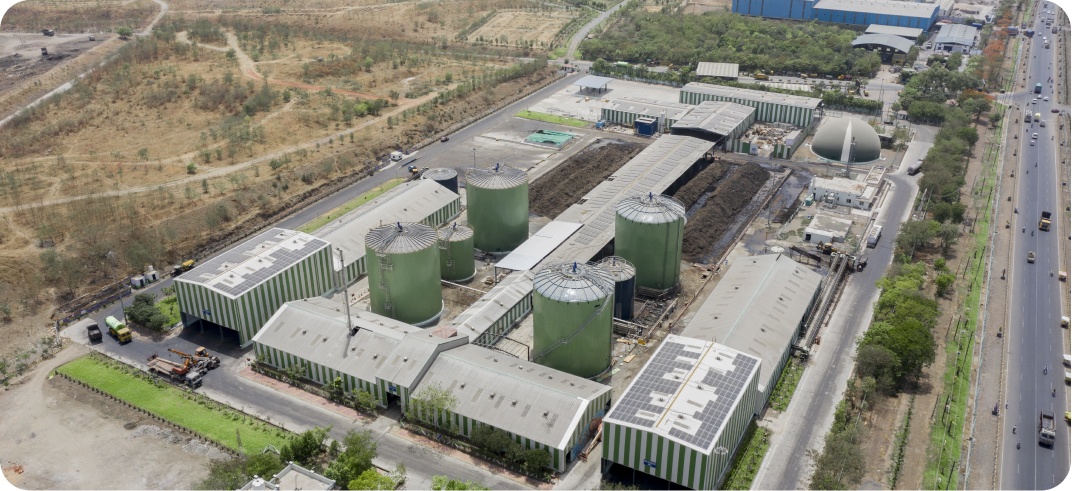
A bus running on yesterday’s dinner sounds like a children’s invention. In Indore, the idea has industrial dimensions: waste trucks, green tanks, gas purification equipment and a municipal customer. GPS Renewables helped engineer and commission the city’s large BioCNG plant for EverEnviro. The company describes a facility processing 550 tonnes of organic waste into 17 tonnes of compressed biogas daily. The curious part is how much of the achievement happens outside those tanks.
- Start small: turn a building’s food waste into usable biogas.
- Grow sideways: add engineering, equipment and plant operations.
- Think like an owner: arrange feedstock, finance and fuel buyers.
That is the thread running through GPS Renewables. Founded in 2012 by IIM Bangalore graduates Mainak Chakraborty and Sreekrishna Sankar, it began with a waste problem and a compact product. Its early BioUrja business served places where organic waste arrives predictably: hotels, offices, hospitals and campuses. An energy project could begin close to the kitchen, with a customer who already needed both waste disposal and fuel.
01 / The kitchen was the proving ground
BioUrja processes organic food waste on site and produces biogas for captive use. GPSR reports more than 100 installations. Its customer list has included Microsoft, Intel and Bosch, alongside hospitality groups such as Oberoi, Taj and Marriott. These are business purchases. A hotel gets a way to handle leftovers and substitute some purchased fuel; GPSR gets an installation where the waste stream and the user sit near each other.
A Trident BKC installation makes the proposition tangible. Commissioned in September 2022, it was designed to process 1.25 tonnes of organic waste a day. In an October 2023 interview, Chakraborty reported cumulative gas production equivalent to approximately 13.8 tonnes of LPG by the preceding September. That is a company-reported conversion, rather than a universal saving every hotel should expect. Still, it gives the kitchen manager something more useful than a sustainability slogan.
02 / A bigger tank changes the business
At city scale, the customer changes. GPSR’s Indore client was EverEnviro, the infrastructure developer. The municipality supplied the waste system around the plant. India’s public-private partnership case study puts the project’s capital investment at approximately ₹150 crore under a 20-year arrangement. That figure belongs to the project, not to a bill paid entirely by GPSR. Construction, ownership and municipal obligations are different jobs.
The arrangement also gave the fuel somewhere to go. The case study describes a municipal purchase commitment for half the gas at ₹5 per kilogram below the market rate, alongside an annual premium of ₹2.52 crore to the city. Waste supply and fuel demand were part of the design. A digester can make gas; it cannot, on its own, make a customer turn up.
Engineering connects the steps. Contracts keep material and money moving.
03 / Dirt sends an invoice
Indore supplies a less photogenic lesson, too. A 2025 Centre for Science and Environment study describes inert material settling inside equipment, causing blockages and reducing performance. It reports a ₹20 crore cyclone-separator upgrade to address the problem. The study also records difficulty finding buyers for fermented organic manure. Both details complicate the easy picture of rubbish going in and valuable products coming out.
For a city considering a similar plant, the practical lesson is to investigate what actually arrives on the truck. Segregation, pretreatment and dependable collection belong in the feasibility work. Product sales need the same scrutiny. Where the input is unreliable or the outputs have weak demand, attractive capacity figures can conceal an awkward operating business. The equipment sits inside a system of habits and contracts.
“Right from inception, GPSR has focused on profitable growth showcasing financial discipline.”Mainak Chakraborty · October 2023
04 / The company steps onto its own books
GPSR expanded beyond supplying plants by launching Arya in 2022, a platform for build-own-operate projects. Its business now spans technology, project execution, operations and asset ownership. OptiMaxx, meanwhile, supplies components such as heat exchangers, gas distribution systems and purification equipment. The company can participate in several parts of a plant’s working life, including upgrades. Public disclosures do not establish how much revenue each activity contributes.
This breadth is its clearest distinction. A buyer can hire an equipment supplier, an engineering contractor or an operator separately; GPSR offers those capabilities within one group. It also acquired German engineering company Proweps Envirotech in 2023. Its technical work includes bioprocess design and gas purification, while its wider development agenda covers ethanol, sustainable aviation fuel and green hydrogen. Those programs should be judged by their own delivery milestones.
05 / Finance the company. Finance the plants.
The June 2026 funding announcement captures the distinction between a growing company and its capital-hungry assets. The advertised ₹635 crore comprised ₹125 crore of company equity led by PixelSky Capital, a ₹200 crore equity tie-up for Arya from an unnamed Korean conglomerate, and an earlier ₹310 crore Sojitz asset-platform tie-up. Reading the whole figure as fresh parent-company equity would miss how the business is financed.
- ₹125cr Company equity
- ₹200cr Arya equity tie-up
- ₹310cr Earlier platform tie-up
The partnerships address another constraint: reaching fuel customers. GPSR has joint ventures with IndianOil, Bharat Petroleum and Oil India. In July 2026, Sojitz described a target of 30 biomethane plants operating by FY2027, with planned annual output of 160,000 tonnes. These are targets. Sojitz’s account explains the division of work: GPSR brings plant expertise; IndianOil brings downstream marketing and access to buyers.
For a hotel, GPSR can begin with a contained waste stream. For a developer or energy company, it can help build and operate larger fuel infrastructure. The transferable idea is to make the surrounding arrangements as concrete as the machinery: know the feedstock, prepare it properly, and identify the buyer. Yesterday’s dinner is plentiful. Turning it into a dependable business takes considerably more organization.