Before Ernest Christian Layman had a recycling app to explain, he had a second-hand truck to put to work. In 2018, he and his college friend Joshua Valentino began learning the waste business with a small plot of land and a handful of business customers. There is a pleasing lack of glamour in that inventory. A truck will carry a great deal, but it has little room for an untested theory.
Layman had spent his early career helping consumer goods reach buyers. Now he was interested in what happened after the buying. The bottle, the wrapper, the box: each had completed its commercial assignment, yet still had a material life ahead of it. Rekosistem, the company he would launch with Valentino, grew out of that awkward gap between a finished transaction and an unfinished object.
His story turns on a practical question. How do you make doing something with those objects convenient enough for people, useful enough for industry, and financially workable enough to happen again tomorrow? It is a question with less sparkle than a promise to save the planet. It also offers considerably more work.
The salesman studies the other end of the sale
Layman studied industrial engineering at Parahyangan Catholic University in Bandung, graduating in 2015. His professional education continued at Procter & Gamble, where he worked in sales and trade marketing and later took on an additional sustainability role. He learned the language of distribution, customers, operating costs, and profit. Those subjects would follow him into a business whose merchandise arrived looking rather worse than it had left the shop.
Packaging made the environmental problem tangible. In consumer goods, getting a product onto a shelf is an achievement with an obvious finish line. Getting the empty packaging into a useful second life involves a different collection of people, incentives, and journeys. Follow that packaging far enough and the familiar sales diagram begins to run backwards.
For Layman, the commercial background mattered because waste recovery still requires a customer. Someone must need the recovered material, and someone must pay for the collection and handling. An environmental intention cannot settle an invoice. His choice of work brought the arithmetic of his first career into direct contact with the concern that was pulling him towards his next one.
A return to campus, with a biodigester
The first venture was called KAHIJI, short for Khazanah Hijau Indonesia. By May 2019, the two founders had returned to their university with plans for managing organic waste through biodigesters. The proposed outputs included biogas and slurry that the campus community could use. Washing and shredding machinery formed part of the design work, applying their engineering education to the operator's daily tasks.
They were also exploring connected waste bins and better monitoring of what the campus threw away. Layman's prescription began with infrastructure and tangible benefits, followed by efforts to encourage habits. The order is revealing. Before asking people to become devoted recyclers, give them somewhere to put the recycling and a reason to return.
A university is an apt place to test that proposition. It can teach a principle in a lecture hall and then confront it with a crowded canteen. A bin, unlike a seminar, has to handle the actual leftovers. Layman's early campus work put that small institutional contradiction to use: learning could be translated into equipment, and equipment could make a daily choice easier.
The machine that asked too much
Rekosistem's public launch came on 21 February 2021, Indonesia's National Waste Awareness Day. That date followed the smaller venture and a period of experimentation. The polished company name had practical baggage behind it. Layman and Valentino had worked as waste collectors and truck drivers, and shared rented living and office space while researching their model.
One early experiment was a recycling vending machine installed in Jakarta in 2021. Layman later described its disappointing productivity: people had to feed bottles in individually, capacity was limited, and users could be unsure what it would accept. Large cardboard presented a particularly ungainly encounter between an everyday object and a tidy machine.
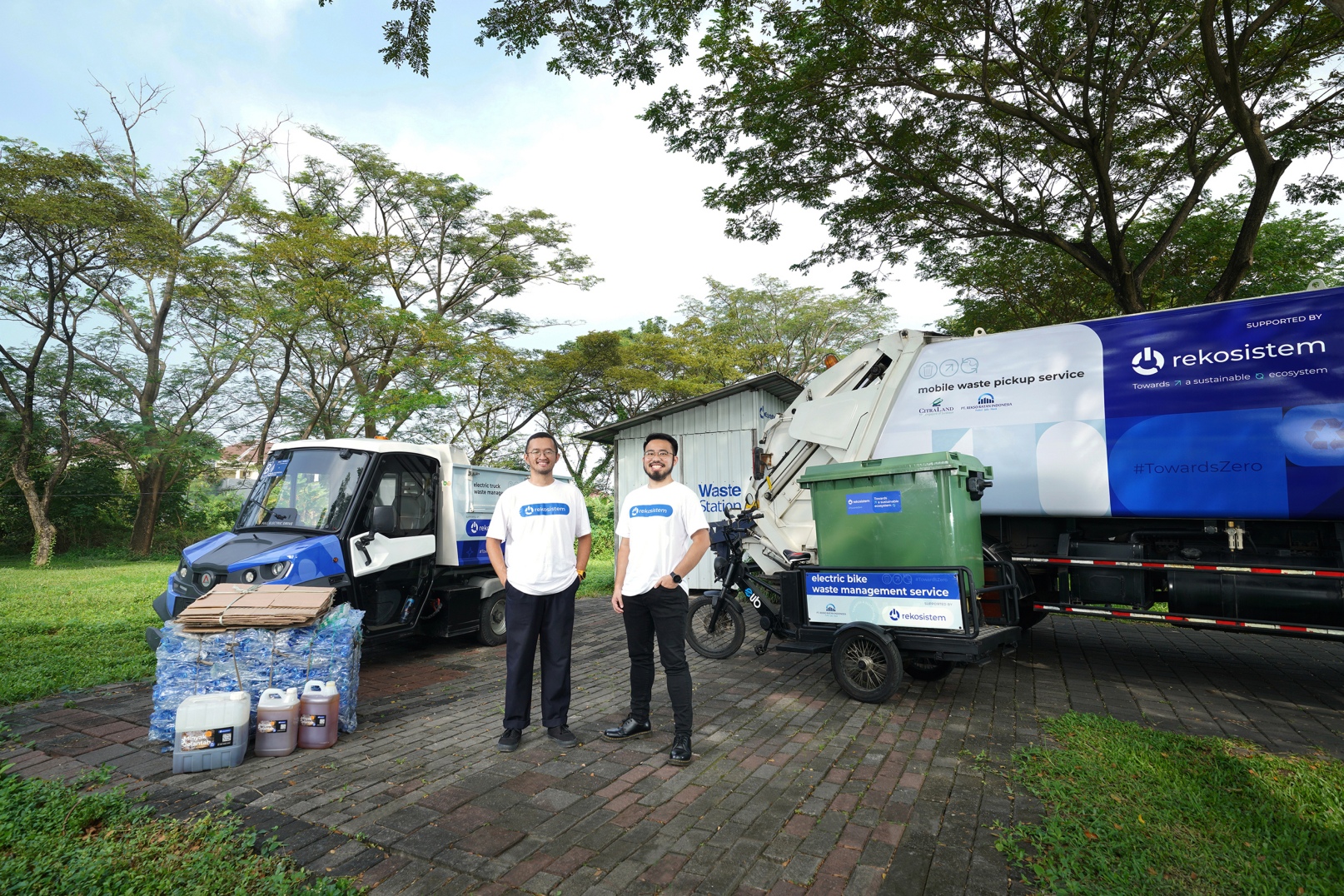
The Waste Station approach reduced that friction. Customers could bring accepted recyclables together, earn points convertible to digital money, and interact with an operator. Behind the station, a Reko Hub sorted materials for recycling buyers. The front of the service could be simple because the complicated sorting happened further along.
There is a useful modesty in that decision. Technology does not become helpful merely by looking technological. A system that requires a long negotiation with every bottle may be admirable in a demonstration and irritating on a Saturday. Layman's account of the experiment leaves room for the person carrying the bag. Their patience belongs in the design brief.
- 01Waste StationPeople deposit accepted recyclables.
- 02Reko HubMaterials are sorted and recovered.
- 03Recycling partnerRecovered material meets a buyer.
Simplified service pathway. Different waste streams require different treatment.
The people already doing the work
Layman and Valentino built around workers and businesses already collecting waste: haulers, aggregators, and waste pickers. Their approach added tools and standardized incentives to existing experience. At the hubs, conveyors, pressing and filtering machines, and weighing systems helped organize recovery. The ambition was to make each stage more productive and connect it to the next.
That is a different starting point from imagining an empty market awaiting an entrepreneur. Indonesia's informal workers were already finding value in discarded things. The founders saw a working economy with constraints, including transport costs and access to equipment. Experience was present. The opportunity lay in helping that experience produce more consistent results.
Layman's advice to other founders reflects the same preference for testing against daily work. He encourages experiments, quick learning, and attention to customers' responses. He also welcomes more participants in waste collection, processing, and recycling. A supply chain needs several kinds of competence. There is little point winning a collection contest if the material has nowhere useful to go.
“Trial, iterate, fail fast, and learn quickly.”
Ernest Layman, 2024
The truck at the beginning of the story belongs here. It put the founders into the movement of materials, where a small inefficiency can be repeated all day. A software interface can record that movement. Machinery can change the work. Neither makes the people who know the routes, the materials, and the customers incidental.
The invoice travels with the rubbish
In July 2023, Rekosistem and WWF-Indonesia opened a Waste Station at RDTX Place in South Jakarta. The partnership connected Layman's concern with habits to a physical location people could reach by public or private transport. He described the station as a way to encourage consistent sorting and deposits. A destination gives a good intention an address.
But a reward for a valuable recyclable can obscure the cost of handling the rest. Layman has been unusually plain about this part of the business. Fees for managing mixed waste and income from recovered materials have different jobs to do. A bottle with resale value and an expensive residue cannot be expected to balance themselves by moral persuasion.
“In the end, where there is waste, there is a cost.”
Ernest Layman, December 2024
That sentence makes his environmental ambition easier to understand. Services need enough revenue to keep operating; useful projects need enough volume to justify their logistics. A collection route that runs repeatedly must pay for the repetition. The invoice is part of the environmental story, however rarely it appears in the photograph.
The company name combines the sustainability prefix “re” with the Indonesian word for ecosystem. It is an economical description of a business involving households, workers, buildings, producers, and material buyers. No single participant can complete the circle alone. Someone else's discarded packaging becomes a resource only when the necessary handoffs actually occur.
A larger audience, and larger loads
Recognition arrived along the way. Layman and Valentino appeared on Forbes Asia's 30 Under 30 list in 2022, in Industry, Manufacturing & Energy. In September 2023, Layman joined Najwa Shihab, actress Chelsea Islan, and musician Robi Navicula for a Mata Najwa session at the Generasi Happy festival in Lampung. The discussion brought household sorting and recycling to a young audience.
The setting offered an entertaining change of scale. Waste work can involve a sorting line in one moment and a public stage in another. The advice must survive both. Asking people to participate is easier when there is a service ready for them after the event. A memorable conversation can begin a habit; the next deposit gives it somewhere to continue.
By March 2025, Rekosistem reported serving more than 90,000 households and individual users and over 200 business clients. The network included 15 hubs, 40 Waste Stations, and more than 600 partner locations. Those dated figures describe a business far removed from the first truck, while preserving the same need to connect supply with demand.
Company figures reported with the May 2025 funding announcement.
In May 2025, the company announced a $7 million Series A led by Saratoga Investama Sedaya and K3 Ventures. Plans included expanding operations, improving the digital ecosystem, and increasing mechanization. Funding changes the available equipment and the possible reach. It also enlarges the practical test: can the model keep working across more locations and more material?
The next city still needs a collection route
Layman represented Rekosistem at SusHi Tech Tokyo in 2025. In March 2026, he spoke at the Macao International Environmental Co-operation Forum and Exhibition, joining a session on building zero-waste cities. Its speakers included officials and experts working on waste systems in Portugal, Beijing, Hong Kong, and mainland China.
That international conversation fits an aspiration he has expressed to make sustainability more accessible and eventually address climate challenges beyond waste. For now, the company is working through Indonesian collection and recovery. Its 2025 activities included opening a Waste Station in Bali, extending the service beyond the Java locations that dominated its earlier work.
The movement from a used truck to those conference rooms can make a neat founder biography. The more interesting continuity is the job waiting outside them. A discarded object needs collecting, sorting, and a destination. Somebody needs to do the work, and the work needs to pay. Layman's career has come to revolve around arranging those ordinary necessities so that fewer useful materials finish their journey in a dump.
The first truck was a modest beginning. Its cargo supplied a demanding education.
Follow the material trail
Explore Rekosistem's services, Layman's public conversations, and the milestones behind this profile.
- Rekosistem's website
- Ernest Layman on LinkedIn · Instagram
- Watch: Layman, Chelsea Islan and Robi Navicula on Mata Najwa
- The 2024 conversation about business and environmental sustainability
- Lessons from Rekosistem's early experiments
- AppWorks on backing Layman
- Katadata's interview on Waste Stations and material recovery
- The March 2026 zero-waste cities forum in Macao