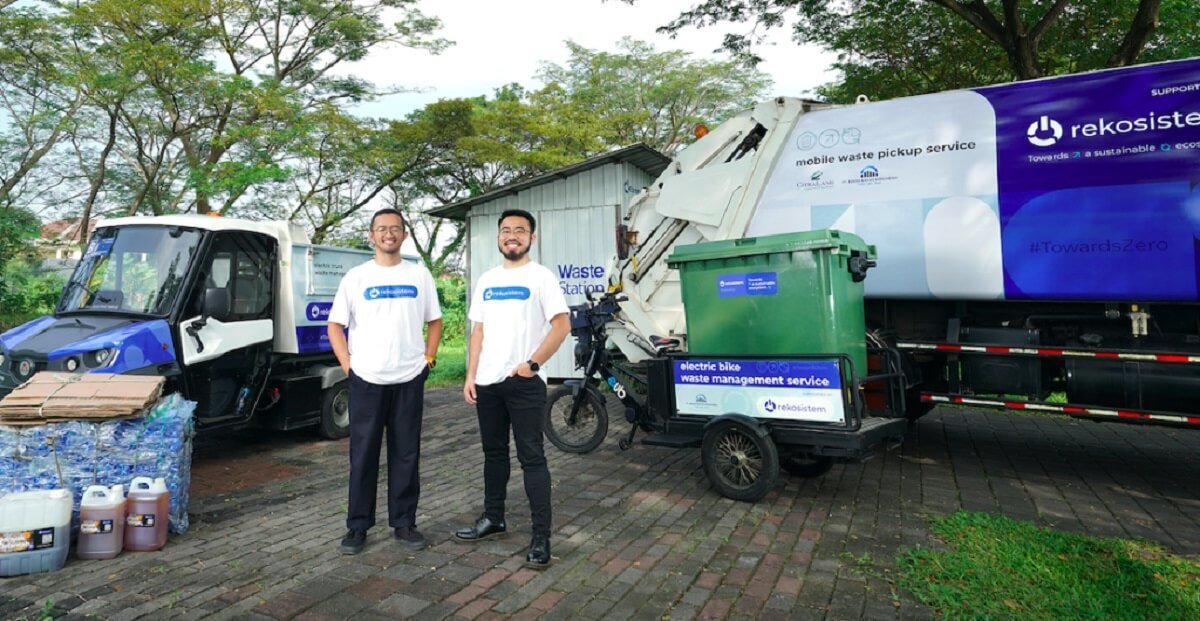
Indonesia produces roughly 69 million tonnes of solid waste a year and recycles about 3.3% of it. The rest is buried, burned, or lost - a good deal of it into rivers and the sea, where the country ranks as the world's second-largest source of marine plastic. Rekosistem was built to close that gap, and it approaches the problem less like a recycler than like a logistics operator: it treats trash as freight that needs a route, a buyer, and a receipt.
The Jakarta-based company describes itself as a clean- and climate-tech firm, but the plain description is simpler. Rekosistem collects waste from homes and businesses, sorts it at its own recovery hubs, and sells what it recovers back to recyclers and manufacturers. What makes that ordinary-sounding chain unusual is how much of it Rekosistem controls end to end, and how deliberately the founders assembled it.
Ernest Layman, the co-founder and chief executive, did not come to waste from an environmental background. He was a marketing manager at Procter & Gamble - and, before that, a nationally ranked DOTA player - who decided around 2016 that waste was the systemic problem he wanted to spend his career on. In 2018 he and co-founder Joshua Valentino started a small collection business. In 2019 Layman quit P&G, put in his savings, and by his own account lived at the office for a year, driving trucks, sorting waste, and sitting with street-level aggregators to learn where the money leaked out of the system. Rekosistem formally launched in 2021, after roughly five years of studying the market from the inside.
What Rekosistem actually does
The business runs on three connected layers - collection, recovery, and reuse - and Rekosistem operates all three rather than stitching together outside vendors. The point of owning the whole line is control: it is what lets the company promise that nearly everything it picks up has somewhere to go.
Collect
App-scheduled pickups from homes and businesses, plus self-service drop-off at Waste Stations and partner kiosks.
Recover
Material recovery facilities separate recyclables, multilayer plastics, and organics for further treatment.
Reuse
Recovered materials and renewable resources are sold to recyclers and manufacturers - about 90% is monetized.
Divert
Waste is kept out of landfills and out of waterways, with roughly 10% ending up as unavoidable residue.
For individuals, the front door is the Rekosistem app, which maps more than 40 branded Reko Waste Stations and over 600 partner kiosks in malls, on campuses, and at transit hubs. Users drop off sorted inorganic waste - and, notably, used cooking oil - and earn RekoPoints, redeemable as e-wallet balance and shopping vouchers. The rates are modest and public: around Rp 800 per kilogram for recyclables and Rp 3,000 per kilogram for used cooking oil. It is a small but pointed design choice. Rather than lecturing people about sorting, Rekosistem pays them for it.
All of the waste we collect - 100% of it - already has an outlet today.
Ernest Layman, Co-Founder & CEOWho its customers are
Rekosistem sells to two audiences at once. On the consumer side, its app serves more than 90,000 households that book pickups or drop off waste at stations. On the enterprise side, it works with over 200 business clients - manufacturers, food-service outlets, offices, schools, and modern retailers - that need reliable, documented waste handling. Consumer-facing Waste Stations have appeared in co-branded form with large companies including Nestlé Indonesia and Toyota.
The enterprise relationships are where the regulatory tailwind matters. Indonesian rules increasingly push producers toward Extended Producer Responsibility - the principle that a company is on the hook for the packaging it puts into the market. Meeting those obligations requires collection, recovery, and above all reporting that stands up to audit. Rekosistem packages this as a tiered EPR program covering collection, recovery, and full circularity, which turns a compliance headache into a recurring contract.
The problem it solves
Indonesia's waste economy is not empty - it is fragmented. Thousands of informal pickers and small neighborhood waste banks already move recyclables, but they operate with thin margins, unreliable buyers, and slow cash flow. Only about 60% of urban Indonesians have formal collection at all. Rekosistem's answer is aggregation: it partners with roughly 600 of these small operators, gives them a dependable buyer and faster payment, and channels their supply to formal off-takers. The fragmentation that makes the sector hard to fix becomes, in Rekosistem's hands, a network to be organized rather than a competitor to be beaten.
Explosive growth, ground-level work
Rekosistem reported a 442% compound annual growth rate through the end of fiscal 2024 - the kind of curve that, in this industry, is built from routes and hubs rather than a viral app.
The 90 / 10 split
For every ten tonnes Rekosistem collects, roughly nine find a productive second life and one becomes residue - a ratio the company treats as its core operating metric.
How it differs from competitors
Indonesia has a small but real cluster of waste-tech startups - names like Waste4Change, Octopus Indonesia, Duitin, Rapel, and MallSampah - most of which focus on one slice of the chain, whether that is consumer collection, marketplace matching, or recovery. Rekosistem's distinguishing bet is vertical integration: rather than owning the app or the facility, it owns the app and the facility and the collection fleet and the off-take relationships.
That integration is what backs the founder's claim that everything collected already has a buyer. It is a harder company to build - physical networks, logistics, and thin margins are unforgiving - but it is also harder to copy. The moat is not a piece of software; it is a working supply chain with hundreds of partners plugged into it and a growth rate that suggests the plumbing holds.
Products & services
Reko Waste Station
40+ branded drop-off points and 600+ partner kiosks where people deposit sorted waste and used cooking oil for RekoPoints.
Repickup Service
Scheduled and on-demand collection for homes, offices, schools, and commercial and public facilities, booked via web and app.
Redrop & RekoPoints
Self-service app deposits that convert sorted trash into e-wallet balance and shopping vouchers.
EPR / Corporate Programs
Three-tier Extended Producer Responsibility programs - collection, recovery, circularity - with reporting for brands.
Material Recovery Facilities
Recovery hubs that sort recyclables, multilayer plastics, and organics into recycled materials and resources.
Renergi & B100 Biodiesel
Waste-to-energy work converting used cooking oil into B100 biodiesel and organics via biodigester stations.
The money
Rekosistem has raised roughly US$19 million in disclosed funding. The most recent round, a US$7 million Series A closed in May 2025, was led by Saratoga Investama Sedaya - the investment vehicle associated with Indonesian tycoon Edwin Soeryadjaya - and by K3 Ventures, founded by Kuok Meng Xiong, a grandson of Malaysian magnate Robert Kuok. AppWorks, Skystar Capital, Bali Investment Club, Orvel Ventures, and Michael Sampoerna's Office also took part. It followed a US$5 million round in 2023 led by Skystar Capital with East Ventures and Provident.
Where it fits in the market
Indonesia is a natural laboratory for this kind of company: a fast-growing economy, a severe and visible waste problem, tightening producer regulation, and a large informal recovery sector waiting to be organized. Rekosistem sits at the center of those forces as an aggregator and operator - the connective tissue between households, brands under EPR pressure, small waste banks, and the recyclers who buy finished material. Whether the consumer side ever pays for itself is an open question; app-based collection is expensive, and much of the industry's economics live in the enterprise contracts. But the company's own framing is telling. It does not sell recycling as a virtue. It sells a system that, by its own numbers, finds a home for nine of every ten tonnes it touches - and gets paid to do it.
Figures in this profile are drawn from Rekosistem, Forbes, e27, Heaptalk, Indonesia Business Post, and other public sources. Growth is shown as an indexed illustration of a reported 442% CAGR; funding bars are scaled to disclosed round sizes. Some legacy product statuses are approximate.
The recordA timeline
The idea takes root
Ernest Layman decides waste management is the systemic problem he wants to solve at scale.
First waste business
Layman and Joshua Valentino start a small collection operation to learn the market from the ground.
All in
Layman leaves P&G, invests his savings, and spends a year driving trucks and sorting waste himself.
Rekosistem launches
The company debuts as a clean- and climate-tech platform for the waste supply chain.
Rewards & stations scale
RekoPoints, Redrop, and Waste Stations expand, letting users trade sorted trash for e-wallet balance.
US$5M raised
Secures a US$5M round led by Skystar Capital with East Ventures and Provident.
442% CAGR
Reports rapid growth, processing roughly 4,500 tonnes of waste per month.
US$7M Series A
Raises a Series A led by Saratoga and K3 Ventures to scale across Indonesia.