The first conveyor belt cost £40 and was meant for exercise. Bought on eBay, the treadmill carried household rubbish through an experiment in Peter Hedley’s parents’ garage. Hedley and Victor Dewulf were trying to teach a camera system to recognise what people threw away. Their training material came from neighbourhood bins. A recycling startup had found an appropriately second-hand beginning.
Seven years after Recycleye’s 2019 founding, the stakes are larger. In April 2026, recycling equipment maker CP Group acquired a majority interest in the London company. Recycleye’s 45-person team and leadership would stay. The transaction joined its software and sorting expertise to a business that builds material recovery facilities - the industrial sorting plants usually shortened to MRFs.
The attraction is practical. A discarded bottle still has to be found, separated and sold before it becomes useful feedstock. Recycleye builds machines that help with those middle steps. Its proposition rests on a less romantic question than whether recycling is good: can a plant recover this particular object for less than someone will pay for it?
A camera was the cheap part
Dewulf studied environmental engineering; Hedley studied computer science at Imperial College London. A facility visit had exposed Dewulf to the amount of manual sorting involved. Computer vision offered a way to recognise objects on a belt and tell a machine what to retrieve. The idea connected two subjects that, in their student lives, had occupied different classrooms.
In a 2022 interview with investor Playfair, Dewulf described six months of bootstrapping from the founders’ savings. He had worked at Goldman Sachs; Hedley had applied computer vision to art. Their test operation eventually expanded into Dewulf’s parents’ garden. Permission for that, he recalled, was difficult to secure. Understandably: most parents expect a visit, not an incoming waste stream.
The £40 experiment tested recognition on moving objects. Selling equipment required a much bigger undertaking: engineering, customer trials, installation and service. Recycleye announced £3.5 million in funding in 2021 and a $17 million Series A led by DCVC in February 2023. The latter funded further development and expansion. An inexpensive proof of concept had become a capital-intensive industrial business.
“We believe that waste does not exist, only materials in the wrong place.”
Peter Hedley · February 2023
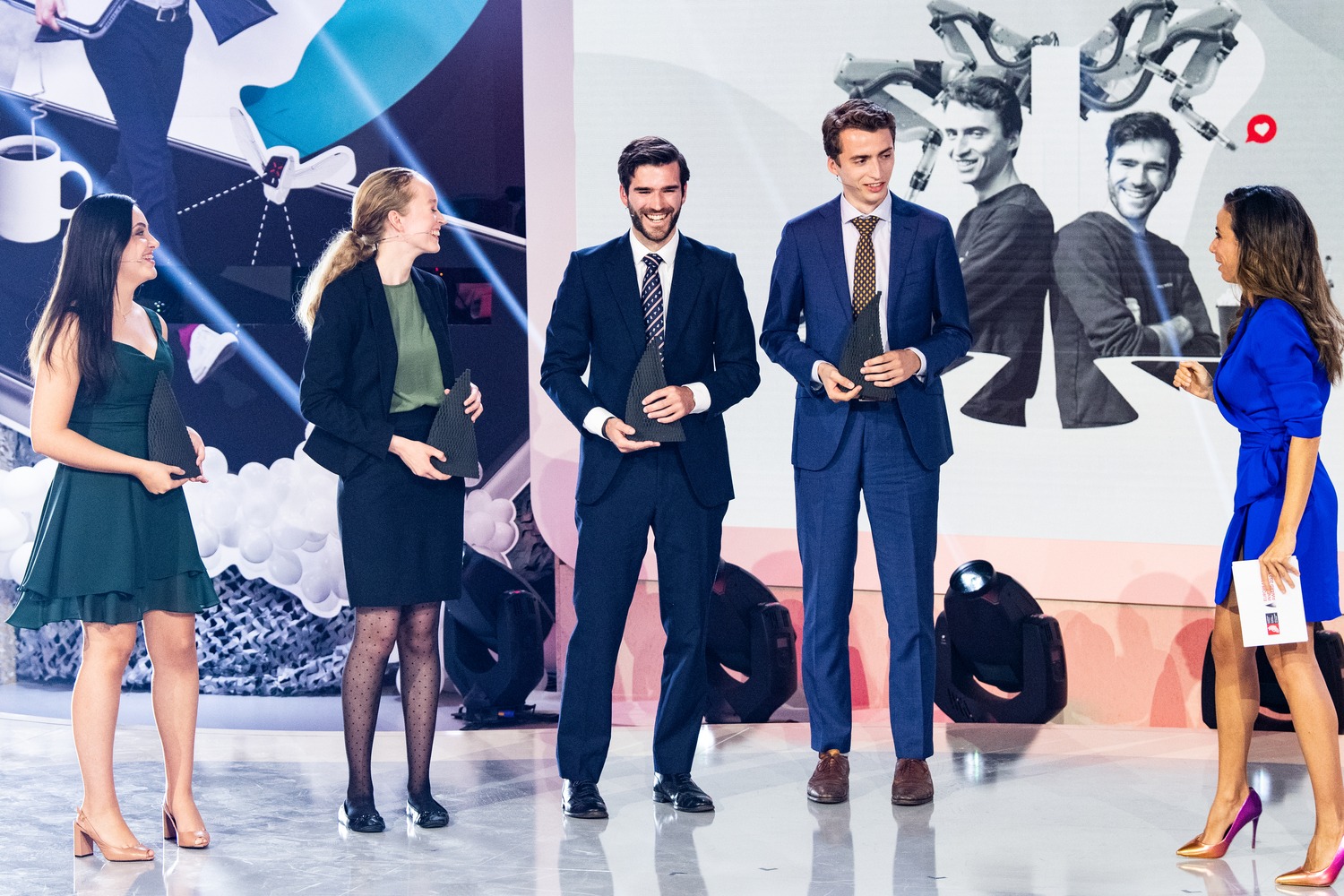
That line from the funding announcement is a tidy expression of the ambition. The founders also gained outside recognition: in 2022 they shared first place in the European Patent Office’s inaugural Young Inventors prize. Awards put the idea on a stage. Operators would judge it beside a conveyor.
There is a useful method to copy here: put real material in front of the system early. The treadmill supplied motion; collected rubbish supplied variety. Neither needed to resemble a finished factory installation to expose whether the recognition idea deserved more work. For another industrial founder, the equivalent might be one camera above an existing process and a tightly defined test. The discipline is to separate the cheap question a prototype can answer from the expensive operating promises it cannot yet make.
The milk-bottle test
At FCC Environment’s re3 facility in Reading, the assignment was specific: improve separation and remove contamination on a split-stream plastics line. Recycleye installed its vision and robotic equipment over an existing conveyor in September 2021. The software identified target items and prioritised the picks; dashboards recorded what the machine collected.
The published customer case study reports an average of 55 successful picks per minute, 99% target-material purity and a 12% increase in target-material volume. Those are results from a particular installation. They describe a useful industrial outcome without establishing what every other plant will achieve.
target-material purity
Purity describes the material in the recovered output. Recovery asks how much of the wanted material was captured in the first place. A machine can produce a clean fraction while leaving valuable objects behind. For a buyer, both measures matter, together with how much material moves through the line and what happens during an ordinary shift.
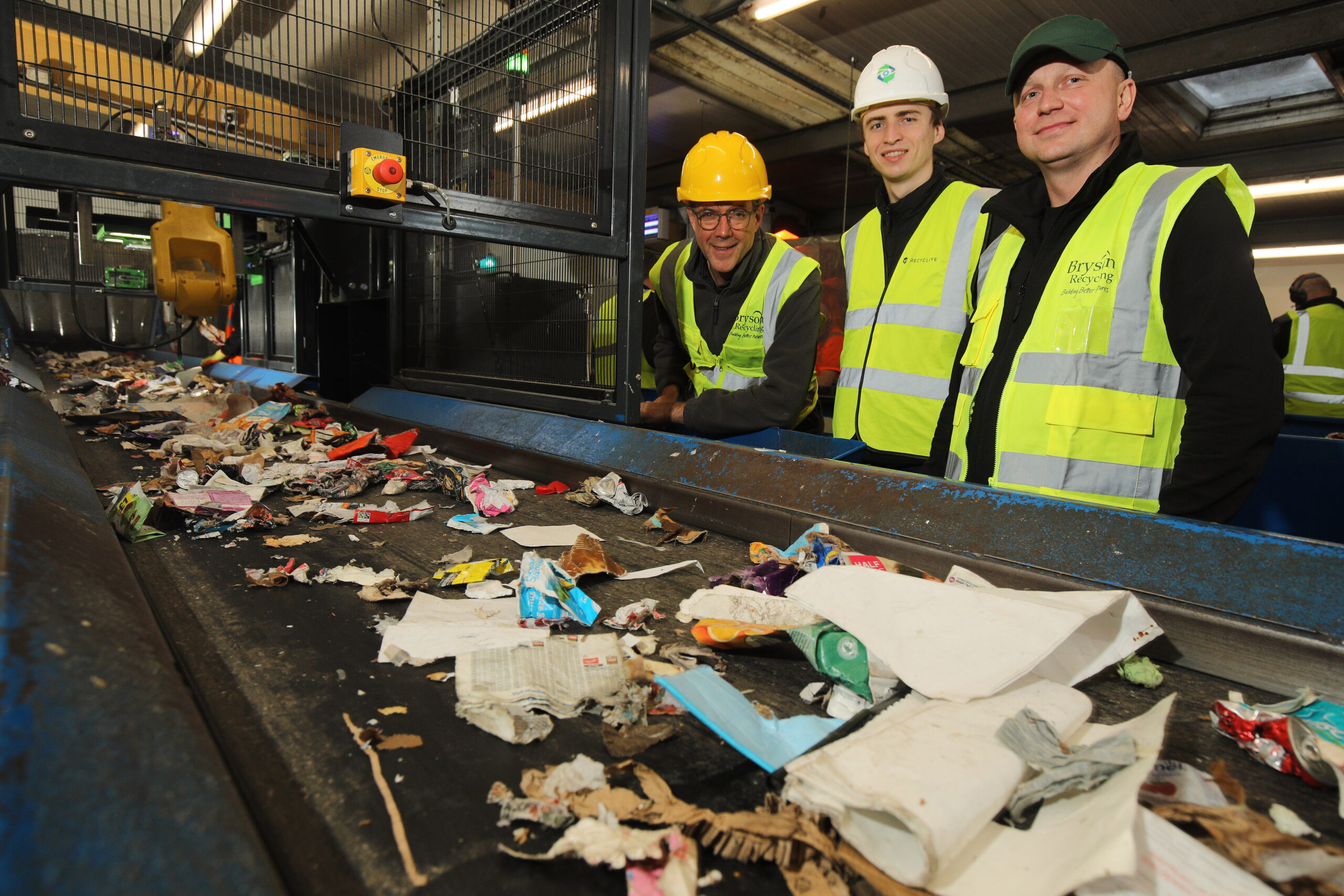
Other deployments show how narrow the job can be. Recycleye’s integrator brochure describes Bryson robots retrieving valuables from fibre quality-control and residual lines. At Panda, robots remove contamination from paper and aluminium streams and retrieve beverage cartons. Levenseat’s task included taking wine-bottle lids out of a stream of aluminium cans and aerosols. Waste management gets surprisingly particular about bottle tops.
Sometimes the right hand is a blast of air
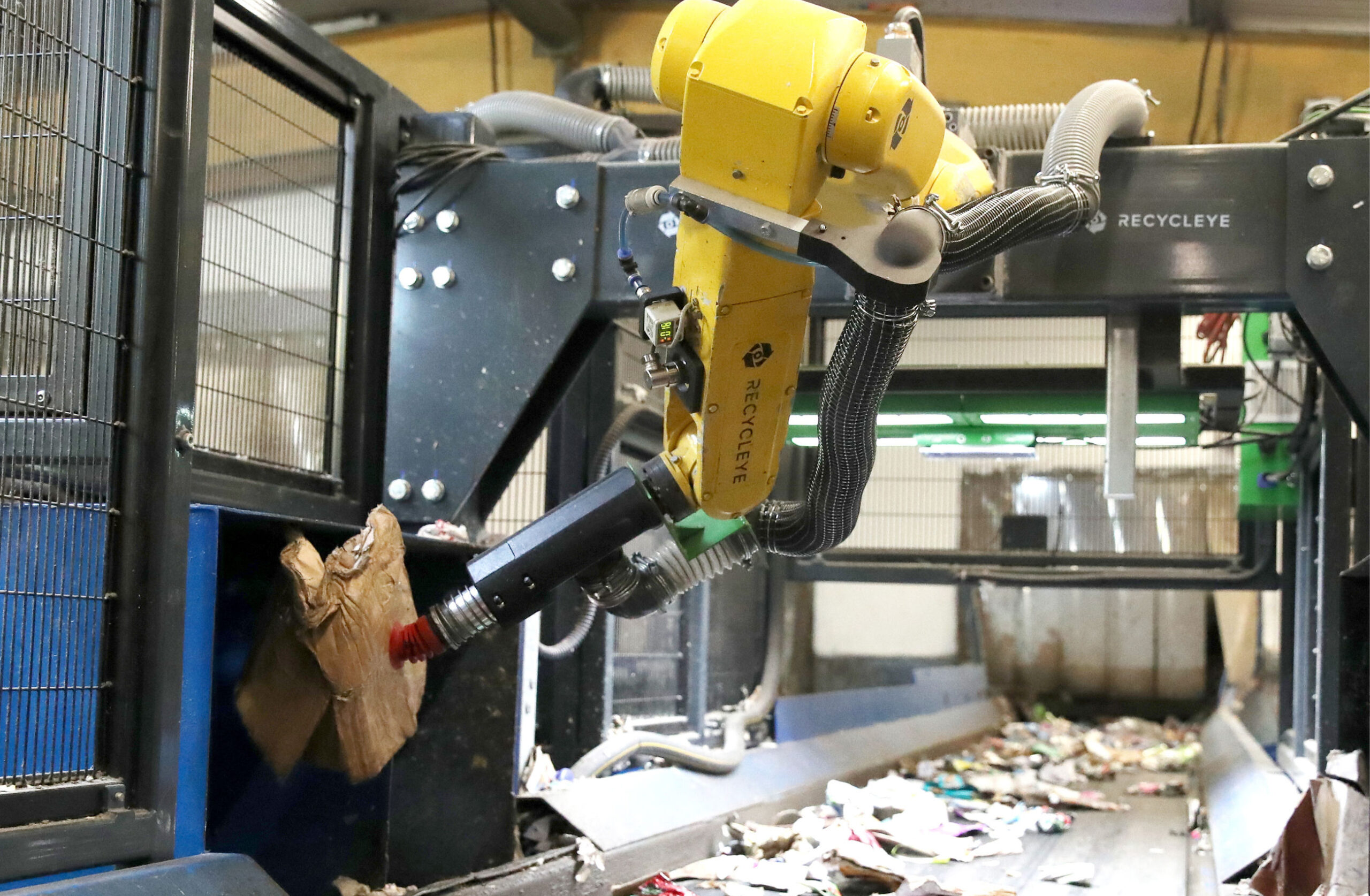
Recycleye’s current range gives operators a choice of physical actions. QualiBot, co-developed with FANUC, uses an industrial arm and suction gripper for quality control in dry mixed recyclables. It can remove contaminants or retrieve wanted items, operating alongside people or in dedicated automated positions. Its vision system supplies the recognition that makes the arm’s movement useful.
QuantiSort 2.0 uses pneumatic ejection for higher-volume sorting. Recycleye advertises up to 1,000 ejections per minute, dependent on belt width, and applications in household recyclables, waste electrical equipment and metals, and construction debris. That maximum is a product specification. It should not be put beside FCC’s observed robot pick rate as though the two were a controlled race.
Cameras capture objects travelling along the belt.
AI classifies the item and selects the target.
A robotic grip or air jet moves the material.
Detections and operating results inform the next decision.
The expansion is visible at HEYDT’s site in Aulendorf, Germany. Working with plant builder STADLER, Recycleye commissioned QuantiSort there in June 2025. The assignment included separating brick from mixed construction and demolition material. Its project announcement describes recognition based on shape, texture, colour and context, addressing sorts that conventional sensing had struggled to perform economically.
Meanwhile, Recycleye Insights turns detections into composition charts, performance information and downloadable data, with email alerts available. An operator can inspect changing material proportions, robot uptime and successful picks. The dashboard’s value depends on someone using those observations to investigate a line or change an operating decision.
That combination calls for several kinds of expertise. In its 2021 account of the company, NVIDIA described models trained on GPU-enabled Microsoft Azure infrastructure before deployment to customer-site devices. Machine learning therefore sits beside physical integration: the system must associate an image with an object that keeps moving, then translate a detection into a timely action. The arm or ejector finally has to complete the separation. Each stage contributes to the output the customer actually buys.
Clean plastic still needs another process
The OMNI project offers a useful check on what sorting achieves. Recycleye worked with Valorplast and TotalEnergies on separating food-contact polypropylene packaging from household waste. Valorplast supplied characterised material from five French locations. After 18 months of research, the partners reported a demonstration with a 50% successful pick rate for the food-grade material and purity above 95%.
Those two figures tell different parts of the story. The recovered fraction was comparatively clean, but the machine had not retrieved all the eligible material. The sorted plastic then went through a separate decontamination pilot. TotalEnergies applied its polymer expertise to the resulting recycled polypropylene. The published results describe a chain of processes, with recognition and separation providing its starting material.
For a prospective customer, the lesson is to test the whole route to a saleable output. Better sorting cannot, by itself, supply a downstream buyer or perform the washing and reprocessing. A carton or plastic tub needs somewhere useful to go after a machine successfully moves it.
The invoice has more than one line
Recycleye sells an industrial installation with software, analytics and support. The practical purchase includes getting equipment into the plant, commissioning it and keeping it operating. Its customer support portal offers guides, troubleshooting, spare parts and consumables, including suction cups. A machine that can recognise rubbish still needs someone to replace the parts that touch it.
In a January 2023 Investec interview, technical sales manager Zoe Cook illustrated a payback period below two years against the cost of three full-time pickers and their overheads. That was a sales example with a staffing assumption. A sensible buyer would rebuild the calculation using local wages, actual operating hours, maintenance and the value of additional recovered material.
Recovered material value
+ operating savings
− installation and running costs
The approach is most useful where a defined sorting job produces enough recoverable value or saves enough operating expense to justify the installation. Thin volumes, few target objects or weak resale prices make the calculation harder. Site trials should use the waste actually arriving at the gate, including its crushed, dirty and overlapping items, rather than a convenient collection of clean demonstration packaging.
A bigger owner, and plenty of competition
Recycleye occupies a busy part of industrial AI. TOMRA’s GAINnext uses deep learning for difficult sorting applications. AMP Jet also combines AI recognition with air ejection. Greyparrot concentrates on waste intelligence and connections to other manufacturers’ equipment. Recycleye’s combination of robotic picking, optical sorting, analytics and retrofit deployment gives it several ways into an operator’s plant.
CP Group’s acquisition builds on an MSS collaboration dating to 2023. The partners now plan hybrid systems combining AI and near-infrared technology, while retaining independent divisional operations. The strategic logic is straightforward: pair recognition software with equipment engineering, installation experience and customer access. It also underlines how much of this business happens beyond the algorithm.
Inside Recycleye, the careers pitch includes upskilling, monthly socials and an annual retreat. Its opening question asks whether applicants want a rubbish job. The pun fits a company whose earliest test data came out of bins. The work has since acquired investors, awards and an industrial owner, but the useful test remains close to the garage original: identify an object in motion, then prove that doing something with it is worth the trouble.
Follow the next sort
Explore Recycleye, its customer stories and company updates.