A bottle can be recyclable and still arrive at a landfill. In 2023, Virginia’s Southeastern Public Service Authority studied the residential trash headed its way. More than a quarter was recyclable plastic, metal, or paper, even in communities with curbside recycling. There was valuable material in the wrong truck. For AMP, the Colorado company once called AMP Robotics, this was an opening: recover the material after people have thrown it away.
- AMP combines computer vision with robotic arms and air jets to separate materials.
- Its newer business includes running whole sorting systems on pay-per-ton contracts.
- Virginia’s expansion couples a 20-year agreement with a $200 million regional investment.
The familiar recycling problem is human behavior: someone puts a bottle in the wrong bin. AMP approaches the next problem, the cost of retrieving it. That distinction explains how a company making sorting robots found itself taking responsibility for infrastructure that communities expect to use for decades.
01 First, see the mess
Recycling is an awkward assignment for a machine. Manufacturing offers repeatable parts; household waste offers the same package crushed, stained, or folded into different shapes. Matanya Horowitz, who studied controls and dynamical systems at Caltech, saw a role for deep learning in that inconsistency. Early prototypes were fallible. “We built (and broke) a bunch of robots,” he recalled in a 2021 interview with Climate Tech VC.
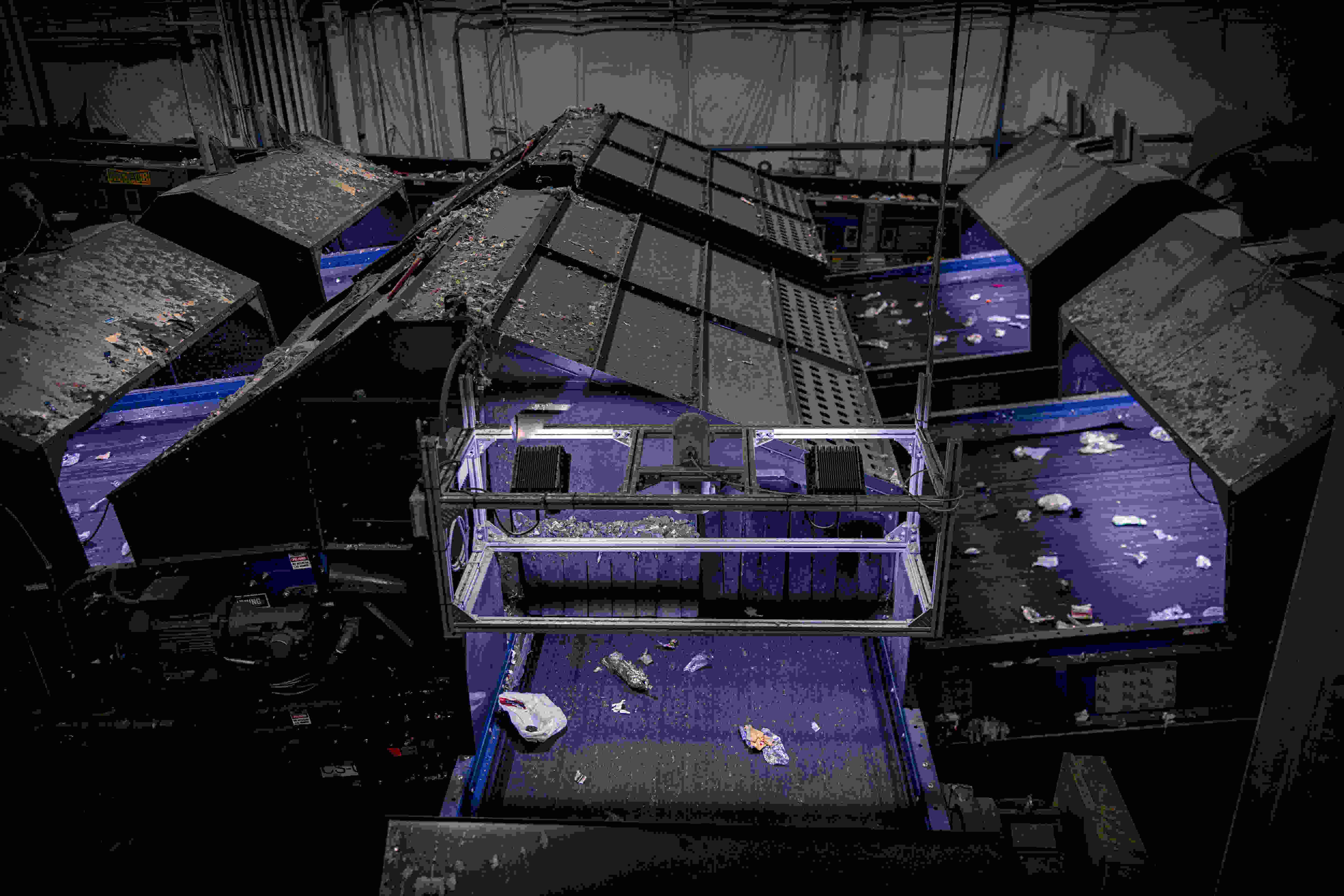
AMP’s initial products fitted into existing facilities. Cameras identified objects; robots picked them off conveyors. The current lineup separates those jobs into components. Vision recognizes material. Delta supplies robotic arms. Jet uses compressed air to redirect objects. Microjet adds pneumatic quality control beside lower-volume belts. Insight turns observations into operating data.
One Jet has two rows of 50 air nozzles. AMP specifies more than 5,000 ejections a minute, a machinery rating rather than a promise about an entire plant’s recovery. Its cameras also supply information about what passes through. A barcode attached to a finished bale can connect that bale to its composition and purity. The buyer gets a record alongside the material.
02 The unit of sale gets bigger
The commercial learning was equally practical. Horowitz said in 2021 that early customers preferred buying or leasing robots to an ongoing monthly service. Waste operators planned over long periods and valued ownership. AMP adjusted. Later, it found another opening: take responsibility for the sorting system itself.
In February 2024, the company shortened its public name to AMP. Horowitz explained the change: “We’re selling more than robots.” AMP ONE put the technology into a facility-wide design. In November, former Republic Services chief operating officer Tim Stuart became CEO, while Horowitz became CTO. The operating experience of the waste industry now sat alongside the engineering.
AMP describes its team as ambitious optimists. Its 2026 Denver Post Top Workplace recognition came from an employee survey. Around the automated equipment, people still solve the maintenance, integration, and operating problems.
Waste Connections illustrates the progression. A 2020 agreement covered 24 robotic systems. By 2022, the relationship had expanded to more than 50 deployed systems. In 2024, Waste Connections agreed to an AMP-operated system for a new Commerce City recycling facility designed for 62,000 tons annually. The commercial unit had grown from a machine to a processed ton.
AMP ONE’s advertised service includes operation, maintenance, upgrades, and optimization. Its standard responsibility chart leaves sourcing material, finding buyers, and disposal with the customer. These boundaries matter. A reliable sorter still needs incoming waste, outgoing trucks, and someone willing to buy the recovered commodities.
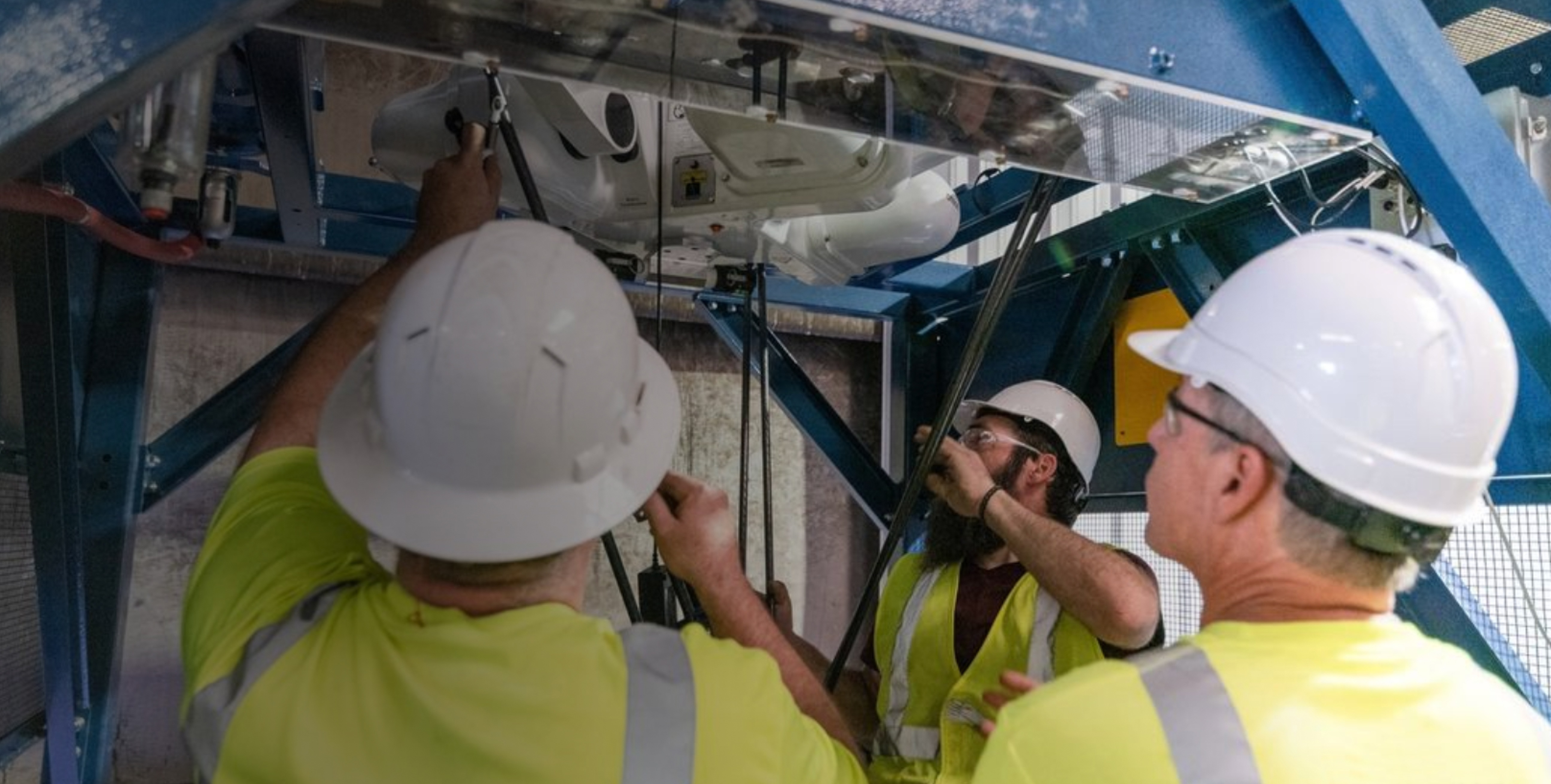
In Cleveland, AMP describes a facility capable of sorting up to 60,000 tons a year without manual sorting. A small team handles checks and maintenance. That remaining work gives the operating contract its substance: someone still has to keep the machinery available and the material moving.
“All you have to do is drop off and pick up. AMP does the rest.”
Kevin Papich, AMP facility operations
Cleveland case study, July 2025
03 The landfill has a deadline
In Virginia, the decision had a clock attached. SPSA said its regional landfill would fill by 2060 without an alternative disposal approach. Expanding locally was unavailable; shipping waste elsewhere would cost more. Its smaller Portsmouth pilot with AMP had already processed tens of thousands of tons a year. In November 2025, the authority approved a 20-year agreement with AMP affiliate Commonwealth Sortation.
The expanded system is designed for 540,000 tons annually. The contract requires half the waste delivered to AMP to avoid landfill, with recycling and organics processing doing different jobs. Calling all that material “recycled” would obscure the design. Plastics and metals can return to manufacturing. Recovered organics are intended for a separate biochar process.
50% diversion is the contract requirement at scale. It is not a claim that half becomes recycled packaging.
The price deserves its own distinctions. SPSA described a $200 million regional investment, with AMP providing half the funding and the authority funding its portion through processing fees. Separately, AMP raised $91 million in Series D equity in December 2024. In September 2026, it secured $70 million in project debt led by Galvanize for Portsmouth’s next construction phase.
That phase includes a second sorting facility expected in early 2028 and an adjacent organics facility. Google’s March 2026 agreement to purchase 200,000 metric tonnes of carbon removal by 2030 supports the planned biochar capacity. Sorting, construction, and carbon storage have different schedules. The regional system is still being built out.
04 Follow the material
AMP competes in a market where TOMRA supplies sensor-based sorting and deep-learning tools, and EverestLabs offers vision-guided robotics and plant intelligence. AI recognition alone is not a unique claim. AMP’s distinctive proposition combines recognition, physical separation, facility design, and operating responsibility. Its customers can buy improvements to existing lines or procure a broader processing service.
The configuration changes with the customer. In August 2026, Kent County, Michigan, announced an AMP system designed to recover recyclables before waste-to-energy processing. That project puts sorting ahead of combustion, giving useful materials another exit from the waste stream.
The lesson to copy is to measure the waste before choosing the machine. Establish what enters, what escapes, what buyers will accept, and who pays when equipment stops. A site without enough suitable material or dependable buyers can struggle regardless of recognition speed. AMP’s wager depends on making those relationships work together, one contracted ton at a time.