In September 2020, Rishi Stocker announced that he was leaving Revolut. He had joined four years earlier, when the company was still young, and had worked on partnerships and international expansion. Now he wanted to build something himself. “I now plan to set up a business of my own,” he wrote. The ideas, for the moment, were staying in stealth.
The eventual answer involved discarded plastic, paper and metal. Stocker became co-founder and chief executive of TrueCircle, later renamed Safi, pursuing a problem that is easy to describe and awkward to solve: material can be recyclable without being an attractive thing to buy. Someone still has to establish its quality, agree a price and get it to a customer.
His career makes an interesting route into that problem. It runs through ancient languages, consumer goods, mobile-phone protection and a financial app before reaching recycling facilities. The settings change considerably. The practical work keeps returning to exchanges between businesses, and to the effort required before those businesses will trust one another enough to transact.
01 /Classics, consumer goods and the partnership desk
Stocker studied Classics at the University of Oxford, attending from 2008 to 2012. His education is a useful detail in a technology founder’s biography precisely because it does not supply a tidy explanation for everything that follows. A degree in Classics establishes what he studied. The commercial apprenticeship came afterwards, inside companies with products to sell and partners to persuade.
He entered Unilever’s graduate programme in July 2012 and stayed until June 2014. Then came SquareTrade, where he worked in European business development until September 2016. His responsibilities there included partnerships with mobile carriers Three and T-Mobile. Consumer goods and device protection offered different products, but both placed him close to the business of getting something into customers’ hands.
Revolut followed in September 2016. Stocker was among its early employees and became its first head of partnerships. During his tenure he worked on new product lines, including insurance, credit and rewards. His remit also extended into international expansion: he moved into launch work in 2017 and spearheaded the company’s entry into Japan.
That Japan assignment gives some substance to the word “partnerships”, which can otherwise sound like a job conducted entirely over agreeable lunches. Entering another market means putting arrangements into place that a customer may never see. Stocker’s work sat behind the app, among the relationships and operations needed to bring a service into use.
By September 2020, he had spent four years at Revolut. His departure announcement made his next ambition explicit, while leaving the business itself unspecified. There was no public recycling manifesto attached to that first announcement. There was a decision to move from helping expand somebody else’s company to starting his own.
- 2012-2016Unilever → SquareTradeConsumer goods & partnerships
- 2016-2020RevolutPartnerships & expansion
- 2021 ONWARDSTrueCircle → SafiRecycling & material quality
02 /What is actually inside the bale?
Safi’s origins reach back to 2021 under the TrueCircle name. Stocker’s fellow co-founder Eamon Jubbawy had previously co-founded identity-verification company Onfido. Stocker brought experience in partnerships and commercial expansion; the venture put computer vision to work in a setting far removed from a phone’s banking screen.
By March 2022, TrueCircle had announced $5.5 million in pre-seed funding. Its vision systems were already deployed at nine large European materials recovery facilities, including sites operated by Viridor. Cameras examined material on conveyor belts, while dashboards and alerts helped operators see changes in the quality of their output.
Stocker described the mission as helping facilities “operate more efficiently and profitably”. Those final two words matter. A recycler’s willingness to use new equipment depends partly on whether it helps the plant perform. Better information has to earn its place alongside the other things a facility could spend money and time improving.
A June 2022 product release targeted PET and HDPE recyclers. The system classified material and helped plants understand what they were recovering or losing during processing. A camera could make a quality problem visible sooner; a dashboard could give an operator something specific to act on. The pitch concerned the daily operation of a plant.
In September 2023, Stocker explained the pricing problem with a particularly revealing example. A bale sold as 95 percent clear PET could actually contain anywhere from 83 to 98 percent, yet command the same price. A nominal grade concealed a large variation. A producer making cleaner material needed a way to demonstrate the difference and be paid for it.
Stocker’s example of variation within one commercial grade. Values show composition, not the frequency of different grades. Scale: 0-100%.
03 /The trouble with finding a better buyer
The trading business grew around that gap between a description and its contents. Safi connected sellers of recovered materials with buyers and helped with the practical arrangements around a sale. Quality measurement belonged inside the transaction because it could make the offer more credible. Transport, paperwork and financing mattered for the same reason: each could obstruct a deal.
For Stocker, a familiar business relationship had an understandable attraction. Finding another supplier involved effort and uncertainty, even when a better price or product might exist elsewhere. Safi’s marketplace tried to make that search less burdensome. A wider set of potential counterparties was useful only if buyers and sellers could actually complete business together.
In November 2023, Safi announced a $19.5 million Series A led by Nosara Capital, with Lowercarbon Capital and Transition participating. The financing gave Stocker resources to develop the operation further. It also brought attention to a founder applying experience from financial technology to the less photogenic work of moving recovered materials between businesses.
Led by Nosara Capital, with Lowercarbon Capital and Transition participating.
The ambition was commercial as well as environmental. Stocker wanted recovered material to compete more effectively with newly produced alternatives. His emphasis fell on unnecessary expense in the supply chain. If recycled input becomes easier to assess, obtain and use, the argument for purchasing it becomes easier to make across a procurement desk.
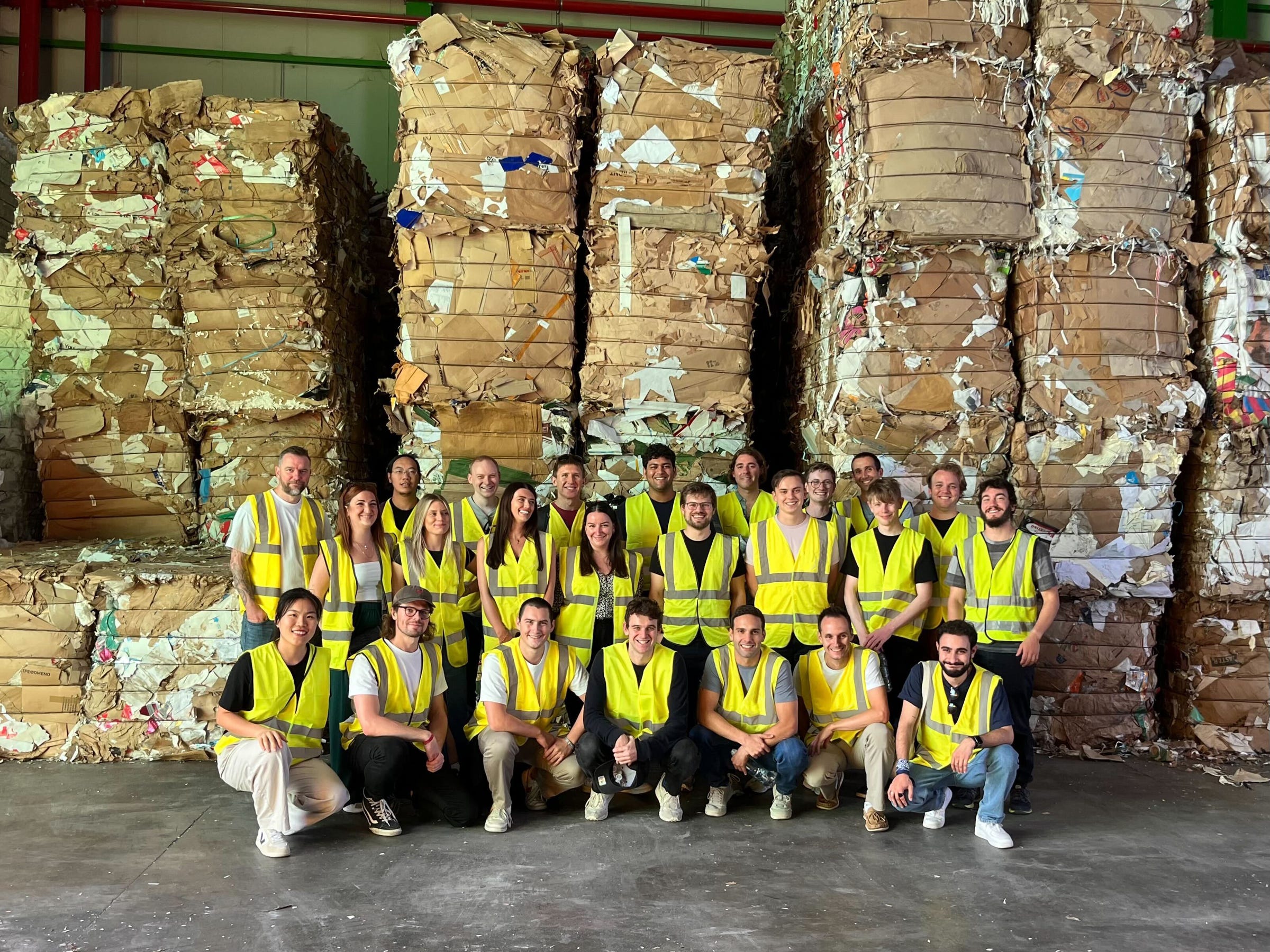
The team photograph from that period has an appropriate backdrop: enormous stacks of baled cardboard. The people wear yellow high-visibility vests; the material towers above them. It is an unusually helpful company photograph. Whatever happens on the software side, there is still a considerable amount of actual stuff to deal with.
04 /A conversation across the factory gate
Stocker also spent time asking industry operators about their work. In May 2023, he interviewed Celine Grant, commercial director at Re-Gen Waste, about the challenges facing recycling. The conversation covered uncertainty in the market, investment and opportunities for growth. Here the founder was asking questions of someone already doing the work his company hoped to support.
In January 2025, he appeared on Theia Ventures’ Unheated Podcast to discuss Safi. The episode covered his route from Unilever into the company, AI in identifying materials and opportunities in international markets. Together, the two conversations show both sides of the role: learning how the industry operates and explaining what a new business hopes to contribute.
There is also an agreeable circularity in Safi’s own financial operations. The company became a Revolut Business customer. Its travelling sales and quality-control teams needed a workable way to pay expenses across countries, and its operations involved multiple currencies. Stocker had left the company as an employee and returned through a different door.
The customer account describes corporate cards for employees across ten countries and the consolidation of currency and expense management. Stocker’s verdict was practical: “It’s given us time back to build our business without worrying about the tedious things.” For a founder whose business addressed transaction friction, tedious things were a recognisable category of work.
“It’s given us time back to build our business without worrying about the tedious things.”
Rishi Stocker / on using Revolut Business
05 /The next inspection fits in a pocket
Safi’s current focus is AI for the operations of circular-economy businesses. It describes its marketplace in the past tense and now develops tools for site operations, production and procurement. That evolution belongs in Stocker’s story. The company he leads has changed the form of its offering while continuing to work on the economics of recovered materials.
The current product starts with photographs taken on an iPhone. Safi uses them to analyse incoming bales and produce composition reports, giving teams information before material reaches the processing line. Its website distinguishes this intake analysis from the earlier conveyor-based approach. Knowing what is coming into a plant creates a different opportunity to plan the work.
One customer example comes from Blue Mountain Plastics in Ontario. In Safi’s account of the deployment, the plant moved from manually sampling about 2 percent of incoming loads to obtaining AI quality reports for every load. Those are results from a particular customer operation, rather than a promise about what every installation will deliver.
An Italian example, Aloxe’s Presenzano facility, shows the practical importance of fitting a tool into an existing routine. Operators photograph bales during unloading. The resulting information supports supplier comparisons and decisions about which material to process together. The usefulness lies in the next decision someone can make with the report, once the photograph has been taken.
06 /The price has to work
Stocker’s route through this industry has required more than a change of vocabulary. A marketplace needs buyers and sellers to complete transactions. A plant tool needs people to use it during an ordinary shift. The company’s present emphasis brings that second requirement into sharper focus, putting the software closer to decisions about incoming material and production.
The continuity is visible in the questions his work addresses. How can a buyer know what is being offered? How can better quality receive recognition? How much effort does it take to establish either? Those questions connect the early conveyor cameras, the trading platform and the current phone-based inspection tools without pretending they are identical businesses.
His stated goal has been to improve recycling’s economics so recovered materials can compete. The test of that goal is unusually concrete: a report used, a load assessed, a purchasing decision made with better information. The second life of a bottle depends on many people. Stocker has chosen to work on the part where somebody must decide it is worth buying.