Before Rebecca Hu-Thrams built a company around discarded objects, her family had a modest system for keeping them. Margarine tubs were washed and used again. Worn-out T-shirts became cleaning rags. An object could finish one job without being excused from all further duties. In that household, the container’s next assignment mattered more than the label on its first one.
Hu-Thrams has carried that way of looking into Glacier, the San Francisco company she co-founded with Areeb Malik in 2019. Glacier builds artificial intelligence and robots for recycling facilities. Its work begins where the household ritual of putting something in a blue bin leaves off, among conveyor belts, mixed materials and decisions made at industrial speed.
The distance between a kitchen container and a recycling plant is considerable. The underlying question travels well: what else can this be useful for? Hu-Thrams has made a career out of asking it where the answers are difficult to see.
A career takes a turn toward the bin
She grew up in the Chicago suburbs with immigrant parents and remembers learning about climate change in a third-grade science class. Her route into the business of waste took several turns. She graduated from Amherst College, worked in consulting at Bain & Company, then joined Thumbtack when the company had roughly 80 employees.
Those jobs gave her a view of established businesses and a growing technology company. When she decided to focus her career on climate work, she initially looked for a startup to join. She spent months considering where her experience might be useful before connecting with Malik, who was working on sorting technology. They became co-founders.
Her attraction to recycling had a practical foundation. Collection routes and sorting facilities already existed. Improving that machinery offered a way to work through infrastructure people were already using. Her earlier career also supplied a language for the problem: costs, operations, commodities and incentives. A facility could care about its environmental results and still have a very pressing electricity bill.
“Recycling is just another form of commodity manufacturing.”
Rebecca Hu-Thrams
The first tool was a telephone
Before Glacier’s founders committed to a product, they spoke with more than two dozen recycling facility operators. The method was straightforward: cold calls, a request for a few minutes, and questions about the work. Hu-Thrams described their opening as an introduction from technologists in San Francisco who wanted to understand the operator’s job.
There is something pleasingly ordinary about this beginning for a robotics company. Before the machine could identify a bottle, its founders had to persuade a stranger to pick up the phone. They asked people who would eventually have to buy and live with the equipment what made their day difficult.
That sequence helps explain Glacier’s attention to the customer’s constraints. A demonstration can show that a robot picks things up. A purchasing decision has to account for its price, its installation and the room available around a working conveyor. The questions were business questions as much as engineering questions.
Hu-Thrams’s account of those calls also shows her willingness to arrive as a learner. Recycling operators had knowledge the founders needed. The early work depended on getting them to share it.
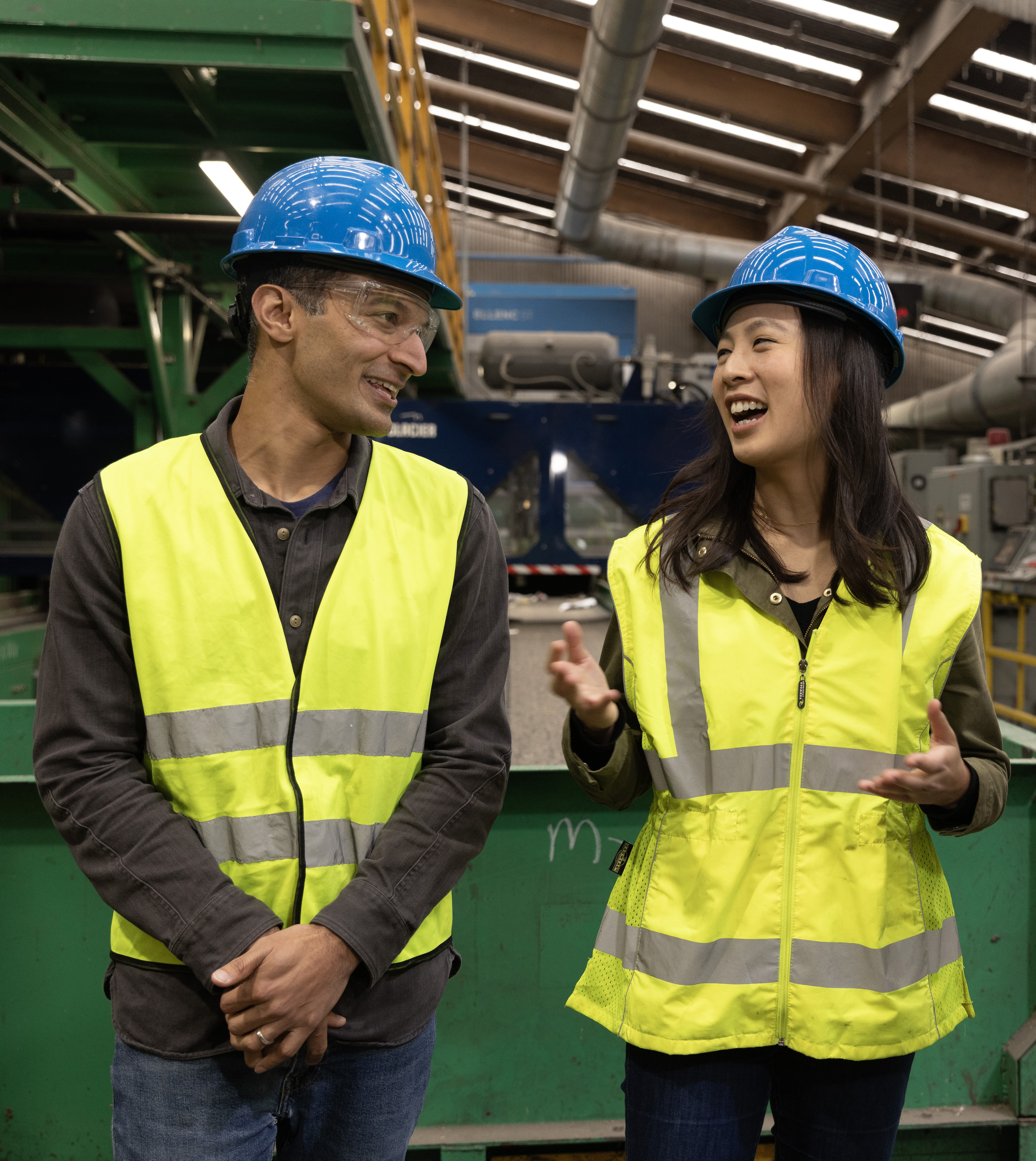
Three feet is a design philosophy
Glacier built its sorting robot from scratch. Hu-Thrams has described the choice in terms of the demands facilities put on it: consistent picking, reliable operation in a harsh environment, a constrained installation space and equipment the on-site team could maintain.
There are two related jobs. One is recovering desirable materials that would otherwise escape. The other is removing unwanted material from an otherwise useful stream. A piece of plastic mixed with paper is a different commercial problem from a plastic bottle heading toward disposal. Both require knowing what is passing on the belt and deciding what to do with it.
The AI can also operate without a robot, monitoring material and tabulating what the camera sees. That distinction matters to her business. A customer may need a mechanical action at one point in a plant and better information at another. Glacier can supply the observation without insisting on supplying the hand.
By October 2025, Hu-Thrams described systems occupying as little as three feet of conveyor space, recognizing more than 70 material types and making up to 45 picks a minute. She also reported installation in under a day. These are company-reported capabilities, subject to the particular task and facility. Their appeal is easy to understand: a working plant has limited appetite for a visitor who requires the furniture moved.
Company-reported system capabilities · October 2025
The package has an afterlife. Who is watching?
Hu-Thrams’s work has taken her from the sorting line to conversations with the companies that design what ends up on it. In September 2024, she appeared at the Packaging Recycling Summit to discuss Glacier’s work with Colgate and Amazon. Those projects asked detailed questions about what cameras could recognize inside a materials recovery facility.
With Amazon, Glacier developed an AI model to identify certain bioplastic packaging. The material could appear in snack bags, produce bags, shopping bags and compostable packaging. With Colgate, the focus included identifying tubes in the recycling stream. The examples bring the discussion down to objects people can hold, empty and throw away.
A package’s design and its eventual journey are separate things to investigate. Recognition provides a way to follow the latter. For Hu-Thrams, that creates a connection between people who make packaging and people who sort it after use. The conveyor becomes a place to learn about decisions made much earlier.
- 01 Design a package
- 02 Use it
- 03 Observe & sort
- 04 Recover material
What the facility sees can inform the next design. Conceptual diagram; no recovery rate implied.
Getting everyone into the same conversation
Hu-Thrams has a broader concern about the industry’s relationships. In 2023, when asked what new talent could help solve, she pointed to communication among recyclers, brands, consumers and governments. She wanted more shared knowledge and ways for those groups to work together. A robot occupies a small patch of conveyor; its usefulness can depend on people well outside that patch.
She also described opportunities for engineers, analysts and technicians as recycling adopts new equipment and gains access to more data. That is a revealing account of her ambitions. She imagines work around the machines as well as work performed by them: interpreting what they see, building better systems and keeping those systems running.
Her relationship with NEA partner Ann Bordetsky gives another view of that expanding circle. NEA led Glacier’s seed financing in 2022 and invested again alongside Amazon’s Climate Pledge Fund in 2024. In their later conversation, Hu-Thrams framed Amazon’s interest as an investment in the company’s own supply chain. Material recovered today can become an input tomorrow. The argument brings her back to manufacturing, and to giving discarded objects another job.
The work leaves San Francisco
In April 2025, Glacier announced a $16 million Series A led by Ecosystem Integrity Fund. The financing included Amazon’s Climate Pledge Fund, NEA and other investors. Its stated purpose included expanding the company’s robot fleet into more municipalities. Capital gave the founders more room to repeat the work they had begun with those early conversations.
The same period brought a deployment at Recology’s King County facility in Seattle. Glacier’s markets also included San Francisco, Los Angeles, Chicago, Detroit and Phoenix. The geographic spread gave Hu-Thrams more settings in which to test whether a system developed for recycling could fit the circumstances of different operators.
Later in 2025, Glacier deployed at the Waste Connections-owned Penn Waste facility in York County, Pennsylvania, with support from Cox Enterprises. Hu-Thrams described goals including better material recovery and cleaner paper for mills. She characterized the early results as preliminary. Even after a machine has been installed, its story needs time on the line.
By February 2026, she was also discussing how the founders had developed an early prototype inside a recycling facility. Watching front-line workers and trying the system in its intended setting allowed them to revise it quickly. Dust, noise and changing material were part of the design brief.
A bigger stage, the same small objects
Recognition has followed her into rooms beyond the plant. Hu-Thrams was named to Waste360’s 2024 40 Under 40 and Inc.’s 2025 Female Founders 500. At the 100+ Accelerator’s 2025 Demo Day in London, she took part in a finance panel; the event also recognized her with its Impatient Optimist Alumni Award.
In 2026, she appeared at the Aspen Ideas Festival in a session alongside physicist Tammy Ma and Aurelia Institute founder Ariel Ekblaw. The program placed AI recycling robots in a conversation that also included nuclear technology and infrastructure in space. It is an amusingly broad itinerary for someone whose daily subject includes yesterday’s packaging.
Her public explanations keep returning to the material itself. Household reuse, a facility’s operating decisions and a brand’s packaging choices are connected by things moving from one owner to another. Glacier’s ambition is to help those things continue moving into useful applications. The work requires machinery, money and people willing to compare what they hoped would happen with what actually happened.
An empty tub is a small object on which to build a philosophy. It has the advantage of being easy to understand. Someone has finished with it. Someone else can still find a use for it. Hu-Thrams is building a company in the space between those two observations.
Follow the material
Rebecca, Glacier & further reading
- Glacier’s website · Rebecca on LinkedIn · Rebecca on X
- Food + Feelings: her career and founding story
- A conversation with Ann Bordetsky
- Her approach to building recycling robots
- The work with Colgate and Amazon
- The Penn Waste installation
- Watch: her 2026 Aspen Ideas session
- Watch: The Solutionaries documentary