The raw material of John McKinney's career is the stuff most people pay to make disappear. Spoiled food. Dairy manure. Municipal biosolids. In the wrong place, each becomes a smell, a hauling bill or a plume of methane. In the right steel tank, with the right microbes and enough patience, it becomes gas clean enough for a pipeline and nutrients useful to soil. The chemistry is ancient. The business around it is a modern obstacle course.
McKinney has spent more than two decades running that course. His public résumé begins in business, not biology: a bachelor's degree in business administration from the University of Colorado, followed by years in renewable project development and finance. The pattern matters. Long before he was buying digesters, he was learning how infrastructure travels from an idea to a bankable asset - and how many good ideas expire somewhere between the two.
At Verde Power, he developed Conestoga Winds, a 198-megawatt wind project in Kansas that was later sold to a strategic buyer. At Greenrock Capital, which he co-founded, his team originated, structured and financed more than $200 million of renewable power projects. Those verbs have the dry texture of a prospectus. They are also the verbs that put concrete in the ground.
01 / The apprenticeshipThe project that stayed on paper
In 2010 McKinney founded Columbia Biogas around a large commercial food-waste plant in Portland, Oregon. The plan was both clever and industrially plain: collect leftovers from grocers, restaurants and food processors; digest them without oxygen; sell the electricity; return heat and soil products to useful work. At full buildout, the proposal was expected to generate roughly five megawatts. The waste that traveled hundreds of miles toward disposal could instead move across town toward production.
The proposal accumulated the recognizably human complications of infrastructure. Neighbors worried about odor and trucks. Public officials debated financing. Columbia Biogas designed negative-pressure receiving bays, worked under a good-neighbor plan and agreed to a community enhancement fee. McKinney appeared at a neighborhood association meeting and on a regional clean-water conference program. A digester may be sealed, but a development process never is.
When the use of public guarantees became controversial, McKinney wrote to Portland's mayor in 2011 that the company would seek private financing. Four years later, Columbia Biogas stopped pursuing the Northeast Portland site. Its statement said the company remained interested in developing food-waste capacity elsewhere in Oregon. The proposed plant did not become the landmark its plans had promised.
This is where a neat founder story would insert a revelation. The public record offers something more useful: McKinney simply stayed in the work. Columbia Biogas remained part of his career until 2017. That same year, he founded Sevana Bioenergy. The mission survived, but the model grew wider. Sevana would develop, design, own and operate projects, taking responsibility for more of the chain that makes a biogas asset dependable.
“Sevana's team believes in building value for all the stakeholders in our projects.”John McKinney, on an Idaho RNG partnership, 2020
02 / The machine around the machineFive parties walk into a digester
Anaerobic digestion sounds like a technology company until you diagram the business. A farm has manure and needs a reliable partner. A city or hauler has organic waste and a diversion target. An engineering team has to keep a living process stable. A utility must accept finished gas. Investors must wait while permits, construction and ramp-up consume time. Each party owns a different clock.
Sevana's advantage, as its projects accumulated, was coordination. In Idaho, it developed a dairy RNG project with New Energy One HoldCo, Meridiam and UGI Energy Services. In South Dakota, Sevana joined California Bioenergy and UGI in a venture designed to connect multiple farms to shared gas infrastructure. McKinney described the goal in communal terms: projects that could benefit local economies, environments and stakeholders.
By March 2023, that operating history had attracted a very large and very patient partner. Ontario Teachers' Pension Plan acquired a majority stake in Sevana and committed $250 million to develop renewable-natural-gas projects across North America. The announcement credited Sevana with more than 20 digester tanks across Oregon, Idaho and South Dakota. Institutional capital had arrived, but only after the unphotogenic apprenticeship in development risk.
03 / The turnaroundA $20 million question in California
The next chapter was not a pristine greenfield site. It was a troubled plant. The Rialto Bioenergy Facility, about 50 miles east of Los Angeles, had been designed to process as much as 1,000 tons a day of organic waste and biosolids and produce close to one million MMBtu of renewable natural gas a year. It was also entangled in the bankruptcy of its previous owner's subsidiary after feedstock volumes arrived more slowly than the plant's economics required.
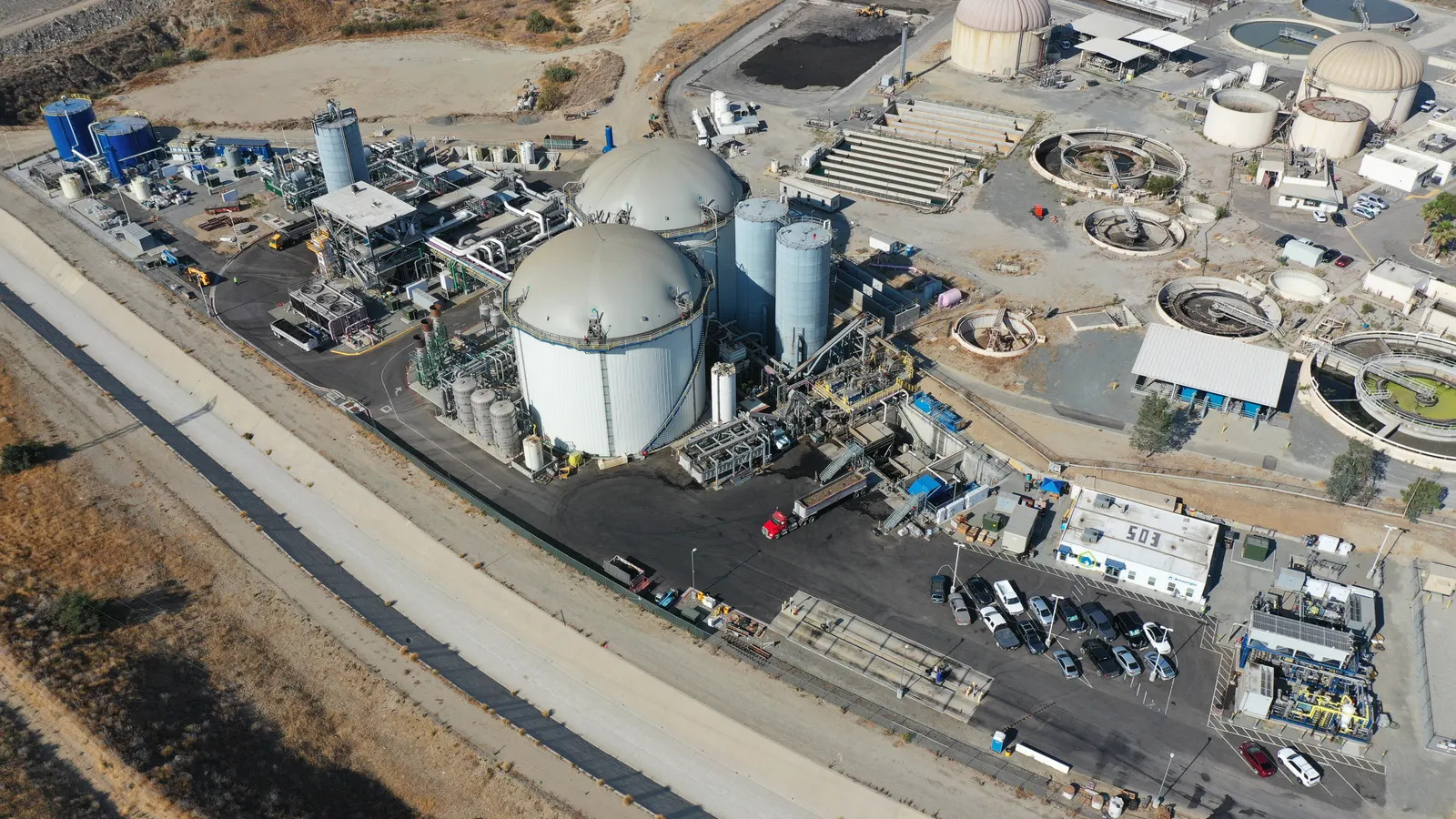
Sevana bought Rialto for $20 million through a bankruptcy auction in June 2024. McKinney called it “a strategic asset” aligned with the company's mission to accelerate RNG production. The phrase carries a tidy corporate calm. The actual assignment was physical and commercial: repair systems, steady operations, sign feedstock providers and let California's organics-diversion rules finally supply the plant they were meant to support.
Rialto also exposed the peculiar problem of building ahead of a waste system. California's SB 1383 rules called for a steep reduction in organic material sent to landfills, but collection networks and municipal behavior could not change as quickly as legislation. A vast plant can be mechanically ready and commercially hungry at the same time. The missed connection is expensive: digesters need a steady diet, while cities need reliable destinations before they can redirect a steady stream.
By November, Sevana said it had completed more than $5 million in capital and operational improvements. It signed a 10-year agreement with Anaergia Services to operate the facility. A February 2025 update to Los Angeles County described new feedstock agreements and rising gas production. In June 2026, Sevana reported Rialto's highest RNG production to date, including a 50 percent increase in gas yield per ton and an average yield of 2.6 MMBtu per ton.
Verde Power and the development of the 198 MW Conestoga Winds project.
Greenrock Capital and more than $200 million in renewable project finance.
Columbia Biogas and the hard education of an urban food-waste project.
Sevana Bioenergy is founded.
Institutional backing, the Rialto acquisition and a production ramp.
04 / The operator's lessonThe glamour of dependencies
McKinney's career offers a corrective to the popular picture of climate innovation. The decisive breakthrough is not always new chemistry. Sometimes it is the ability to keep farmers, municipalities, engineers, utilities, lenders and neighbors inside the same project long enough for proven chemistry to matter.
His move from wind development to finance to biogas also shows how expertise compounds sideways. Project finance taught him to think about contracts and counterparties. Portland taught him that local trust and feedstock logistics are as real as turbines and tanks. Dairy projects taught Sevana how several farms can share infrastructure. Rialto asks whether that accumulated knowledge can revive an enormous existing asset under a changing waste regime.
It also explains why Sevana's partnerships recur so often in the record. Meridiam brought infrastructure investment. UGI brought energy-market capabilities. California Bioenergy brought dairy-project experience. Ontario Teachers brought long-duration capital. Anaergia returned at Rialto as the contracted operator. The company did not try to make every discipline disappear inside one logo. It assembled roles around projects whose complexity would punish a thinner coalition.
There is no need to make waste beautiful. Its usefulness is enough. A ton diverted from a landfill can avoid uncontrolled methane, earn a tipping fee, produce pipeline fuel and leave nutrients behind. But each benefit belongs to a different party, and the founder's craft is to arrange the incentives so the entire loop keeps moving.
McKinney's public comments return to stakeholders with notable regularity. The word can become mush in corporate prose. In a digester project, it is literal: people deliver the waste, live beside the trucks, finance the equipment, buy the gas and spread the soil product. Ignore any one of them and the biology may continue beautifully inside a tank while the business fails around it.
“The Rialto Bioenergy Facility is a strategic asset that aligns perfectly with Sevana Bioenergy's mission to accelerate the production of RNG.”John McKinney, June 2024
From Tetonia, Idaho, McKinney now leads a Boise-based company with an institutional majority owner and a continent-sized mandate. Yet the work remains stubbornly local. Every project begins with a particular farm, road, pipe, permit and pile of organic matter. Climate ambition may be global; infrastructure always has an address.
That tension is the most revealing thing about his story. The numbers have become larger - 20-plus tanks, a $250 million commitment, a facility built for 1,000 tons a day - while the essential job has stayed small enough to describe in a sentence: get all the necessary people and materials to arrive at the same place, in the right order, every day.