Blackvolt Energy makes a product that is invisible when it works. On a sunny afternoon, its batteries will absorb electricity the grid cannot conveniently use. A few hours later, or in the split second when frequency wobbles, they will send it back. No app chirps. No parcel arrives. The lights simply remain boring, which is precisely the point.
The Austrian company, founded in 2024, develops stand-alone battery energy storage systems, or BESS, measured in megawatts rather than garage-wall units. Its first construction project in Oberndorf near Salzburg is rated at 18 MW and 36 MWh. A second in Wöllersdorf doubles both figures. Together, the two sites account for 54 MW now being built and enough stored energy to discharge at full power for two hours.
The containers and cells are only the visible nouns. Blackvolt's verbs are scout, permit, connect, finance, build, trade and operate. The company says it shepherds more than 30 projects through that sequence, with 251 MW ready to build, 950 MW in a late-stage pipeline and 2,500 MW in its total portfolio. Those labels are not interchangeable. A pipeline is a collection of possible futures. Concrete, debt and grid access are what make one real.
The timing shop
Wind and solar are obedient to weather, not dinner schedules. That mismatch produces low or even negative prices when power is abundant, expensive peaks when it is scarce, and a constant engineering job for the grid operator. A battery turns timing into inventory. It can buy or absorb power cheaply, sell it later, and reserve some capacity for services that keep the system close to 50 hertz.
Blackvolt does not rely on one customer in the familiar sense. Its batteries face a market. Revenue can come from wholesale and intraday arbitrage, frequency containment reserve, automatic frequency restoration reserve, peak shaving and reactive-power support. An optimization system decides which job deserves the available capacity. The end beneficiaries include grid operators, industrial users and ordinary power customers, while the commercial counterparties include energy markets, lenders, landowners, municipalities and infrastructure investors.
One battery, several shifts
The bars above show roles, not a revenue forecast. The mix changes with prices, reserve calls, battery state and contractual limits. That qualification matters. Merchant storage benefits from volatility, but a rush of new batteries can also flatten the price spreads everyone came to harvest. The machine that solves scarcity can gradually make its original trade less lucrative.
The expensive proof
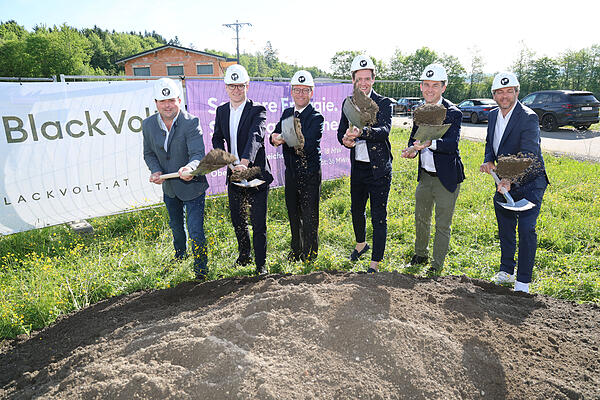
Oberndorf is the clearest test of the model. Blackvolt says the project occupies roughly 2,000 square metres and will begin commercial operation in the first quarter of 2027. Local reporting put the investment above €15 million. In March 2026, Raiffeisen-Landesbank Steiermark closed a long-term senior secured facility in the double-digit millions of euros. The unusual bit was what the loan did not lean on: no public subsidy scheme and no long-term contracted revenue.
That makes Oberndorf a merchant project. Lenders must accept that earnings will be assembled from market services rather than a single fixed-price buyer. Blackvolt's founders are unusually tailored to that conversation. CEO Gregory Green and CFO Constantin Vana came through investment banking, capital markets and infrastructure finance. CTO Johannes Srajer brings technology-development and energy experience. The company presents the trio's combined vocabulary - basis points, battery degradation and building permits - as a competitive edge.
“Running a BESS with an inflexible guarantee is like paying rent all year for an umbrella shop.”Gregory Green, on matching battery warranties to real market use
Green's umbrella line exposes a quiet tension. A battery warranty may assume a tidy number of cycles and a predictable operating envelope. A trader wants freedom to exploit the rainy week. Push the asset too hard and degradation or warranty limits bite; protect it too carefully and the best revenue hours pass. Blackvolt argues that warranties should anticipate flexible dispatch and even midlife repowering for assets expected to last roughly two decades.
What failed first?
There is no public tale of a Blackvolt battery catching fire or a flagship project collapsing. The failure it explicitly designed around is more mundane: fragmented responsibility. One adviser finds a field, another negotiates land, another files permits, another engineers the grid connection. Information evaporates at every handoff. The technology survives. The schedule does not.
Blackvolt's answer is an eight-phase, one-team process from site analysis to operations. It screens for grid capacity, zoning, distance from homes and protected areas, logistics, revenue potential and long-term operability before a project enters active development. After commissioning, a dedicated subsidiary is meant to manage the project company, safety compliance, technical monitoring and service partners. The strategic change is subtle but important: Blackvolt is moving from being a developer that can sell a permitted project toward being a long-term owner and operator.
The playbook worth stealing
Most founders cannot copy a €15 million battery park. They can copy Blackvolt's ordering. Start with the bottleneck, not the shiny component. In this market, cells are increasingly standardized. A viable grid connection, defensible land rights, permits and a financeable revenue plan are scarce. Blackvolt screens those constraints before spending years polishing a doomed site.
Second, design the first decision with the last operating day in mind. A land contract affects construction access. Battery chemistry affects warranty freedom. Warranty freedom affects the trading algorithm. Trading affects debt service. Each local optimization can make the whole asset worse. Keeping one accountable owner across the chain is less glamorous than a breakthrough cell, but it attacks the coordination tax directly.
Third, stack revenue without pretending diversification abolishes risk. Balancing reserves can pay for availability. Arbitrage can harvest price spreads. Grid services add another lane. But the same physical battery cannot promise all of its capacity everywhere at once, and every service has rules. The useful trick is a decision engine with explicit constraints, not a slide covered in five colorful revenue arrows.
Secure the scarce permission layer first, keep one owner accountable across handoffs, and build several honest ways to earn. It fails when grid access is unavailable, permits stall, capital becomes too expensive, degradation is mispriced, or competitors erase the volatility that funds the asset.
A small team with a crowded phone book
The supplied company record counts nine employees, while LinkedIn places Blackvolt in its broad 11-to-50 band. Either way, this is not a utility-sized payroll. The model depends on orchestrating specialists: Rolls-Royce was named as the EPC partner at Oberndorf, Griesemann Engineering Austria as owner's engineer, Schoenherr as financing counsel, Raiffeisen-Landesbank Steiermark as lender, and Equans among the construction participants. Blackvolt keeps the project brain and hires capable hands for defined work.
That arrangement explains the culture the company advertises. Green speaks finance; Vana structures capital and investor relationships; Srajer owns system architecture and technical design. The wider team spans law, corporate finance, accounting, business development and plant engineering. Their public events look less like startup demo days and more like municipal committee meetings with hard hats. In heavy infrastructure, charisma is useful. A clean grid study is better.
Municipalities and landowners are not decorative stakeholders. They control local acceptance, access and pieces of the permitting path. Oberndorf prompted predictable questions about fire, noise and community benefit. Blackvolt said it examined safety and sound closely and planned a screening hedge around the facility. The project offers no local factory full of shifts; batteries are quiet employers. Its bargain is instead system value, construction activity and a place in the physical architecture of Austria's energy transition.
This is where the model cannot be copied by software instinct alone. Moving faster is helpful only inside legal, engineering and community constraints. A clever trading algorithm cannot cure a weak interconnection. Cheap cells cannot rescue hostile zoning. A signed land option is not valuable if trucks cannot reach the site. Blackvolt's apparent discipline is to treat these veto points as product requirements, not annoyances to be solved after fundraising.
Where Blackvolt sits
Blackvolt lives between equipment vendors and power utilities. It does not appear to manufacture cells. Nor is it merely a consultant selling a feasibility report. It assembles infrastructure projects, brings in specialist partners for EPC, engineering, legal work, market access and maintenance, and intends to retain operating control. That puts it alongside independent storage developers and owners such as Enery, Voltida, Green Flexibility, Eco Stor and larger infrastructure platforms. Pumped hydro remains a formidable Austrian alternative, especially for longer storage durations.
The young company's claims still need time. A 2.5 GW portfolio is not 2.5 GW of operating hardware, and the first scheduled commercial date is in 2027. Yet the progression from presentation to permit, from permit to senior debt, and from debt to shovels is real. Wöllersdorf, at twice Oberndorf's size, is the next useful check on whether the process scales or merely repeats.
For Austria, the need is easy to understand. More renewable generation makes flexibility more valuable even as new flexibility changes its own economics. For Blackvolt, the wager is that controlling the unphotogenic middle - grid studies, municipal conversations, covenants, warranties and dispatch logic - will matter more than owning a novel battery. The field in Oberndorf currently offers flowers, hard hats and a construction schedule. By next year, it is supposed to sell time.
Keep the current flowing