Long before a megawatt became a unit of AI strategy, Michael McNamara was trying to make computing less obstinate. Data centers ordinarily want what they want when they want it: steady electricity, unruffled cooling and no surprises. The power grid, increasingly fed by wind and solar, has a different temperament. Supply rises, falls and occasionally arrives in abundance when demand has gone home. McNamara and his co-founders at Lancium wondered whether the load could learn some manners.
The first question was almost modest. Could a data center turn on and off in about 15 minutes? If it could, computing equipment might sit beside renewable generation, consume power when it was plentiful or cheap, and ease off when the grid needed relief. The result outran the original target. Lancium software eventually demonstrated that very large data center loads could ramp in seconds, and in 2020 enabled what the company described as the first load-only Controllable Load Resource data center in the ERCOT market.
The phrase is sufficiently bureaucratic to make a transformer yawn. The idea is lively. A voracious electricity customer can become responsive, bidding into the same Texas market that coordinates generators and grid services. Consumption stops being a fixed fact and becomes something that can be orchestrated.
Teach the appetite to listen
Lancium was founded in 2017, but McNamara did not arrive through the conventional technology-founder corridor. He graduated magna cum laude from Georgetown University with degrees in finance and accounting. He then spent years on the buy side, serving as a vice president at Twin Capital Management, leading event-driven equities research at One East Partners and heading natural-resources research at Talpion Fund Management. Later he founded ROR Capital, where he worked with private-equity firms on restructurings involving large natural-resource companies.
That background is visible in the company he built. Lancium is not merely software, property development or electricity procurement. It sits at the awkward table where all three must agree. A campus needs land and substations. It needs contracts, permits, transmission and civil engineering. It may add batteries, solar resources and behind-the-meter generation. Then the whole collection must provide reliable power to computing customers while responding sensibly to the grid.
A clean campus, reduced to five moving parts
The trick is coordination: power sources and a large computing load are managed as one campus-level system.
In a 2019 seminar at Texas Tech, McNamara described early Lancium facilities designed without the usual uninterrupted power supply, HVAC or redundant systems. Power and thermal control would instead come from dynamically managing individual servers. The plan was suited to parallel workloads that could pause when electricity became scarce or expensive. This was infrastructure designed around the character of renewable power, rather than insisting renewable power behave like a coal pile.
Could we build a data center that could turn on and off quickly?Michael McNamara, recalling Lancium's founding question
Then the market changed. Bitcoin mining had supplied an early use case for interruptible computing. AI supplied a much larger demand for dense, dependable infrastructure. Lancium's vocabulary evolved from special computing loads to Clean Campuses and AI factories, but the old question remained useful: how should a giant electrical appetite behave inside the system feeding it?
From clever load to concrete landscape
The Abilene project made the answer physical. Lancium selected the West Texas city for its flagship campus after studying the region's combination of wind, solar, transmission and land. In 2024, Crusoe announced an initial 200-megawatt AI data center there, designed to expand across 1.2 gigawatts. The first phase called for two buildings and roughly 998,000 square feet. By March 2025, six more buildings were under construction, taking the planned footprint to about four million square feet.
Here is where a neat thesis becomes a convoy of gravel trucks. The data halls use direct-to-chip liquid cooling and a closed loop designed to avoid evaporative water consumption. Lancium's power plan includes the grid interconnection alongside battery storage, solar resources and backup generation. Crusoe builds and operates the computing facilities; Lancium develops and orchestrates the campus beneath them. Each party has a clear piece of the puzzle, and neither piece is small.
Capital followed the construction logic. Lancium closed $150 million in financing in 2021, led by Hanwha Solutions. A $3.4 billion joint venture announced in 2024 financed the first large Crusoe development at Abilene. In 2025, Lancium secured $600 million in debt financing for Clean Campus development. By August 2026 the company reported four gigawatts under lease and a development pipeline above 15 gigawatts.
The roster widened as well. Lancium and QTS announced a campus near Turkey, Texas, in Hall County. Lancium and Crusoe announced another one-gigawatt campus in Childress. Then NVIDIA entered a strategic collaboration spanning Lancium's portfolio and made an investment in the company. Lancium said the campuses would use NVIDIA reference designs to fit more computing within a given power budget and adjust consumption with grid conditions.
Gigawatts still have neighbors
Infrastructure may be financed globally, but it is experienced locally. At an Abilene Kiwanis Club meeting in April 2026, McNamara received a welcome song written for the occasion to the tune of “Old MacDonald Had a Farm.” The verses teased the gravel trucks, housing pressure and billions being spent nearby. The final flourish was fitting: the song had been made with AI.
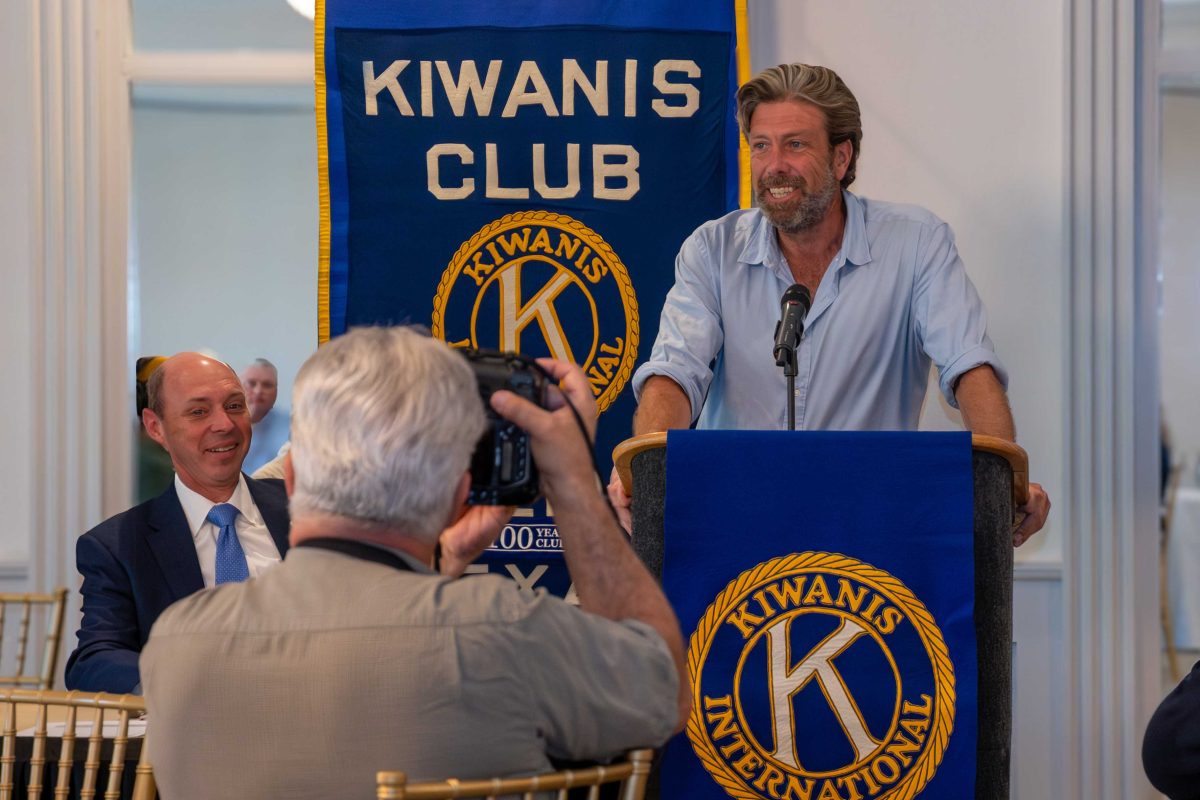
McNamara had come to answer concerns about water, electricity, construction and the community impact of the project. He said the operational campus used a closed-loop cooling system and gave figures comparing allocated water with recent use. He discussed local vendors, housing pressure, jobs and the difference between grid power and backup generation. Whatever one thinks of any forecast, the setting itself is instructive. A grand strategy eventually has to survive questions asked over lunch.
That obligation has since become part of McNamara's public language. In August 2026, Lancium backed verified reporting on data center power and water use, protection for household ratepayers and engagement with local officials, school districts, water boards, landowners and residents before a site plan is settled. The company described community learning as two-way. For an industry fond of one-way announcements, that phrase carries useful weight.
We work with communities long before development begins - before we've committed to a site, before there's a plan to present.Michael McNamara, August 2026
Share the control panel
Lancium's approach to intellectual property offers another window into McNamara's operating style. The company defended its patents in court and won a disputed inventorship case in 2023. It also chose cooperation when that served the system. Lancium and Crusoe cross-licensed technology in 2022, saying their shared aim was to reduce waste and strengthen power grids. In 2025, Lancium gave ERCOT and its market participants a non-exclusive, perpetual, royalty-free license to patents relevant to registering and operating load resources.
The decision was pragmatic. Exclusive control could preserve leverage; wider participation could help the Texas grid make better use of flexible demand. McNamara said the latter was more valuable for long-term reliability. The inventor's trophy remained on the shelf while the operating instructions went into circulation.
There is a clean business lesson in the arc. McNamara did not begin by predicting a particular AI model, customer or chip. He focused on the deeper constraint shared by all of them. Computing demand was rising. Renewable generation was growing. The grid needed flexible participants. Land, transmission and generation would take years to assemble. If the demand arrived, the difficult thing would not be explaining AI. It would be finding somewhere responsible to plug it in.
Now the scale can make the founding question look quaint. Fifteen minutes has become gigawatts. A software response has become a map of West Texas campuses. The investor who once studied natural-resource businesses is assembling the natural resource of the AI era, only this resource arrives through substations and must be balanced every second.
McNamara's bet is that the appetite can keep growing without becoming careless. That requires software, steel, storage, contracts and a willingness to answer for the gravel trucks. The data center may be the visible machine. The more interesting invention is the agreement it makes with everything around it.