In 2018, Lancium was running 120 cryptocurrency miners at a Texas research site. The machines were not remarkable. The way they behaved was. Software watched electricity prices, Bitcoin economics and grid conditions, then decided when individual miners should work and when they should go quiet. Wind power could be cheap or stranded one minute and valuable the next. Lancium’s trick was to make computing follow the weather and the market.
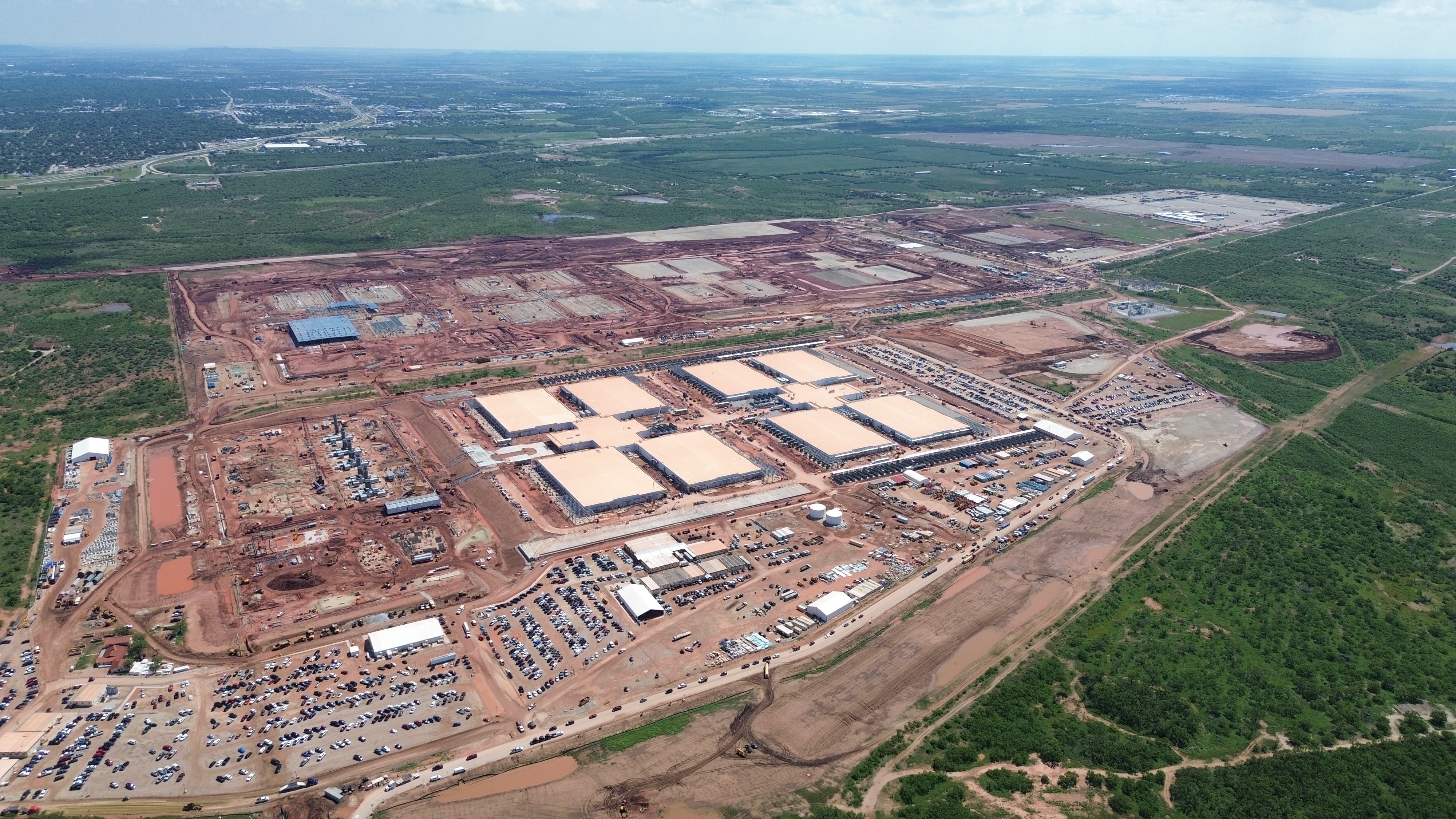
Eight years later, the company talks less about coins and more about concrete. Its flagship Abilene Clean Campus has a fully reviewed 1.2-gigawatt grid interconnection. Crusoe is building the data-center buildings there: eight are planned, covering roughly 4 million square feet. The campus became the first location identified with Stargate, the AI infrastructure effort associated with OpenAI, Oracle, SoftBank and MGX.
Lancium occupies the layer most people skip when drawing the AI stack. It does not train the model, design the chip or rent the cloud instance. It finds land, secures the interconnection, engineers the site, builds high-voltage infrastructure and manages a power mix that can include the grid, solar, batteries and on-site gas. If AI is a factory, Lancium is arranging the industrial estate and its private power system.
01 / The original product
A data center with a dimmer switch
Michael McNamara and Raymond Cline founded Lancium in 2017 around an awkward feature of renewable power: the best wind and sun are often far from the people and businesses that need electricity. Transmission gets congested. Generation gets curtailed. Prices can collapse. A computing facility placed beside that supply could soak up the surplus, provided it could also surrender the electricity almost instantly when the grid needed it elsewhere.
Bitcoin mining was a useful first workload because stopping a calculation does not ruin a batch of work or annoy a video-call participant. Lancium’s early system calculated the break-even price for different mining machines, suspended the unprofitable ones and restarted them when conditions improved. By 2019, its software was consuming signals from a wind farm and ERCOT alongside real-time power and cryptocurrency data. It became Lancium Smart Response.
In June 2020, Lancium says it qualified the first data-center Controllable Load Resource in ERCOT. That bureaucratic phrase carries the whole idea: a giant consumer of electricity can behave like a grid tool. It can reduce demand within seconds, much as a power plant can increase supply. ERCOT later licensed certain Lancium patents at no cost so other controllable loads could enter the market without infringement worries. A proprietary advantage became a piece of market plumbing.
The important invention was not cheap computing. It was computing that knew when electricity mattered more somewhere else.
02 / The bruise
What failed first
In 2021, the plan looked like a familiar infrastructure land grab. Hanwha Solutions led a $150 million financing and contributed $100 million itself. Lancium had bought thousands of acres in Texas and described more than 2,000 megawatts of capacity in development. The first Clean Campus broke ground near Fort Stockton. In March 2022, listed Bitcoin miner CleanSpark contracted for an initial 200 megawatts and an option that could take it to 500.
Then the sequence broke. CleanSpark’s annual filing that year said it had not deployed miners under the agreement. Lancium, the filing said, had reported significant delays as capital markets tightened. This is the unromantic failure mode of ambitious infrastructure: the customer can be real, the technology can work, the land can exist, and financing can still arrive in the wrong order.
The public record does not show a single boardroom epiphany in which Lancium abandoned Bitcoin for AI. It shows a gradual widening. The company had always pitched high-performance computing beside mining. Abilene broke ground in late 2022 with both workloads in view. Then generative AI made power availability a front-page constraint, and a site engineered for a large, energy-hungry customer suddenly had a larger pool of candidates.
One idea, increasingly alarming units
Bars show project progression, not a linear comparison between machine count and electrical capacity.
03 / The new customer
Crusoe put AI on top of the interconnect
Crusoe began the first 200-megawatt Abilene phase in June 2024. The partnership is unusually legible. Lancium controls the campus and its energy infrastructure. Crusoe designs, builds and operates the data center. Each of the eight planned buildings is designed to support as many as 50,000 NVIDIA GB200 NVL72 systems on a single integrated network fabric. The first two buildings account for more than 980,000 square feet; the next six take the total capacity to 1.2 gigawatts.
The energy story is not a spotless green postcard. Lancium intends to combine an ERCOT connection with nearby wind, behind-the-meter solar and batteries, plus natural-gas generation and turbines for dependable supply and backup. The buildings use direct-to-chip liquid cooling in a closed loop designed to avoid ongoing evaporative water consumption after filling. The product is orchestration across cost, carbon, availability and local constraints, not loyalty to a single fuel.
That distinction matters. A gigawatt data center cannot promise grid friendliness merely because software once switched Bitcoin miners off. AI training jobs have deadlines and expensive equipment that customers want fully utilized. Lancium’s proposition works when flexible load, storage, generation and contracts together create room to respond. It is an engineering and commercial design problem.
Secure
Lancium acquires land and wins the slow, formal work of transmission study and grid approval.
Build
Lancium installs civil and electrical infrastructure; a partner constructs and operates the data halls.
Orchestrate
Grid power, storage and on-site resources are coordinated around price, carbon and reliability.
04 / The business
The product is partly a queue position
Utilities cannot provision a gigawatt with a credit card. Developers need land, transmission studies, substations, equipment, permits, community agreements and years of patience. Lancium’s website advertises “time-to-value,” but the less polished translation is more useful: it has already waited in lines its customers are only beginning to discover.
Its older hosting contract with CleanSpark charged for electricity consumed plus a hosting fee. The newer campus model appears closer to long-term infrastructure capacity and energy-management economics. At Childress, announced in July 2026, Lancium owns 270 acres, the power interconnect and energy system; Crusoe again owns the data-center operation. The partners plan one gigawatt. Two days earlier, Lancium and QTS announced a campus near Turkey, Texas, expected to bring more than $10 billion of capital investment, with Lancium providing the site’s electrical and civil works.
This is expensive progress. The 2021 equity round was followed by a reported Blackstone investment of more than $500 million in 2024 and a $600 million debt package led by Santander in 2025. In August 2026, media reports said NVIDIA agreed to invest $2 billion, with another $1 billion available as Lancium secures more power. The company has not disclosed a valuation in the public material reviewed for this profile.
What another builder can steal
- Keep the capability, not the customer label. Lancium preserved grid software, power-market expertise, patents and sites when crypto financing weakened.
- Own the slow constraint. ERCOT approval and high-voltage infrastructure are tedious, durable and increasingly valuable.
- Split the stack cleanly. Let Crusoe or QTS operate the buildings while Lancium specializes in land and power.
- Sell a measurable clock. “Approved power sooner” is easier to value than a vague sustainability promise.
05 / The edge and its limits
Where Lancium sits in the market
Traditional data-center developers can assemble similar ingredients. Utilities can build grid infrastructure. Independent power producers understand generation, while Crusoe itself is vertically integrated across energy, buildings and compute. Lancium’s difference is the package: large Texas sites with advanced interconnection work, an operating history in responsive load and a willingness to stop at the power-and-campus boundary when a partner is better suited to run the computers.
Its likely customers are therefore not ordinary enterprises shopping for racks. They are hyperscalers, cloud and AI infrastructure companies that need hundreds of megawatts, can commit for years and care about energization dates as much as price. For them, an already approved block of power can be worth more than a clever data-center floor plan.
When the model does not travel
Do not copy Lancium literally where power markets do not reward flexible demand, transmission is uncongested, customers cannot tolerate curtailment, local water or generation rules prevent the proposed design, or contracts are too short to finance substations and land. It also weakens if AI efficiency improves faster than demand grows, if new generation and transmission erase the scarcity premium, or if communities decide the promised jobs and tax revenue do not justify the load.
Lancium’s most copyable insight is smaller than a gigawatt: a failed first market does not make the underlying constraint imaginary. Bitcoin provided the test workload and the first big customer agreement. The delay exposed how vulnerable the plan was to capital. AI arrived with deeper pockets and an even more urgent need for power. The company changed what sat on its sites without changing what it knew how to do.
That is also the tension still hanging over the business. Lancium must prove that a campus drawing electricity on the scale of a city can behave like a responsible grid participant, not simply arrive with enough private generation to overpower objections. Its record with controllable load gives it a credible argument. Abilene, Childress and Hall County will supply the harder evidence.