Before Jesse Gronner had a company, a development pipeline, or a CEO title, he had a temporary assignment. He had graduated from the University of Massachusetts Amherst in 2000, headed west by way of a few national parks, and found his first foothold in energy at PacifiCorp Power Marketing. Wind was barely an industry by today’s standards. Gronner was a temp. Neither condition lasted.
He stayed inside the same corporate lineage as its name changed around him: PacifiCorp Power Marketing became PPM Energy, which became part of Iberdrola Renewables, which became Avangrid Renewables. His job changed too. Project management gave way to lead development, then responsibility for the western United States, then leadership of the full U.S. development organization. A public regulatory filing from 2019 credited him with direct involvement in more than two gigawatts of completed renewable projects.
This is the useful version of a founder’s origin story: less lightning bolt, more long exposure. Gronner spent nearly two decades watching projects move from contour maps and contracts to operating plants. He learned where plans snag. Land must be leased. Wildlife must be studied. Transmission must be available. A buyer must want the electricity at a price that can finance the thing. County officials and neighbors must understand what will appear on the horizon, and why it belongs there.
The project before the project
Gronner’s public biography contains one comic detail that explains the rest. He calls himself an “amateur part-time philosopher” who hopes someday to have intelligent answers when asked. Until then, he likes to ponder on foot around his home base in Oregon orchard country. The line is modest, dry, and oddly suited to power development, a trade in which definitive answers often arrive years after the first question.
He studied communication at UMass, graduated cum laude, and minored in philosophy. He also took part in international study programs in Argentina and Spain. None of this is an engineering credential. It is, however, a fair toolkit for a business whose raw materials include language, competing interests, and time. Former colleague Paul Koehler described Gronner as both a natural team leader and a roll-up-the-sleeves developer who listens well and can communicate with a broad range of people. Another former colleague, Laura Beane, pointed to his technical knowledge, vision, and willingness to mentor others.
“Community engagement is a hot topic, but that’s what you do when you show up to work every day at Triple Oak Power. Everywhere we go, it’s all about partnering.”Jesse Gronner, at CLEANPOWER25
When Gronner co-founded Triple Oak Power in Portland in mid-2020, alongside chief financial officer Kenneth Labeja, the pitch was wind-centric and deliberately experienced. EnCap Energy Transition backed the new platform. Ryan Leonard joined the following year as chief operating officer, adding wholesale-market and implementation experience to a leadership group that already knew the long, unphotogenic middle of development.
The company’s mission, “to develop sustainable energy plants,” is almost aggressively plain. The interesting word is sustainable. For Gronner, it is bigger than an emissions claim. Speaking to officials in Finney County, Kansas, in 2026, he defined it as economic stability for a community and a legacy that helps agricultural properties survive the ups and downs of farming. A turbine lease or tax agreement belongs in the same sentence as a megawatt.
Forty-eight turbines and a handoff
Triple Oak’s first clean proof arrived in Wharton County, Texas. Prairie Switch Wind was a 160-megawatt project near El Campo, a name that nodded to the community’s past. Triple Oak developed it to a ready-to-build state. Fengate Asset Management acquired it in 2022. GE supplied 48 turbines. Meta signed a long-term agreement for all of the project’s output. Existing ranching and farming could continue around the new infrastructure while leases and taxes added another revenue stream.
For a young developer, selling a project before construction can look like leaving before the applause. Gronner treated the eventual ribbon cutting in 2024 as a return, not an exit. He celebrated with landowner partners Laurance and Andrew Armour of Pierce Ranch and with a local charitable group, Hesed House of Wharton. In his account, the project was Triple Oak’s first completed asset from its development portfolio and a legacy of careful siting and transparent engagement.
Infrastructure is a relay race disguised as a monument. The finished turbine appears permanent; the team around it changes repeatedly. Developer, owner, buyer, manufacturer, builder, county, landowner. The project survives only if the handoffs work. Prairie Switch established that Triple Oak could package agreements, engineering, relationships, and risk into something another owner could finish.
Three projects, three stages
Capacity is shown for scale, not as a cumulative portfolio total. Prairie Switch is operating; Home Range and Black Ridge figures describe proposed developments as publicly presented in 2026.A company changes owners without changing pilots
By January 2024, Triple Oak managed a development pipeline of more than eight gigawatts, mostly utility-scale wind opportunities across the central and western United States. Energy Capital Partners acquired the company from EnCap and co-investors Yorktown Partners and Mercuria Energy. Financial terms were not disclosed. Gronner, Labeja, and the operating team stayed at the controls.
The transaction gave Triple Oak another kind of validation: an experienced energy investor was buying the platform, not merely one finished project. Gronner said the new backing would help accelerate development as demand for power grew. He also repeated two commitments that travel through nearly every public account of his work: transparency and diversity, applied to both teams and projects.
Diversity soon acquired a technical meaning. Triple Oak had begun as a contrarian, wind-focused developer. By 2025 and 2026, Gronner was talking about “wind plus.” Wind remained the base, supplemented by solar and battery storage, and, where the load required it, firm generation using newer approaches to conventional fuels. The change reflected a grid confronting data centers, expanding domestic manufacturing, electrification, and transmission constraints all at once.
Watch: Gronner explains “wind plus”Triple Oak Power executive interview · YouTubeA founder can cling to the first slide deck as though consistency means immobility. Gronner’s version is more practical. The persistent asset is development judgment: knowing how to find a site, work with a landowner, study the resource, navigate an interconnection queue, assemble capital, and negotiate a path through public review. The generation mix can change around that capability.
The open house is the work
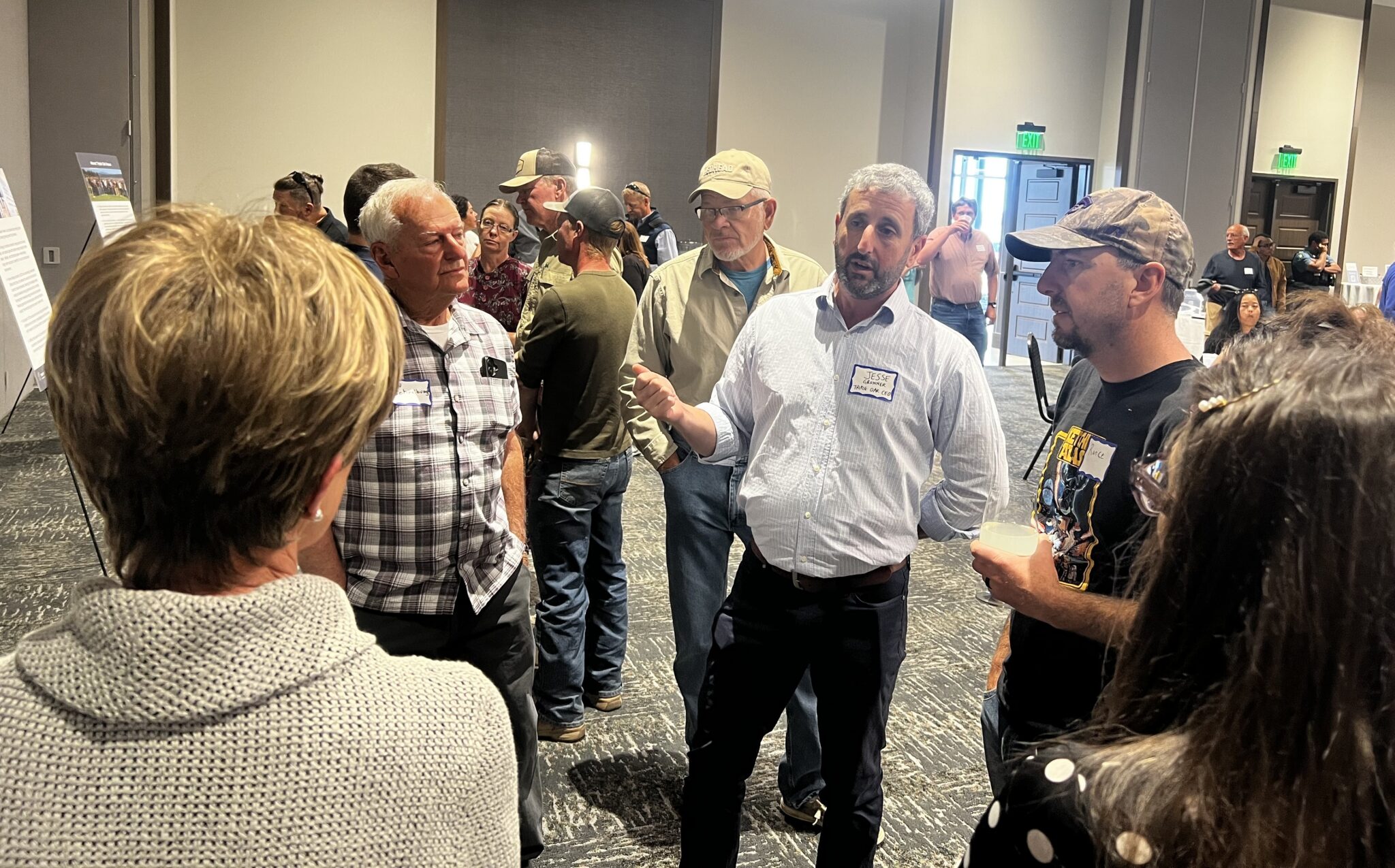
In May 2026, more than 100 people came to an open house at The Refinery in Garden City, Kansas. Home Range Clean Power had started in 2021 as a wind development. It had grown into a proposed 1,000-megawatt combination of wind, solar, battery storage, and natural gas, designed around rising demand in southwest Kansas and the possibility of a large new industrial load. The room held more than a dozen stations covering water, soil, wildlife, generation, and other parts of the plan.
The revealing part was timing. Triple Oak held the meeting while questions remained open. Ann Gravatt, the company’s vice president of external affairs, described honesty and transparency as one of Gronner’s core principles. She also acknowledged the frustration this can create: people want answers, while early-stage developers do not yet possess all of them. Triple Oak’s promise was to say what it knew, explain what it was planning, and come back.
A few weeks later, Finney County commissioners approved special-use permits for a 400-megawatt solar project and a battery-storage component within Home Range. Approval did not mean bulldozers the next morning. Development agreements, site plans, road arrangements, stewardship plans, emergency preparation, sound and glare studies, and decommissioning obligations still lay ahead. Gronner welcomed the detail. Local concerns about blowing sand, vegetation, and water were not side issues; they could alter both the project and its neighbors’ lives.
“The more we know about hyper local concerns, the more we can address them early.”Jesse Gronner, Finney County, June 2026
The same approach appears in Arizona, where Triple Oak’s proposed Black Ridge development near St. Johns combines wind and solar across a large private-and-state-land footprint while using a small fraction of the total acreage. Public meetings, a local office, environmental studies, landowner leases, and transmission work precede a proposed construction schedule. Gronner has also appeared in Triple Oak videos interviewing ranchers about what energy infrastructure means for the economics of working land.
There is no tidy ending because the grid has no ribbon-cutting moment of its own. Demand keeps rising. Technologies improve. A permit creates another checklist. A completed project becomes a line item in a much larger system. Gronner’s aspiration is similarly ongoing: diversify the grid with energy resources developed appropriately enough to last, and create value shared by investors, customers, landowners, and communities.
He entered the business when wind was young, almost by accident, and learned it through repetition. The philosophical questions never left; they simply acquired maps and interconnection studies. Who benefits? What endures? What does responsible development require today that it did not require yesterday? After 25 years, Gronner’s intelligent answer seems less like a sentence than a habit: go to the room, listen early, and keep showing up.