The cleverest thing about Vistra is easy to miss because it happens on opposite ends of an electrical wire. On one end, the Irving, Texas company operates a roughly 44,000-megawatt fleet: nuclear reactors, gas turbines, coal units, solar fields, and batteries. On the other, its retail brands send bills to nearly 5 million residential, commercial, and industrial customer accounts. Vistra can make the commodity and own the customer relationship. In a business ruled by weather, fuel costs, regulation, and prices that change by the hour, that pairing is less a slogan than a form of ballast.
The Vistra name rarely appears on a household bill. Texans know TXU Energy. Customers elsewhere may know Dynegy, Homefield Energy, Ambit Energy, Energy Harbor, or U.S. Gas & Electric. Behind those local storefronts sits one national portfolio operating across the country's major competitive power markets. That makes Vistra neither a conventional regulated utility nor simply a merchant generator. It is an integrated competitive power company: part industrial operator, part retailer, part commodity-risk desk.
The two-sided power company
Wholesale electricity can be brutally cyclical. A generator benefits when power prices rise, but a retailer that has promised customers a fixed price may feel the squeeze. When prices fall, the relationship can reverse. Owning both businesses does not remove risk, but it creates a natural offset. Vistra can match some of the electricity demanded by its retail book with output from its own fleet, then manage the remainder through market purchases, sales, and hedges.
The company solves two practical problems. Grid operators need power plants that can run reliably, respond when conditions change, and provide services that keep frequency and supply balanced. Customers want electricity without having to become commodity traders. Vistra stands between those needs. It maintains large physical assets, forecasts demand, procures fuel, trades around its positions, designs rate plans, handles billing, and answers the phone when a customer cannot make sense of a charge.
The advantage is not a single technology. It is the connection between plants, markets, risk, and customers.
A portfolio built for disagreement
Vistra's fleet reads like an argument among energy experts. Nuclear offers around-the-clock, zero-carbon generation but comes with high fixed costs, regulatory scrutiny, and long planning horizons. Natural gas plants are dispatchable and flexible, though they emit carbon and depend on fuel supply. Solar is inexpensive when the sun cooperates. Batteries can shift electricity across a few crucial hours, but they do not create energy. Coal remains reliable in some contexts and increasingly difficult to reconcile with emissions goals.
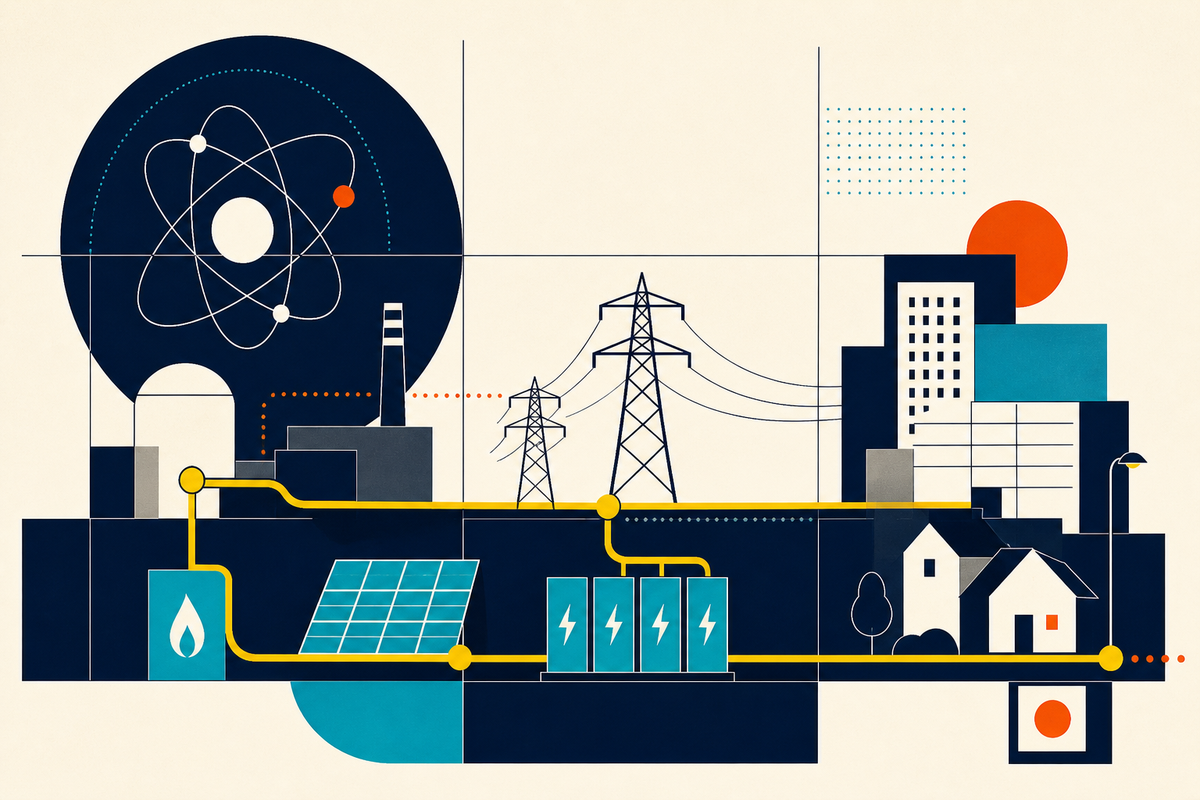
That untidy mix is Vistra's answer to the central grid problem: electricity must be available every second, even while the industry cuts emissions and demand grows. The company has targeted a 60 percent reduction in Scope 1 and 2 greenhouse-gas emissions by 2030 from a 2010 baseline, and net zero by 2050, subject to technology and policy conditions. It has retired coal units, added solar and storage, and enlarged its nuclear fleet. It has also bought and proposed more gas generation. The strategy is transitional in the literal sense, with cleaner assets growing alongside dispatchable fossil capacity.
The nuclear turn
The 2024 acquisition of Energy Harbor changed Vistra's center of gravity. It added about 4,000 megawatts of nuclear generation and roughly 1 million retail customers, giving the company the second-largest competitive nuclear fleet in the United States. The deal paired a larger block of carbon-free baseload power with an already large customer book. It also gave Vistra more exposure to PJM, the sprawling electricity market across the Mid-Atlantic and Midwest.
Then the data-center boom changed the conversation around old reactors. In January 2026, Vistra and Meta announced 20-year power purchase agreements tied to more than 2,600 megawatts from the Perry and Davis-Besse plants in Ohio and Beaver Valley in Pennsylvania. The contracts include 2,176 megawatts of existing generation plus 433 megawatts of planned uprates, essentially extracting more output from operating sites through equipment upgrades. Meta gets long-term support for its power needs. Vistra gets enough revenue certainty to pursue upgrades and additional 20-year license extensions.
The arrangement captures where Vistra fits in today's market. Big technology companies need power faster than new transmission and generation can often be built. Existing nuclear plants offer scale, round-the-clock output, and no operational carbon emissions. Companies that already own those plants possess something newly scarce: deliverable power with years of operating history.
Batteries, fire, and operational reality
Vistra also made Moss Landing in California a symbol of utility-scale storage. After a 350-megawatt third phase came online in 2023, the site reached 750 megawatts and 3,000 megawatt-hours. In simple terms, that configuration could discharge at its full rated power for four hours. The appeal is obvious: charge when electricity is abundant, release it when the grid is tight.
The site also demonstrated the physical risks of scaling a young technology. A major fire in January 2025 affected the separately housed 300-megawatt first and second phases, drawing emergency response and regulatory attention. The incident is a necessary part of the Vistra story because grid innovation is not a slide deck. Batteries occupy buildings, heat up, require monitoring, and can fail. The competitive advantage belongs as much to incident learning, engineering, and safety discipline as to procurement or project size.
Built by consolidation, not mythology
Vistra has no tidy garage-founder tale. Today's company emerged from the Energy Future Holdings restructuring in 2016, carrying operating businesses with much older Texas roots. It merged with Dynegy in 2018, creating a far broader national generation platform. Energy Harbor followed in 2024. Seven additional gas plants closed into the portfolio in 2025, and in early 2026 Vistra agreed to acquire Cogentrix Energy's ten gas facilities, totaling about 5,500 megawatts.
Vistra emerges as a public company from restructuring.
The Dynegy merger creates a national competitive power platform.
Energy Harbor adds nuclear scale and about one million retail accounts.
Meta's long contracts put existing nuclear plants at the center of AI-era demand.
This acquisition history explains the company's expertise. Vistra is good at operating fleets across different markets, integrating assets, managing commodity exposure, allocating capital, and retaining local retail identities. Competitors include Constellation Energy in nuclear and commercial supply, NRG Energy in retail and generation, Talen and Calpine in competitive generation, and larger renewable developers such as NextEra Energy. Vistra's distinction is breadth: a large multitechnology fleet joined to one of the country's largest competitive retail books.
What customers can actually do with it
For households and smaller businesses, the practical interface is a retail brand. Depending on the state, customers can choose fixed-price plans, renewable options, conservation-oriented products, billing tools, and services designed to help manage usage and cost. The product is not glamorous. It is predictability, understandable billing, and a plan that fits how a home or business consumes power.
For industrial users and hyperscalers, Vistra can structure larger and longer agreements around a deep portfolio. For grid operators, its plants and batteries supply energy, capacity, and balancing capability. For investors, the model is a bet that electrification and data-center construction will raise the value of dependable generation, while the retail operation and hedging program temper some of the commodity swings.
The hard part is holding three goals at once. Power must remain reliable, customers must be able to afford it, and emissions must fall. Vistra's own preferred trio is reliability, affordability, and sustainability. None stays politely in its lane. Closing a plant changes local jobs and grid margins. Building a plant requires permits, transmission, capital, and time. Extending a reactor raises questions about safety, waste, and economics. Adding gas can support reliability while complicating carbon targets.
There is a quieter customer benefit in the scale. A broad fleet gives Vistra more ways to respond when one fuel becomes expensive or one region is strained. A large retail book, meanwhile, turns millions of small usage patterns into information about when and where demand will appear. That does not guarantee a lower bill or prevent an outage - local wires are generally operated by separate utilities - but it improves the company's ability to price plans, procure supply, and manage exposure. The distinction matters: Vistra often supplies the energy; the local transmission and distribution utility delivers it and restores the line after a storm.
Vistra is interesting because it cannot resolve those contradictions in theory. Every day, its operators and traders must resolve them in megawatts. The company occupies the messy middle of the energy market, where promises become schedules, turbines, customer bills, and occasionally very long contracts with technology companies. Its most useful product may be coordination itself.